


What is a Tractor Differential?
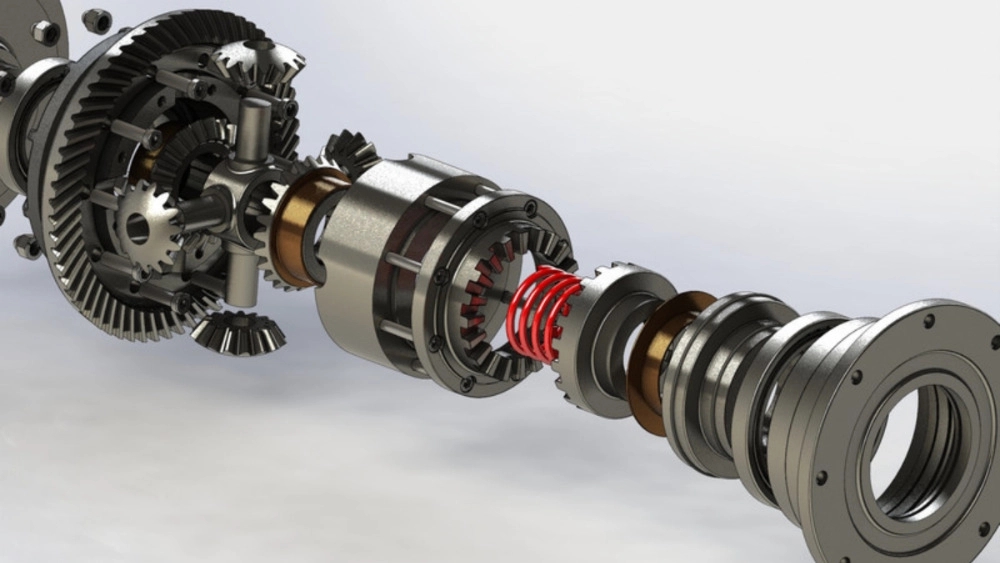
Tractor differential is responsible for changing the direction of power transmission, and in other words, this part consists of several bevel gears that take the engine power from the gearbox and distribute it to the wheels to rotate each part of the wheel. If the tractor does not have a differential, the wheels will lock and one wheel will drag on the ground when turning. In the process of power transmission, the power produced in the engine is transferred to the gearbox to create the necessary speed and torque, and its output will be transferred to the wheels using the crankshaft.
Differential tasks in the tractor
The differential in the tractor is responsible for various tasks, which include:
1. Coordinate between wheels while bypass tractor
In the tractor, the engine is placed on the chassis longitudinally, but the axis of the wheels must rotate transversely, so that changing the direction between the axis of the wheels and the axis of the engine will be possible with a differential.
2. Increased torque of tractor wheels
Due to the fact that the differential has two bevel gears with different diameters, it increases the torque of the wheels and reduces their speed relative to the output axis of the gear.
1. Creating a coordination between wheels while bypass tractor
The Neroni differential will divide the torque received between them according to the condition of the drive wheels. When driving in a straight line, because the Mahramt wheels are in the same position, they will rotate at the same speed, but when going around the corners, the path traveled by the inner wheel is less than the outer wheel. Therefore, the differential should rotate the inner wheel at a lower speed and the outer wheel at a higher speed. This action makes it possible to go around in turns.
Differential types
The differential is produced in different types so that it can be used in all vehicles according to the required work. Among the widely used types of differential are:
1. Locked differential
The locking differential will keep the speed of the shafts of one axle constant, so that the left and right wheels travel the same revolution. Also, this type of differential makes the axle with tension and without tension receive the same rotation. The automatic locking differential has a reasonable price and does not require the driver's intervention, but it makes a lot of noise when it is locked and unlocked.
2. Open differential
1. Differential
The torque dividing differential is one of the newest and most advanced types of differentials used in the vehicle manufacturing industry. In addition to its main duties, this differential model will also help with handling and maneuverability. This differential model uses speed sensors and accelerometers to constantly check the stability of the tractor and adopt the best strategy for dividing the power between the four wheels in this regard. These types of differentials are heavy and expensive, and they calculate the safety of the driver first, and speed is the second priority for them.
1. Limited slip differential with electrical controller (LSD)
Limited slip differential with electric controller is used in racing cars. This model of differential is actually an example of a locking differential and has the same function as an open differential. The power output from the engine in this differential is adjusted between the wheels every second and does not transfer all the power to the wheels that have friction, but a percentage of the power is sent to the wheels that have less friction.