

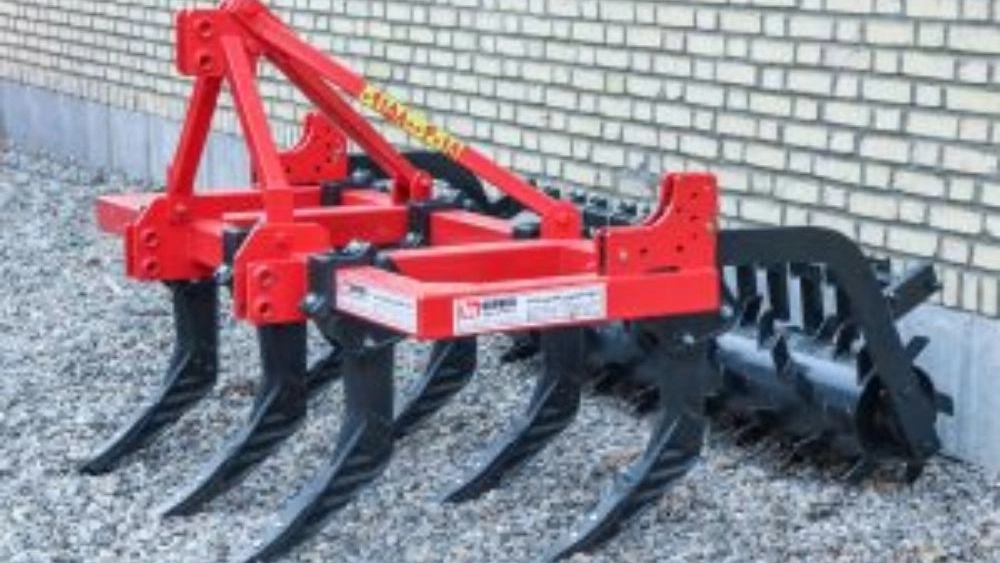
During several years of using the very simple and early models of this device to the new models today, the goal is still to aerate and stir the soil by turning it a little. Chisel is used in cases where turning the soil, despite the positive effects, is not recommended for some reasons. For example, when plant residues should not go underground for erosion control, or in addition to limiting surface evaporation, they should cause better penetration and maximum moisture storage. Weeds can be controlled by this device. Also, using them at depths greater than the depth of reversible plows, it is possible to break the hard layer formed by the continuous work of reversible plows at a fixed depth.
Also, in chisels, due to not returning the soil, their tensile strength per unit width and depth of work is almost half of the tensile strength of the plow. But in the compound model, due to the addition of the roller part to the back of the machine, the tensile strength increases, while it is still less than the reversible plow. Therefore, if it is not necessary to completely cover the plant residues on the surface of the soil, the use of this device is more economical and its working speed can be higher.
According to the research, only 25% of the residues go underground with chiseling. Goose claw chisel is used in summer fallow operations to put vegetation on the soil surface (plant mulch), usually they are equipped with goose claw blades instead of wide, with a width of 12 to 30 inches, and plowing is done only to a depth that Just cut the weeds and make the least disturbance on the soil surface. This device is usually available in the market in five-branch chisel, seven-branch chisel and nine-branch chisel models. Also, you can visit the chisels available on the site, which are made by the industrial group of Engineer Maruti.
Pit
Trial and error in the chisel resulted in the conclusion that, in this device and sub-breaker, the minimum tension required occurs when the lifting angle is 20 degrees. If you need to work deep, you should either use a longer base chisel or chisel twice, the second time chiseling vertically or at an angle to the first time to reach the full depth. If the upper part of the curve comes into contact with the soil surface, it means that the working depth is too high for the chisel operation.
With increasing depth and advancing speed, the tension of this device increases. The speed of this increase depends on the type of soil, moisture content, shape of the blade and the angle of penetration into the soil. If the speed increases, the soil is crushed more, although probably because the need for secondary tillage is less, the increase in speed is justified. Weeds should be removed better and the soil should be more crushed, as well as deeper tillage and better covering of residues.
Is one of the better or the pitches?
In the unit of work width and same depth, the tension required for a chisel is maybe half of a plow. Therefore, when it is not intended to completely cover the remains, using a chisel instead of a plow makes it faster and more economical. Chisel is also used to break the hard layer of the bottom soil, which is created due to the continuous use of the plow at the same depth. Iran's soils are mostly dry and with low organic matter, so the use of this device is better and more recommended. Meanwhile, the plow buries plant remains and the soil surface is left unprotected against erosion. As a result, soil erosion is more in the plow.
Because these tools break and cut the soil, it is the best option for dry and hard soils. When the soil is too wet, it is simply crushed and opened by the base of the chisel without being cut and disturbed. In fact, when wet soil is tilled with this machine, large clods may form that are difficult, if not impossible, to be broken up by the next tiller to create a suitable seed bed.
Simple one
This device is without rollers and consists of chassis, legs and blade or socket. In a simple chisel, each branch contains a stem and a blade. The simple chisel usually has two or three rows of branches, the small rider model has two rows and the large and stretchy rider model has three rows of branches. The branches of different rows are connected to the chassis in a zigzag pattern so that they are not in a row and behind each other, so that no work is done again, and the hay can pass through them without hindrance. The transverse distance of the branches from each other is 30 cm and the height of the chassis from the ground is about 60 to 70 cm. Different blades are used in this device, the most common of which is the pen blade. The basis of the work of this device is to break and crush the soil, not to overturn and turn the soil, as a result, it will have the best performance in dry and hard soils, and the benefits and advantages of the chisel are better defined in dry soil. If the soil moisture is higher than usual, the stalks remain in the soil and no crushing and softening of the soil is done. It is closed when it is connected to the chassis. If during tillage operation, the stems hit a hard obstacle, the pin is cut and the stems are guided back around their holding screw in the frame, thus preventing damage to the blade and stem. The common types of this device are 5-branch, 7-branch, 9-branch and 11-branch simple chisels. The classification of these tools is based on the number of their branches, which ends in the difference in the width of the work and the difference in the required power.
Composite
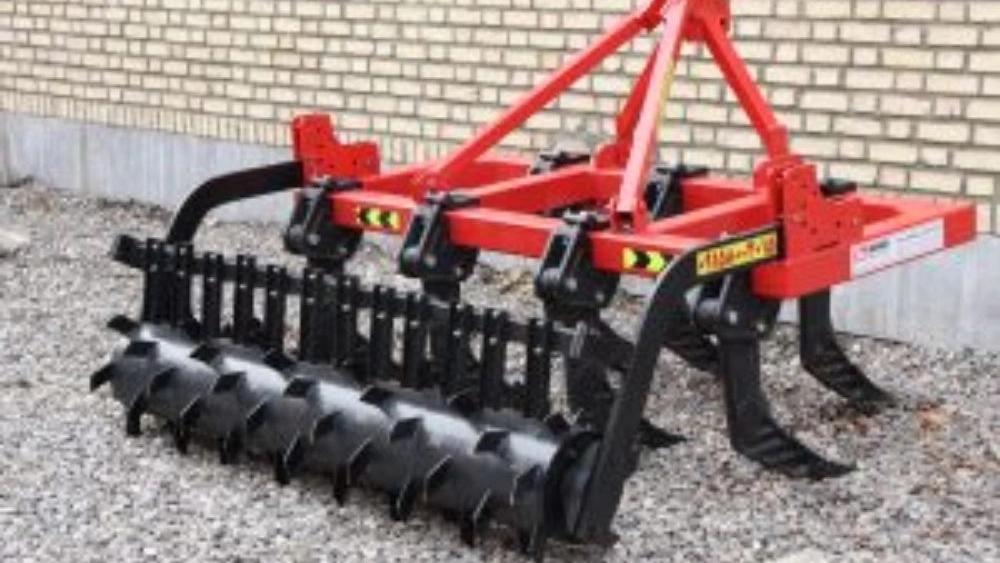
The compound chisel is one of the most common conservation tillage and low tillage tools, which is used in most regions of Iran. The advantages of the compound chisel include ease of work, simple settings, less traffic in the field, reduction of soil compaction, reduction of fuel consumption, and reduction of tillage operation time.
Chisel with 7 branches with rollers This device is made of a combination of two devices. 1- Chisel 2- Toothed roller for crushing lumps or packers. The use of the chisel part is to penetrate the soil and break the soil layers and plow the soil, and the roller part has the task of crushing the lumps and smoothing the surface of the earth and soil. This device is also known as chisel peeler, chisel packer, roller chisel and roller chisel.