


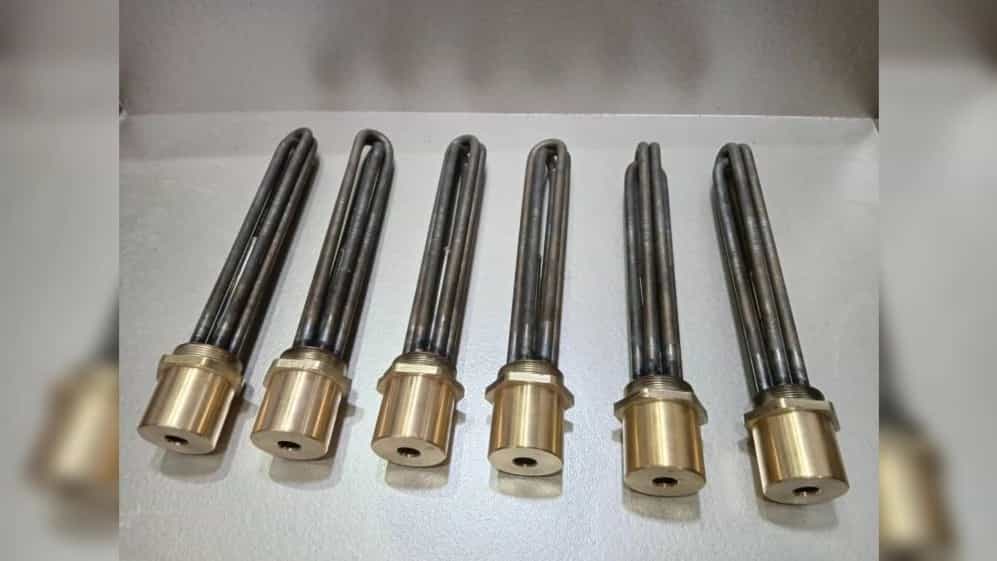

In many industrial processes, fluid heating is not limited to temperature increase; It is also important to maintain a uniform temperature, prevent material properties from changing, and accurately control the process conditions. In storage tanks, oil transfer systems, chemical equipment and processing lines, the use of a suitable heating system can play an important role in production stability.
One of the widely used equipment for this purpose is the industrial flanged element. This type of element is installed on the tank or chamber using a flange connection, and its thermal parts are placed directly in the fluid. In this way, electrical energy is converted into heat and transferred to the fluid without the need for an external heating system.
Manufacturing of industrial flanged element has a favorable result when all product specifications are determined based on the type of fluid, tank volume, required temperature, working pressure and environmental conditions. Incorrect choice of sheath material or thermal power can cause corrosion, sedimentation, local heating and reduce the life of the equipment.
In this article, we will examine the technical and practical aspects of the production of this product so that you can make a more accurate decision when choosing or ordering it.
What is an industrial flanged element and how does it work?
Flanged element is a type of electric immersion heater designed for direct heating of liquids and some industrial fluids. This equipment consists of several heat pipes that are connected to a flange plate.
The flange is responsible for connecting the assembly to the body of the tank, and the thermal pipes are placed inside the fluid after installation.
The main structure of this product includes the following components:
- Connection flange: Metal plate with screw holes for mounting on the tank or connection nozzle.
- Heat pipes: Parts that convert electrical energy into heat.
- Resistance wire: The main element of heat production that is placed inside the sheath.
- Electrical insulation: Usually compressed magnesium oxide powder that enables heat transfer and prevents the connection Prevents unwanted electricity.
- Power terminal: Connection of power cables to the circuit of the element.
- Protective housing: To protect the connections against moisture, dust and environmental conditions.
- Temperature sensor: Used to measure and control the temperature of the fluid or sheath if needed.
When the electric current passes through the resistance wire, the heat produced is transferred through the insulation to the metal sheath and then to the fluid.
In the correct design, the heat transfer should be done in such a way that the surface temperature of the pipes does not exceed the allowed range and the fluid does not overheat.
Why is it important to make an industrial flanged element for tanks?
Using the flange element in many industrial systems is considered a practical solution due to the possibility of direct installation on the tank and transferring heat to the fluid.
Compared to some indirect heating methods, this product can have a simpler structure and occupy less space for peripheral equipment.
The most important advantages of using this system are:
Direct fluid heating: The heating part is placed inside the tank and the heat energy is transferred directly to the desired environment.
Custom design capability: The number of pipes, immersion length, power and flange dimensions are determined based on the specifications of the tank.
Possibility of temperature control: The process temperature can be controlled by using a thermostat, thermocouple or suitable sensors.
Usability in different capacities: It is possible to design thermal sets for small tanks and large industrial equipment.
Convenient maintenance and replacement: In many designs, the element assembly can be disassembled and serviced through a flange connection.
If your tank is used for continuous heating of water, oil or industrial solutions, choosing an element suitable for the working conditions can help improve the performance of the system.
Types of flanged elements based on the type of application
One of the most important steps in manufacturing an industrial flanged element is to determine the type of fluid that is to be heated. Water, oil, chemical solutions and thick fluids behave differently in terms of heat transfer and corrosiveness.
For this reason, the design of the element should be done according to the work environment.
Flanged element for water
This model is used to heat water in storage tanks, washing systems, industrial equipment and some production processes.
In making this product, choosing the material of the sheath is very important. Water quality, amount of solutes, hardness and working temperature are factors that should be checked before designing.
The presence of many salts in water can cause the formation of sediment on the surface of the element over time. Sediment also reduces heat transfer and increases the possibility of local temperature increase.
Flanged element for oil
In different industries, thermal oils, hydraulic oil and industrial oils need a heating system to reach a certain temperature.
Flanged oil element should be designed according to fluid viscosity and circulation conditions.
One of the important points in this application is surface power density. If the heat is concentrated on the surface of the casing too much, the possibility of oil degradation, formation of carbon deposits and reduction of the life of the element increases.
Flanged element for chemicals
In chemical tanks, choosing the right material is very important; Because some solutions can cause rapid corrosion of metals.
In this situation, the material of the sheath, flange, welds and connections must be compatible with the chemical composition of the fluid.
For example, in some corrosive environments, the use of special steels, nickel-based alloys or titanium may be required. The final choice should be made according to the substance concentration, temperature and actual process conditions.
Flanged element for thick fluids
Some industrial materials such as heavy oils, resins and semi-solid materials are difficult to move due to their high viscosity.
In such a situation, the heat transfer from the surface of the element to the fluid should be designed more carefully.
Using a lower surface power, increasing the heat transfer surface or considering the fluid circulation system can help prevent local heating.
How is the material of the flanged element sheath selected?
The type of sheath is one of the most important factors determining the quality and longevity of the element. Choosing the wrong material can cause premature failure of the product, even if a high-quality resistance wire is used.
304 steel sheath
Steel 304 is used in some general applications and environments with limited corrosiveness. This material can be tested for many common water conditions and industrial processes.
However, its resistance to all chemicals is not the same and the composition of the fluid and working conditions should be checked.
316 steel sheath
316 steel has better resistance than 304 steel in many chloride-containing environments due to its molybdenum content.
This feature has made it used in some chemical and process equipment.
Inculo sheath
Incoloy family alloys are used in some high temperature applications and corrosive conditions. Choosing the right grade depends on the working temperature, the composition of the fluid and the amount of thermal stress.
Copper or steel sheath
In some specific applications, copper or carbon steel is used. For example, copper can be a good choice in some clean water systems, and carbon steel is used in some industrial oil applications.
The important point is that no material is suitable for all fluids. Before ordering, the chemical composition, working temperature and possibility of corrosion should be checked.
Manufacturing stages of industrial flanged element
Production of this product requires engineering design and precise execution of manufacturing steps. Simply connecting several heat pipes to a metal plate cannot guarantee proper performance.
The main stages of production are:
First step: check the characteristics of the tank and fluid
In the beginning, information such as tank volume, fluid type, initial and final temperature, working pressure and environmental conditions are collected.
This information is the basis of thermal calculations and mechanical design of the product.
Second step: Calculate the required power
The power of the element should be calculated based on the energy required to increase the temperature of the fluid and the amount of heat loss.
For this, the heat capacity of the fluid, its mass, temperature difference and heating time are considered.
The third step: flange design
Flange diameter, thickness, number of holes, diameter of screws and type of sealing surface should match the connection of the tank.
In pressure tanks, the choice of pressure class and connection design must be done according to engineering requirements and related standards.
Fourth step: selection and construction of thermal pipes
The number, diameter, length and shape of heat pipes are determined according to the total power, heat transfer level and internal space of the tank.
The fifth step: assembly and connection to the flange
The heat pipes are connected to the flange assembly with a suitable connection method. The quality of welding and sealing is very important at this stage.
The sixth step: installation of connections and control equipment
Electrical terminal, protective housing, temperature sensor and protective equipment are installed based on the needs of the project.
The seventh step: testing and quality control
At the end, electrical tests, insulation check, resistance control, connection inspection and required mechanical and sealing tests are performed.
The exact implementation of these steps in the construction of industrial flanged elements helps to increase reliability and reduce the probability of failure during operation.
How to calculate the power of flanged element for tanks
One of the most important questions when ordering an element is how much power is required to heat the fluid.
The following relationship can be used for the initial estimate of the required thermal energy:
Heat energy = fluid mass x specific heat capacity x temperature difference
mathematically:
Q = m × Cp × ΔT
In this regard:
- Q is the required thermal energy in joules.
- m is the mass of the fluid in kilograms.
- Cp is the specific heat capacity of the fluid.
- ΔT is the initial and final temperature difference.
Application example:
Suppose a tank has 500 liters of water and the temperature of the water is supposed to rise from 20 to 60 degrees Celsius.
assuming the approximate density of water is equal to one kilogram per liter and the specific heat capacity is about 4186 joules per kilogram Kelvin:
- Water mass: 500 kg
- Temperature difference: 40 degrees
- Required energy: about 83.7 million joules
If the desired heating time is 2 hours, the ideal power will be about 11.6 kW.
This number is just a preliminary estimate, and to choose the final power, heat loss, installation conditions, tank insulation and fluid circulation should also be checked.
What effect does the surface power density have on the performance of the element?
Surface power density refers to the amount of power produced per unit area of the element sheath.
This parameter is one of the most important criteria in the design of submerged elements; Because it determines how much heat is transferred from the sheath surface to the fluid.
If the power density is too high, the sheath surface temperature may exceed the permissible range. This issue is more important in thick fluids, oils and sediment-causing solutions.
For example:
- Clean water usually has a suitable heat transfer capacity.
- Industrial oils require different design due to differences in viscosity and thermal properties.
- Corrosive fluids require a corrosion-resistant sheath in addition to power density.
- Thick materials may require a higher thermal surface and lower surface power.
Therefore, in the construction of industrial flanged element, you should not only pay attention to the total power. The effective level of heat transfer and fluid characteristics should also be considered in the design.
Factors affecting the price of manufacturing industrial flanged element
The price of this product is determined based on technical specifications and order conditions. For this reason, it is not possible to provide an accurate price without knowing the type of fluid and the dimensions of the tank.
The most important factors affecting the construction cost are:
1. Material of sheath: The use of steel, copper, carbon steel or special alloys can change the final cost.
2. Flange materials and dimensions: diameter, thickness, connection standard and pressure class have an effect on the price
3. Thermal power: Increasing power usually requires changing the number or dimensions of thermal pipes and the structure of the complex.
4. Immersion length: The depth of placement of the element in the tank affects the amount of consumables and its design.
5. Fluid Type: Corrosive environments or special fluids may require more expensive materials and designs.
6. Control equipment: thermocouple, thermostat, sensor, switchboard and protection equipment affect the order cost.
To get the exact price, provide the tank and fluid type information to the technical unit so that the product can be checked based on your actual needs.
Important points for installation and maintenance of flanged element
Correct installation is as important as the quality of construction. Even an element with a proper design may fail prematurely if placed incorrectly in the tank.
For safe use and to increase the useful life of the product, observe the following:
- The active part of the element must be completely in the fluid under operating conditions.
- Avoid the accumulation of deposits and sludge around the heat pipes.
- Consider the appropriate distance between the element and the tank wall in the design.
- Use temperature control equipment and independent over-temperature cut-off.
- Check the electrical connections periodically.
- When emptying the tank, Prevent the element from being turned on.
- Disconnect the power to the device completely before carrying out repairs.
- For pressure vessels, comply with the design pressure and sealing requirements.
One of the most important risks in this equipment is turning on the element when the fluid level is lower than its active part. Such conditions can cause a sharp increase in the sheath temperature and damage to the element.
Also, to prevent the increase of electrical hazards, proper ground connection and leakage current protection should be considered in the design of the electrical system.
What is the difference between a flanged element and a threaded element?
Both types of elements are used for direct heating of fluids; But their installation method and capacity are different.
The threaded element is usually mounted on the tank through a threaded connection and is suitable for many small and medium tanks.
In contrast, the flanged element uses a bolted connection plate and is more useful in projects that require a larger thermal assembly, more tubes, or a flanged connection.
Feature | Flanged element | Threaded element | ||
|---|---|---|---|---|
Installation method | Screw connection | Thread connection | ||
Design capacity | Suitable for various and high powers | Suitable for various applications, often smaller | ||
Number of heat pipes | Possibility of using several pipes | usually set Smaller. rowspan="1"> Service | Flange Assembly Disassembly | Unthreaded Connection |
The choice between these two models depends on the dimensions of the tank, required power, working pressure and type of connection.
What information is required when ordering the production of flanged elements?
In order for the final product to be compatible with your equipment, it is better to provide the following information when inquiring about the price:
Specifications | Required information |
|---|---|
Fluid type | Water, oil or solution Chemical |
Tank volume | Capacity in liters or cubic meters |
Initial and final temperature | Range Required temperature |
Heating time | Expected time |
Power | kW required or Computable |
Voltage | Single phase or three phase |
Sheath material | Steel, copper or alloy Suitable |
Type of flange | Suitable to tank conditions |
Working pressure | Normal and maximum pressure Design |
Connection dimensions | Flange diameter and standard |
Immersion depth | Inside section length Fluid |
Control equipment | Sensor, thermostat and thermal protection |
The more accurate the initial information, the less error the design and pricing will have.
To order a flanged element suitable for your tank, send the technical specifications, fluid type and connection dimensions right now, so that it will be possible to provide an expert review and a suitable offer.
Why custom manufacturing of flanged element is a better choice?
In many industrial projects, the use of ready-made elements is not possible due to the difference in tank dimensions, fluid type or installation conditions.
In such a situation, a dedicated design can have important advantages:
- Adapting the dimensions of the flange with the tank connection
- Determining the appropriate length of the submerged part
- Choosing the material of the sheath suitable for the fluid
- Adjusting the power based on the heating time
- Predicting the appropriate location of the temperature sensor
- Designing the number and arrangement of heat pipes
- Considering protective equipment suitable for the process
In fact, custom manufacturing allows the element itself to be designed based on the real needs of the system, instead of matching the existing equipment with a ready-made product.
Frequently asked questions about the construction of industrial flanged elements
1. What type of tanks is the flanged element suitable for?
2. How is the price of the industrial flanged element calculated?
The price is determined based on the power, number and length of heat pipes, sheath material, flange dimensions, fluid type and control equipment. To get the exact price, the technical specifications of the tank and working conditions should be provided to the manufacturer.
3. What information should be provided to make a flanged element?
Fluid type, tank volume, initial and final temperature, heating time, electric voltage, required power, working pressure, connection material and flange dimensions are the main information for design and order.
summary; Basic design, the key to the reliable performance of the flanged element
Flanged element is one of the important equipment in industrial heating systems, which is used for direct heating of water, oil and many fluids.
The proper performance of this product depends on factors such as sheath material, heat capacity, surface power density, connection quality and flange design.
Industrial flanged element manufacturing can properly meet the needs of a production set when all these factors are selected based on the actual conditions of the process.
If you need a standard and custom flanged element for your tank or production line, contact us now for technical advice and price inquiries. The experts of the collection can help you in choosing the right specifications by checking the tank information, fluid type and working conditions.
