

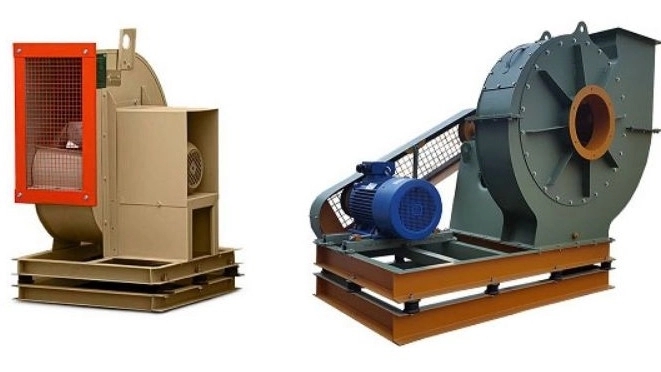


What is Centrifuge fan?
Centrifugal fans or centrifugal ventilators are devices that move air or gas by increasing kinetic energy and high pressure. These fans direct the absorbed air outwards at a 90 degree angle. High strength, low noise and its ability to be used in harsh and heavy conditions make it among the popular products related to ventilation. These fans are also used in high pressure ducted systems. Centrifugal fans are one of the most widely used products of their kind for industrial ventilation systems due to their ease of production and simplicity of installation. The main difference between these fans is in the size and type of their fan and they are rated based on the degree of protection or the IP standard.
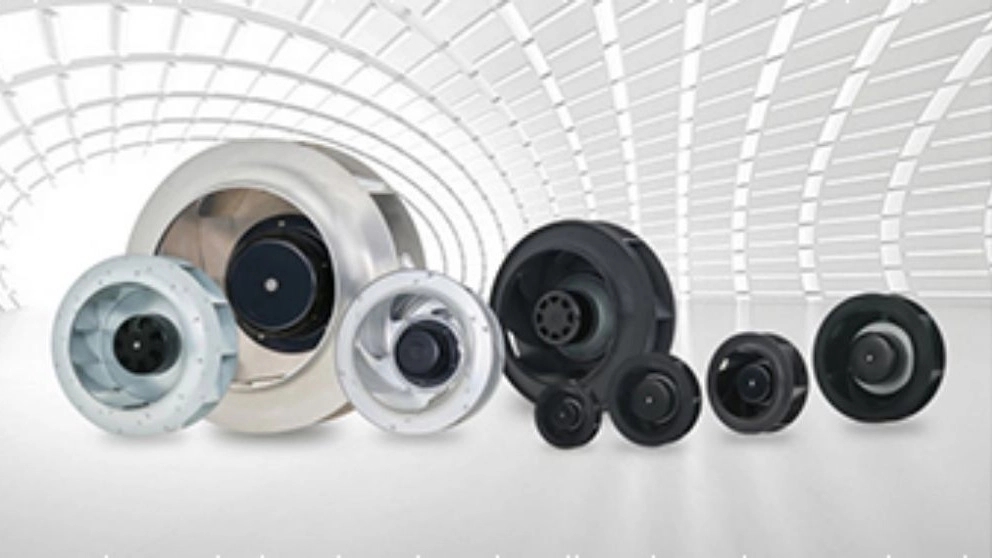
Centrifuge fans components
Centrifugal ventilators include fan housing parts, impeller or impeller, air outlet and inlet duct, drive mechanism, bearings, couplings or couplers, impeller locking device, fan discharge pipe, shaft plates, the three main parts of which are the impeller. , the motor and the snail, which we will examine each of them in the following.
Propeller: The main part of the fan is the propeller, which circulates the air inside the spiral with the rotation produced by the motor.
Engine: The main task of the engine in centrifugal fans is to create the necessary energy for the rotation of the propeller. When the motor is activated, it rotates the propeller quickly and absorbs the air and directs it to the outlet.
Snail: Snail plays an important role in ventilator performance. After the air passes through the impeller and enters the outlet, the spiral causes the air to return to the environment and completely exit it. A snail as an air flow regulator helps the strength of the fan. In general, centrifugal ventilators, with the harmonious combination of these three parts, absorb air from the environment and transfer it to the outside.
Application of fan centrifuge
Industrial use: Air suction or blowing devices are widely used in workshops and factories. The main function of the spiral impeller (or centrifuge) is to discharge excess heat and pollutants produced from industrial devices into the air. In the oil and petrochemical industries, different types of centrifugal ventilators are used to discharge acidic and polluted gases. It should be noted that in industrial applications and disposal of acid gases, different parts of the centrifuge must be made of stainless steel materials. Of course, in some cases, due to the reasonable price, polyamide or polypropylene blades are used as an alternative. Residential and urban applications: the product is intended for the evacuation of unpleasant air in kitchens, the transfer of smoke resulting from fire (in case of emergency) in workshops and factories and apartments, in industries related to dyeing for the evacuation of pollution resulting from the spraying of pigments, inside restaurants for evacuation Smoke and vapors emitted from cooking pots are used. In general, these products are used to collect dust and clean space, to transport materials in a fixed motion path, as a coolant, in industrial environments, and to dry clinker in kilns.
Conventional types of fan centrifuge
The first type; Forward: These products use low rotation speeds that reduce noise, and centrifugal fans, which are mostly used in heating, ventilation and air conditioning systems, are smaller than other fans and have lower efficiency (approx. 55 to 65 percent).
the second model; Backward: The vanes of this type are in the opposite direction to the movement of the propeller and are more efficient than forward fans and radial propellers. Backward is used when it is not possible to use airfoil propellers due to corrosion and wear. It should be noted that the model in question generates high air pressure, has the ability to move a large volume of air, and has high efficiency with low noise.
the third type; Airfoil: Due to the type of implementation of its blades, the airfoil has the highest efficiency among other similar models. The contact angle of the fin with the air flow (fluid) in this model is low, and due to its high mechanical strength, it has a special ability to produce high pressures. These products have a very high speed, even twice as fast as the forward fan.
the fourth model; Radial propeller: This type of fan dramatically increases the resistance to corrosion and erosion due to the good cover of the blades. They have reliable performance and are economical products in terms of price. Due to high pressure production, they are able to effectively move air along with coarse particles, dust, wood shavings or iron particles. This model is suitable for industrial applications and environments with dust particles, various gases or high humidity.