
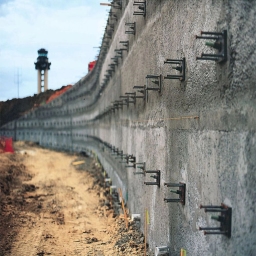

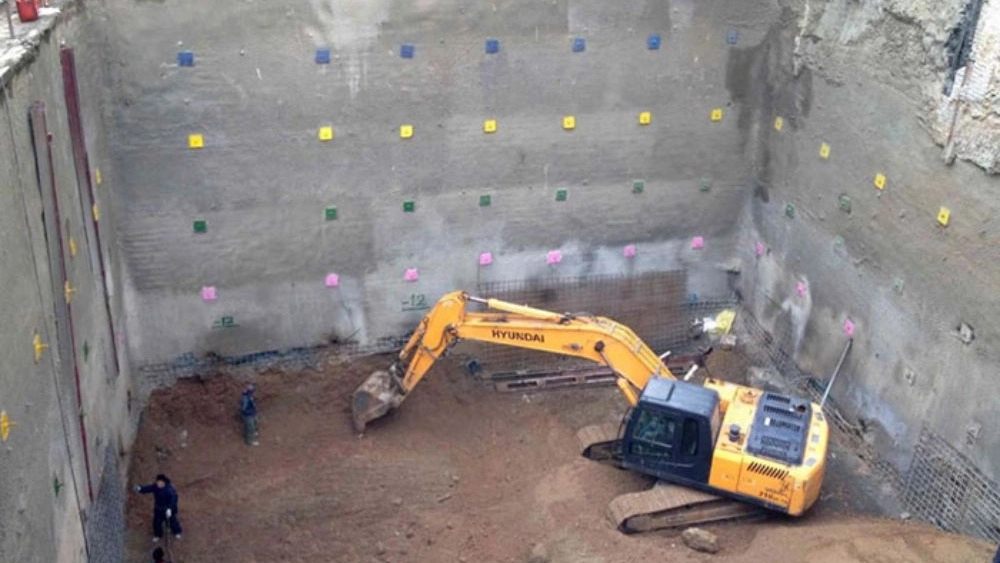
Pit stabilization (in English: soil stabilization for excavation) is an operation to secure and prevent the collapse of the pit wall dug for the construction of a building. This operation also aims to secure nearby buildings and reduce the risk of their collapse. Stabilization of the pit is done in different ways; including the method of nailing, trussing, top-down, mutual restraint, etc. These methods secure the excavation wall and adjacent buildings and reduce and eliminate the risk of falling. Therefore, different support systems can be proposed to stabilize excavations and their surroundings. Which method is the best option and provides more safety depends on several factors. Factors such as environmental conditions, soil type, economic conditions, etc.
What is the purpose of stabilizing the pit?
Basically, before the pit becomes stable, it must be created! Excavation will eventually lead to the creation of a vertical wall. On this vertical wall, two types of forces are applied:
Resistant forces: forces that tend to stabilize the pit and want to prevent the pit from collapsing.
Driving forces: these forces tend to destroy the pit wall.
If the sum of driving forces exceeds the resistance forces, the pit wall will collapse. The pit stabilization operation is carried out with the aim of increasing the resisting forces and its dominance against the driving forces. Because as the resisting forces increase, the resistance against the wall collapse increases and thus, the pit wall will be stable.
During demolition and excavation, there are many risks. If proper methods are not used to stabilize excavations, the probability of danger will be 100%. Therefore, stabilization and safety of the pit is done in order to achieve the following goals:
prevention of financial and life damages to workers and nearby neighbors
preservation of property inside and outside the pit
providing safe conditions and Sure to implement the work
stabilize and stabilize the soil, it is done by physical, mechanical and chemical solutions. Soil stabilization aims to adjust soil properties in order to meet some requirements. Soil has five important characteristics: soil strength, its volumetric stability, permeability, resistance, variability, each of these soil characteristics can be measured using physical methods. , mechanically and chemically brought to a steady state. Nailing and shielding can be considered as mechanical methods and the use of mortar and shotcrete is one of the chemical methods of soil stabilization during building excavation.
A variety of pit stabilization methods
Truss guard structure method
Nailing or nailing method
Stabilization of the pit by the method of stitching to the back (Tie back) or tensile restraint of the walls of the pit (Anchorage)
Stabilization of the pit by the top-down or high construction method Top-Down pit stabilization with piles Braced Excavations - Struts pit stabilization by wall method Diaphragm Pile Wall
Sheet Pile
Berlin Wall or Soldier Pile
What is the best way to stabilize the pit?
In the case of stability in retaining walls, narrow spaces and small excavations, slope stabilization and repair and reconstruction of existing retaining structures, the nailing method is suitable. is This method is not suitable for wide pits.
In pits with a depth of about 5 meters, it is usually economical to use pile stabilization. Also, in a large volume, the cost of operation is reduced.
In the conditions where the length of the channel is long and the width of the pit is small, and in addition to the speed of the work, high safety is also needed, the impact shield will be the best way to stabilize the pit. > In the case of deep excavations where soil movements should be as minimal as possible, the best method is top-down construction. main street It is possible, the best way to stabilize the well is the top-down construction method.