

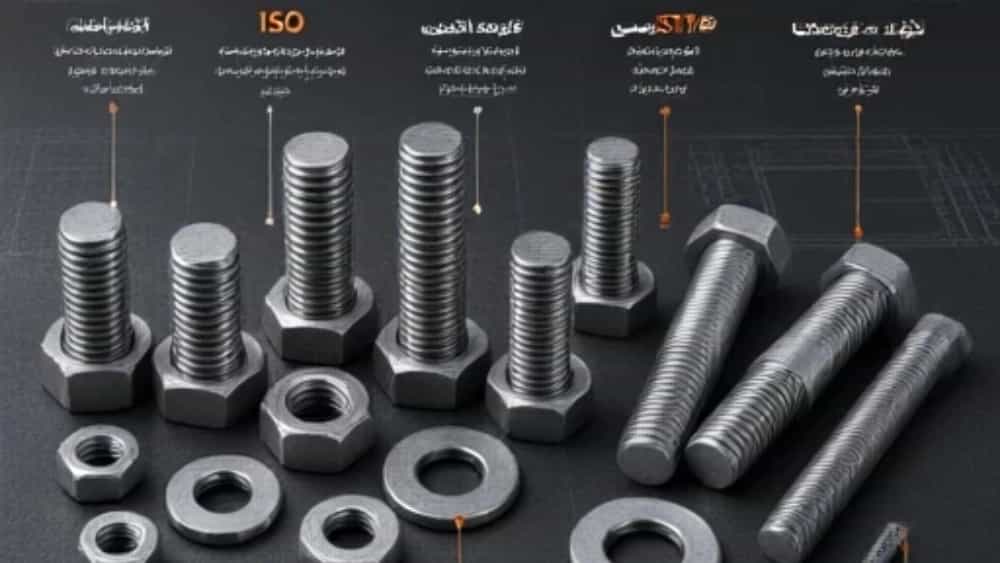

standard tables of bolts and nuts; Complete guide to dimensions, thread pitch and resistance class
Bolts and nuts are the most important mechanical connections in various industries, which are used to connect parts, equipment and structures. The correct selection of bolts and nuts plays an important role in the safety, strength and longevity of connections. For this reason, it is necessary for engineers, technicians, craftsmen and activists in the field of industrial equipment supply to be familiar with the standard tables of bolts and nuts and their technical specifications.
In this article, we review the standard tables of dimensions of hexagon bolts, nuts, washers, thread pitch and resistance class.
What is the bolt standard?
The bolt and nut standard is a set of technical specifications that determine the dimensions, appearance, thread type, material, mechanical properties and production tolerances of these parts.
Among the most important standards used in the industry, the following can be mentioned:
- ISO: International Standard for Bolts and Nuts
- DIN: German Industrial Standard
- ASTM: American Standards for Industrial Materials and Components
- ASME: Standards for Mechanical Engineering and Connections
Using the right standard makes bolts and nuts produced by different manufacturers to be replaceable in terms of dimensions and technical specifications.
1. Standard table of hexagon screw dimensions
Hexagon screw is one of the most widely used types of screws in the construction, automotive, machinery and industrial equipment industries.
These screws are produced in two main types:
- DIN 931: half-thread hexagon screw
- DIN 933: full thread hexagon screw
The table below shows the common dimensions of metric hex screws.
Screw size | Nominal diameter (mm) | Thread pitch (mm) | Wrench (mm) | Head height (mm) |
|---|---|---|---|---|
M4 | 4 | 0.7 | 7 | 2.8 |
M5 | 5 | 0.8 | 8 | 3.5 |
M6 | 6 | 1 | 10 | 4 |
M8 | 8 | 1.25 | 13 | 5.3 |
M10 | 10 | 1.5 | 17 | 6.4 |
M12 | 12 | 1.75 | 19 | 7.5 |
M14 | 14 | 2 | 22 | 8.8 |
M16 | 16 | 2 | 24 | 10 |
M18 | 18 | 2.5 | 27 | 11.5 |
M20 | 20 | 2.5 | 30 | 12.5 |
M22 | 22 | 2.5 | 32 | 14 |
M24 | 24 | 3 | 36 | 15 |
M27 | 27 | 3 | 41 | 17 |
M30 | 30 | 3.5 | 46 | 18.7 |
M36 | 36 | 4 | 55 | 22.5 |
Note: The values in the table are for common sizes and are provided as a basic guide. For order or detailed design, the dimensional standard and product series should be checked.
2. Standard metric screw thread pitch table
Thread pitch is the distance between two consecutive teeth of the thread, which is measured in millimeters.
Metric screws usually have two types of threads:
- Coarse thread: the most widely used type of thread in general connections
- Fine thread: suitable for some more precise connections and special mechanical conditions
سایز پیچ | گام رزوه درشت (mm) | گام رزوه ریز (mm) |
|---|---|---|
M4 | 0.7 | 0.5 |
M5 | 0.8 | 0.5 |
M6 | 1 | 0.75 |
M8 | 1.25 | 1 و 0.75 |
M10 | 1.5 | 1.25 و 1 |
M12 | 1.75 | 1.5 و 1.25 |
M14 | 2 | 1.5 |
M16 | 2 | 1.5 و 1 |
M18 | 2.5 | 2 و 1.5 |
M20 | 2.5 | 2 و 1.5 |
M22 | 2.5 | 2 و 1.5 |
M24 | 3 | 2 و 1.5 |
M27 | 3 | 2 و 1.5 |
M30 | 3.5 | 2 و 1.5 |
M36 | 4 | 3 و 2 |
Choosing the right thread pitch is very important; Because it affects the amount of thread engagement, opening and closing speed, and connection performance.
3. DIN 934 hexagon nut standard table
The hex nut is one of the most common types of nuts used to connect metric threaded screws.
DIN 934 standard specifies the dimensional specifications of the metric hexagon nut.
Nut size | Nominal thread diameter (mm) | Wrench (mm) | Nut height (mm) | |||
|---|---|---|---|---|---|---|
M4 | 4 | 7 | 3.2 | rowspan="1">5 | 8 | 4 |
M6 | 6 | 10 | 5 | |||
M8 | 8 | 13 | 6.5 | |||
M10 | 10 | 17 | 8 | |||
M12 | 12 | 19 | 10 | |||
M14 | 14 | 22 | 11 | |||
M16 | 16 | 24 | 13 | |||
M18 | 18 | 27 | 15 | |||
M20 | 20 | 30 | 16 | |||
M22 | 22 | 32 | 18 | |||
M24 | 24 | 36 | 19 | |||
M27 | 27 | 41 | 22 | |||
M30 | 30 | 46 | 24 | |||
M36 | 36 | 55 | 29 |
When choosing a nut, you should pay attention to the thread diameter, thread pitch, resistance class and its compatibility with the screw.
4. Standard table of resistance class of bolts and nuts
One of the most important technical specifications of bolts and nuts is its resistance class. This class indicates the mechanical properties of the piece and its resistance to tensile forces.
In metric steel screws, the strength class is usually represented by two numbers such as 8.8, 10.9 and 12.9.
Resistance class | Nominal tensile strength (MPa) | Common use |
|---|---|---|
4.6 | 400 | Light connections |
4.8 | 400 | General Consumer |
5.8 | 500 | Typical connections |
8.8 | 800 | Industrial connections |
10.9 | 1000 | High load connections |
12.9 | 1200 | high resistance connections |
For example, a class 8.8 screw has a nominal tensile strength of 800 MPa and a nominal yield strength of about 640 MPa.
Note: The choice of resistance class should be based on engineering calculations, type of loading and environmental conditions. Also, the resistance class of the nut must be compatible with the screw used.
5. DIN 125 flat washer standard table
A flat washer is an annular piece that is placed between the connection surface and the nut or screw head. This part helps to distribute the compressive force better, protect the surface of the parts and improve the connection performance.
سایز واشر | قطر داخلی (mm) | قطر خارجی (mm) | ضخامت (mm) |
|---|---|---|---|
M4 | 4.3 | 9 | 0.8 |
M5 | 5.3 | 10 | 1 |
M6 | 6.4 | 12 | 1.6 |
M8 | 8.4 | 16 | 1.6 |
M10 | 10.5 | 20 | 2 |
M12 | 13 | 24 | 2.5 |
M14 | 15 | 28 | 2.5 |
M16 | 17 | 30 | 3 |
M20 | 21 | 37 | 3 |
Washers are produced in different types, such as flat washers, spring washers, locking washers, and special structural washers, and each one has a specific use.
6. Standard bolt selection guide
To choose the right bolt and nut, several important factors should be considered:
1. Screw diameter: The nominal diameter of the screw should be selected according to the amount of load and the type of connection.
2. Bolt length: The length of the bolt should be such that after passing through the parts, sufficient thread engagement with the nut is created.
3. Thread pitch: Coarse thread is suitable for many general applications; But in some precise applications, fine thread will be a better choice.
4. Resistance class: The strength of the screw must be determined according to the applied loads and working conditions.
5. Material and coating: Bolts and nuts may be made of carbon steel, alloy steel or stainless steel. Also, coatings such as galvanized can increase corrosion resistance.
6. Production standard: Be sure to check the bolt and nut standard so that the parts are compatible with each other in terms of dimensions and technical specifications.
summary
Bolt and nut standard tables are one of the most important sources for the correct selection of industrial connections. Using these tables, you can check the dimensions of hexagon bolts, nuts, washers, thread pitch and resistance class.
Selecting standard bolts and nuts, in addition to increasing the strength of the connection, reduces maintenance costs and increases the safety of industrial equipment.
Before buying or using bolts and nuts, it is better to carefully check the technical specifications of the product, the production standard and its working conditions.
تماس و مشاوره
استاندارد پیچ و مهره
Company catalog
Download file