
An interior designer in Tehran may choose a nice-colored lamp for the wall, but after delivery, he finds out that the width he saw in the invoice is not the same as the width he covers on the wall. In another project, a wooden facade is delivered with the name "thermo", without being clear about the type of wood, the type of processing, or the proper conditions for its installation. The result of both situations is the difference in estimation, extra cuts and hasty decisions in the workshop.
The root of the problem is usually not the lack of options in the market; Uncertainty of product definition and unit of calculation before ordering. In order to make an informed choice in the field of production and distribution of wooden lamp and Termwood, we must know that "lamp" refers to the shape of the profile, and "Termwood" refers to the wood modification process. These two can be combined in one product, but they do not replace each other.
wooden lamp or termwood; Which is more important for your project?
If you need a cover with a neat connection for a wall or ceiling, first determine the profile and width of the lamp cover. If the place of execution is exposed to humidity and weather changes, type of wood and thermal modification are equally effective in the selection.
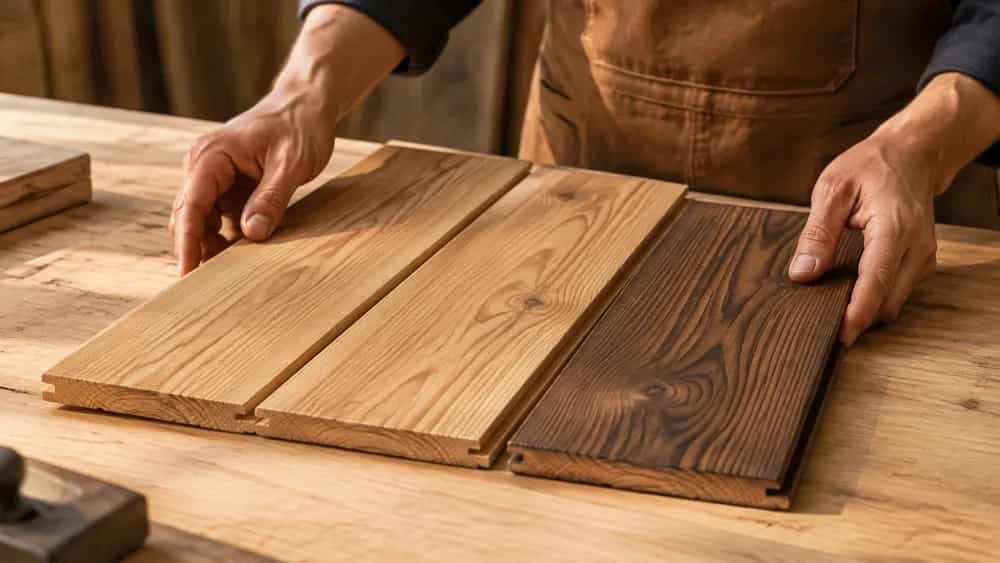
Lemba is the name of a joining form: the edges of the board are shaped so that the pieces sit together and form a continuous surface. The lamp can be made of ordinary wood suitable for interior space or of thermally modified wood. Therefore, the question "Is the bulb better or thermwood?" It is not accurate; The practical question is: "What wood with what profile is suitable for this installation?"
Thermwood is used in everyday market talk for thermally modified wood. However, ThermoWood is a registered trademark and any dark colored board or any heat treated wood should not be labeled as a product without proof. The International ThermoWood Association also differentiates between the Thermo-S and Thermo-D grades and does not mention the same applications for them.
For the main wall of a dry space, the quality of the finish, the regularity of the grooves and the color coordination of the parts may be more important than the choice of heat treated wood. For the exterior, in addition to the appearance, it is necessary to decide on the right outdoor product, underlayment, drainage, connection and surface coating. Thermwood does not replace the correct design of the execution details.
What factors change the quality and price of a wooden lamp?
The price of a wooden lamp cannot be compared only with the number of "per meter"; The unit of sale, the useful width of the cover and the specifications of the wood should be written next to it. In the bulk purchase, the uniformity of the load and the amount of deviation can become more important than the apparent price difference between the two offers.
To compare offers, define a common specification: wood species, actual thickness and width after polishing, length of pieces, profile, appearance quality, type of processing, surface finish and place of delivery. Then ask the sellers to price the same specs. Comparing two numbers without this information is not comparing two identical products.
Nominal width, useful width and sales unit
The useful width is the part of each board that is visible on the surface after the joints are engaged. If you estimate with nominal width, you may underestimate the number of branches needed.
Before ordering, measure the useful width of the same profile you are going to receive or record it in the pre-invoice. The approximate number of branches is obtained by dividing the coverage area by the product branch length × useful width; All measurements should be in meters. For example, in a purely hypothetical calculation, if the area is 30 square meters, the length of each branch is 3 meters and the useful width is 10 cm, the initial estimate is 100 branches; This number does not yet include cut-outs, openings and design details.
If the price is stated in cubic meters, the basis is different: the volume of wood is calculated from number x length x actual board width x actual thickness. Do not compare the square meters of the coating and the cubic meters of wood without converting the unit and knowing the actual dimensions.
Moisture, finishing quality and fit with the installation location
Two sets of lamps of the same size may behave differently after installation. The moisture condition of the wood, the method of storage, the quality of the tooling and the conditions of the place of execution play a role in opening the seams or changing the shape of the parts.
Look at the edges of the joint: a broken tongue or misaligned groove will slow down the installation. Put some branches together and check the warping, the difference in thickness and the noticeable difference in color. For interior wood, the dryness of the storage area and the opportunity for the materials to adapt to the environment are important; For exterior wood, the moisture exit path and facade details should also be seen in the design. The American Forest Products Laboratory guide emphasizes that moisture control during storage and installation helps to reduce unwanted dimensional changes in wood.
Comparison criteria | Wooden lamp for indoor space | Light made of heat treated wood | Note when inquiring |
Product description | Joining profile for surface covering | Same profile, with heat treated wood | Record the name of the profile and the type of wood separately. |
The main application in this comparison | The wall and ceiling of the dry space, according to the specifications of the wood | Interior or exterior space, Depending on the product category and implementation design | The title "Thermo" alone is not enough to confirm the outdoor use. |
Base of coverage estimation | Useful branch length and width | The length of the branch and the useful width | Do not confuse the useful width with the nominal width. |
Items affecting the cost of implementation | Quality of payment, dodging, infrastructure and Installation | In addition to the previous items, connections and covering suitable for the place | Weigh the final cost next to the price of the wood itself. |
Test and control before delivery | Dimensions, wood species, and appearance quality agreed upon | The same, plus claimed processing specifications | Document grade or trademark claims. |
This table is for matching the subject of the query, not to declare the absolute superiority of a product. The right choice is determined by the installation location and verifiable specifications, not the name written on the package.
In my experience, the most costly mistake when considering a lamp order is asking for a price before specifying the job details. When the designer and the supplier talk about "meters" but one is referring to length and the other to square meters of coverage, the discrepancy usually only becomes apparent at the time of delivery or installation.
In business discussions Azerwood for Tehran projects, my preference is that before comparing the price, three things are clear on one sheet: the picture of the execution site, the surface that really needs to be covered and the example of the profile that is going to be used. This simple task takes the discussion from "How much is this wood?" to "How many branches of what useful width are needed for this level?" converts The second answer is much more useful for project planning.
A few small controls should not be postponed until installation:
- Don't judge a sample branch by itself. Put several pieces from different parts of the load together to see the difference in color, thickness and seating of the grooves.
- Estimate the cut from the cut plan. The net surface of the wall, the direction of installation, the openings and the length of the branches determine how much wood is actually used; A fixed percentage is not reliable for all designs.
- Consider the depot location as part of the quality of the purchase. A package that is exposed to water or unfavorable conditions in the workshop may differ from the situation at the time of selection.
- Do not rely only on the resistance of the wood itself for the facade. Substructure details, proper distance from trapped moisture, sealing of sensitive points and environment-friendly connections are part of the final performance.
This sensitivity about moisture is not just a matter of workshop taste: wood gains or loses moisture as environmental conditions change, and its dimensions may change. Also, surface coating can help protect, but it does not replace moisture control and proper design.
For the outdoors, another misconception is common: "Thermo wood does not need maintenance." Thermal modification and surface maintenance are two different issues. If maintaining the appearance and color is important for the design, coordinate the type of coating and its periodic inspection schedule with the radiation and rainfall conditions of the project from the beginning.
Conclusion and final opinion
From my point of view, the right choice in the production and distribution of wooden and termwood lamps starts from exact definition of application, profile and calculation unit, not from hasty comparison of prices. If these three things are clear, it becomes much easier to measure the quality of the sample and the actual cost of implementation.
I, Shahbazi, for Tehran projects, I recommend that you put together a floor plan, a photo of the installation location, and sample specifications before finalizing the order. If you are still hesitating between a regular lamp and a profile made of heat-treated wood, a technical conversation about the application and implementation details is a better starting point than asking for a general price.

جهت ثبت سفارش با ما تماس بگیرید