
To receive free technical advice and order detailed industrial services, it is enough to contact Isfahan Ramezani welding experts.
The importance of quality control in metalworking industries
In the metal industry, material quality and cutting accuracy are the main criteria for the success of a production line. If the quality control is not carried out in a continuous and scientific manner, even the best equipment cannot give the desired result. Recognizing the importance of this issue, Josh Brash Ramezani Isfahan has focused on quality monitoring since the beginning of its establishment and has created a precise quality control system.
Quality control in this collection is carried out from the raw material entry stage to the final delivery of the piece, and no stage goes to the next stage without quality approval.
Quality control steps in Isfahan Ramazani cutting welding
The quality control process in Ramadani Isfahan welding and cutting complex consists of several main steps, each of which is performed with specific tools and criteria so that no piece is below the standard.
1. Preliminary examination of raw materials
One of the most basic quality control steps in Isfahan Ramazani cutting welding is the initial inspection of incoming material. All metal sheets, pipes and profiles are checked for thickness, strength, alloy, rust and distortion before entering the production line.
This step is done by experienced experts and each shipment has an initial inspection sheet. If the smallest physical defect is observed, those materials are removed from the production cycle.
2. Control of cutting machines and equipment
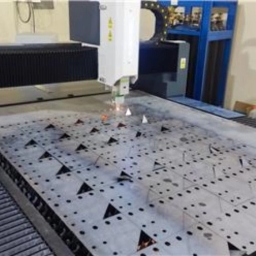
CNC machines, plasma, laser and guillotine cutting machines used in Isfahan Ramazani cutting welding are periodically calibrated to maintain millimeter accuracy of each cut. If the devices are not precisely adjusted, the smallest error will cause a deviation in the dimensions of the final piece.
Regular calibration and performance data recording are special features of this collection. Also, each operator is required to test the accuracy of the device before starting the work shift and record it in the daily control form.
3. Measuring the quality of cutting operations
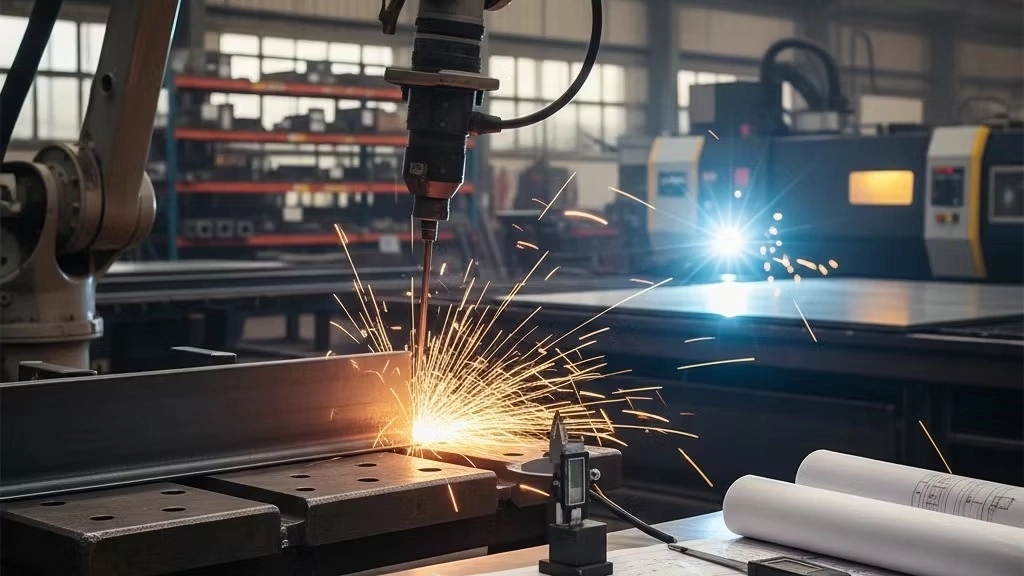
During the cutting stage, technical experts measure the accuracy of cutting depth and angle using digital calipers, simulation software and standard checklists. In Isfahan Ramazani welding and cutting factory, all CNC cuts are under constant supervision so that human error is reduced to zero.
This stage is especially important in projects that require high precision such as light metal structures or industrial equipment.
4. Quality control in the welding process
In any type of metal structure, the welding process is one of the most important production steps. In Ramazani Isfahan welding complex, all welds are done according to the WPS (Welding Procedure Specification) pattern to ensure the final strength of the structure.
Monitoring the type of electrode used, welding temperature, thickness of the welding line and the technique of welders are part of the duties of the quality control team. After the completion of each weld, test operations such as magnetic testing and color penetration are performed to identify surface cracks.
5. Final test and dimensional evaluation
After all the production steps are completed, the parts made in Ramazani welding of Isfahan enter the final testing stage. In this step, the dimensional control is compared with the technical plan of the project. This work ensures the complete matching of the components with the customer's plan.
The quality control team records all the results of this test in a special form for the project and a copy of it is kept in the quality assurance unit for archiving purposes.
6. Appearance evaluation and final payment
The appearance of the product reflects its inner quality. In the last step, the surface of the parts is checked for smoothness, cleanliness, rust and color. For its final products, Ramadani Welding, Isfahan uses sandblasting techniques, electrostatic powder paint and mechanical polishing to achieve not only durability, but also a beautiful appearance.
The role of quality engineers in Isfahan Ramadan cutting welding
Quality control engineers in this series receive periodic training so that they can work with precision measuring devices and CAD/CAM software. The goal of this team is to ensure customer satisfaction with the final result.
They continuously analyze data on dimensional deviation, welding temperature, and sheet thickness and provide reports for continuous improvement. For this reason, many reputable factories and industrial projects of Isfahan have trusted Isfahan Ramezani welding for technical cooperation.
Quality control tools and equipment in the collection
In Isfahan Ramazani cutting welding, tools such as calipers, angle gauges, micrometers, welding testers, reflection hammers, and digital data reading systems are used.
Also, the automatic data logging system (Data Logging System) in this collection ensures that no deviation or mistake goes undetected. This accuracy of performance is one of the main strengths of the collection compared to other similar workshops in Isfahan province.
International standards used
Quality control in Isfahan Ramadani welding is done based on the following international standards:
ISO ****: Quality Management
ISO ****: Control of welding processes
EN ****: Requirements for the construction and assembly of metal structures
AWS D1.1: Steel Welding Regulations
By complying with these standards, it is ensured that the products are at a high level not only in terms of appearance but also in terms of technical and durability.
Benefits of implementing continuous quality control
It is for these reasons that this collection has been able to strengthen its position in the metal service market in a short period of time.
Quality control in custom projects
Some projects, such as the construction of pressure vessels, industrial machinery chassis or production line equipment, require special quality control. For these projects, Ramezani Welding Co., Ltd. implements a three-stage inspection (before, during and after the operation) to reduce the error to zero.
If requested by the customer, all quality control documentation will be provided with the final product. This transparency has increased the credibility of the collection among contractor companies and regulatory institutions.
A continuous improvement approach in Ramadan cutting welding of Isfahan
One of the management principles in this collection is the concept of "continuous improvement". This means that even if the customer is completely satisfied, the quality control and production team are looking for solutions to increase speed, accuracy and uniformity.
Monthly meetings of performance analysis, review of error reports, and training of employees are considered to be fixed elements of the quality system in this factory.
Distinctive features of quality control in Isfahan Ramadan cutting welding
Digital recording of each control step
Using experienced engineers in CNC welding and cutting
Completely archived database of past projects
Fast response to customer correction requests
These features have made Ramadani welding and cutting in Isfahan known as one of the most professional metal quality control centers in the province.
conclusion
Quality is not a random result; It is the result of targeted planning, continuous monitoring and technical expertise. Ramadani Isfahan welding and cutting group has proven this principle in practice and by implementing the most accurate quality control processes, it has been able to win the trust of large industries and private customers.