


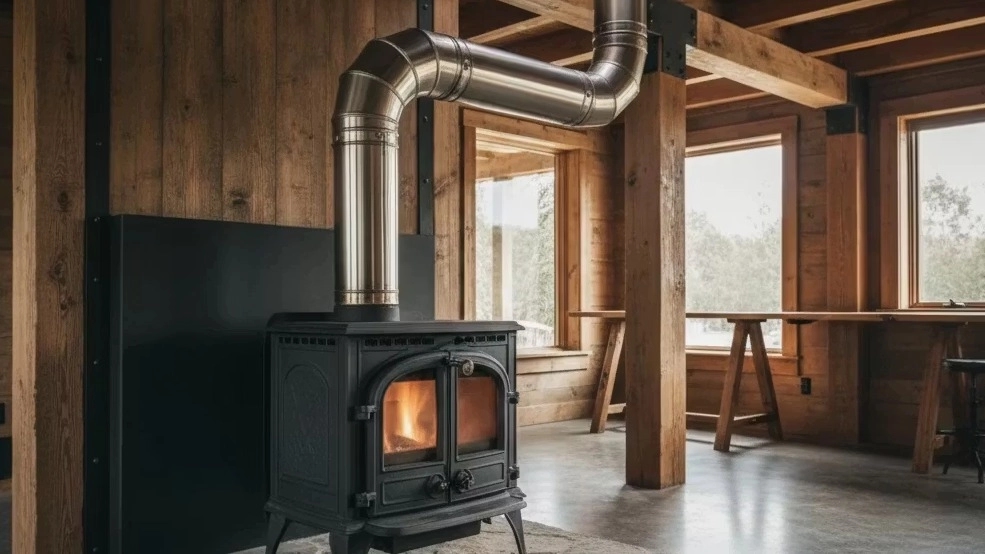
The use of wood heaters has become popular again in recent years. The nostalgic feeling of burning wood, the crackling sound of fire and the pleasant heat created by these systems have made many people install these heaters in villas, gardens, traditional restaurants and even modern homes. But a point that is often overlooked is the importance of designing the wood heater channel in a principled and engineered way. Contrary to popular belief, a wood heater is not just a metal enclosure; Rather, it is the beating heart of a heating system, whose veins are the pipes and channels of the smoke outlet. If these vessels are not designed properly, not only will you not get the desired heating, but you will also risk your life due to carbon monoxide gas. In this comprehensive article, we examine the principles of design, construction and installation of smoke evacuation and ducting systems for wood-burning heaters, and examine the role of the specialized Sahil channel cooler collection in providing customized solutions.
Why is designing a custom wood heater channel so important?
Many people think that by buying a few meters of ordinary heating pipe from the hardware store and connecting them together, the work is done. But in reality, designing a wood heater channel requires accurate physical calculations. Unlike gas heaters, wood heaters have very high thermal fluctuations. The smoke from burning wood contains suspended particles, soot and acid gases that can quickly wear out ordinary pipes.
Furthermore, "suction" or Draft in a wood-burning heater is completely dependent on the design of the channel. If the diameter of the channel, its height, and insulation are not done correctly, the phenomenon of "smoke return" will happen. This is where the customization services of Coast Cooler Channel become important. A custom design takes into account all angles of the building, prevailing wind direction in the area, roof height, and the type of heater you have to design the best path for the smoke to exit.
Principles of physics in smoke evacuation and ducting
Warm air is lighter than cold air and tends to rise. This simple principle is the basis of chimney operation. But when it comes to designing a wood heater duct, many variables come into play. If the channel is too wide, the smoke is cooled and the speed of its ascent is reduced, which results in rapid sooting of the walls. If the channel is too narrow, it will not have the capacity to discharge the volume of produced smoke and the smoke will return to the room.
Experts at Coast Cooler Duct calculate the exact diameter of the duct by checking the thermal capacity of your heater (which is usually measured in kilowatts or BTU). Also, the use of conversions and standard elbows with appropriate angles (preferably 45 degrees instead of 90 degrees) to facilitate the flow of smoke is part of the art of duct design.
Material science in the construction of channels and pipes for wood-burning heaters
One of the frequently asked questions in designing a wood heater channel is the type of sheet and the material of the channel. Thin galvanized pipes, black pipes and steel pipes are usually found in the market. But which one is suitable for a wood heater?
Black or oily sheet (Black Steel)
For wood heaters that have very high outlet temperatures, it is very common to use thick black sheets (eg 0.6 mils and up). These sheets have good heat resistance and if painted with fireproof colors, they give a very stylish and decorative look to the interior. Coast cooler channel with laser cutting and precise rolling of thick sheets, creates cylindrical or square channels that exactly match the output of your heater.
Galvanized sheet
Galvanized sheeting is great for normal ventilation ducting, but should be used with caution in wood heater ducting designs. If the chimney temperature rises too high (over 200°C), the zinc coating may produce toxic fumes. Therefore, galvanizing is usually used for the outer layer of double-walled chimneys or parts that are outside the home.
Stainless steel sheet
The best, most resistant and, of course, the most expensive option for designing a wood-burning heater channel is steel. Stainless steel is very resistant to acids caused by burning wood (creosote) and does not rust. If you are in the humid northern or southern regions of the country, the suggestion of Sahil Cooler Channel is to use steel chimneys for a lifetime.
The role of insulation and double-walled channels
One of the biggest mistakes in installing a wood heater is not paying attention to the temperature drop along the path of the chimney. When hot smoke enters a pipe exposed to cold outside air, it cools quickly. The cooling of the smoke causes the suspended particles in it to turn into a viscous liquid called "creosote" or wood tar. This material is highly flammable and is the main cause of fire in chimneys.
In designing a professional wood heater channel, it is recommended to use double-walled channels. These channels include an inner tube, an insulating layer (rock wool or ceramic) and an outer tube. Kanal Cooler Sahel has the ability to manufacture all kinds of customized double-walled pipes and channels. This insulation makes the smoke stay hot until it leaves the hood and the heater's suction is always maintained at its highest level.
Architectural challenges and channelization solutions
Each building has a unique architecture. Sometimes the heater is in the middle of the hall and the pipe has to travel a long distance to reach the wall. Sometimes the roof is steep and it is challenging to pass the pipe. This is where the word "custom" in the phrase customized wood heater channel design becomes meaningful.
Passing through the ceiling and wall
Passing the hot pipe through flammable materials such as roof wood or roof waterproofing requires special parts called "Thimble" or passage. Coast Cooler Channel by making metal interface parts and special flanges, it allows the pipe to pass through the roof or wall without dangerous heat transfer to building materials. The sealing of these points is also guaranteed by the use of flushing sheets produced by the same group.
Knees and deviations
Ideally, the chimney should be completely vertical. But in the reality of architecture, we have to bend and deviate. Using 90-degree elbows in designing a wood-burning heater channel is a suction killer. Soot gets stuck in the 90 degree bend and blocks the track. The Sahil Channel Cooler series smoothes the flow of smoke with the design of soft elbows (for example, two 45-degree elbows with one interface). Also, the installation of the inspection valve on the knees for annual cleaning is one of the details that only experienced designers observe.
Aesthetics in the design of the wood heater channel
Today, the heater channel is not only a technical element, but also a part of the interior decoration. Industrial and rustic decoration styles emphasize the display of pipes and fittings.
A crooked channel with thin sheets and ugly fasteners will destroy the entire beauty of your luxury fireplace or heater. The design of the wood heater channel is done by Sahil Cooler Channel with precision and elegance.
Clean welding, use of thick sheets that do not wave, furnace or fireproof painting and the use of fasteners and designed supports, make your chimney system as beautiful and eye-catching as the heater itself. You can order channels with a circular, square or even oval cross-section to match the interior design language of your villa.
adjustment cap and H cap; Professional finish
The end point of any smoke exhaust system is its cap. In wood heater duct design, the cap is not just to keep birds out. Strong winds can cause smoke to flow back into the pipe.
Ordering and manufacturing process in Koller Sahel channel
When you refer to the Sahil Cooler Channel collection for wood heater channel design, an engineering process goes through:
- Visit and measurement: First, the location of the heater installation, the distance to the wall and ceiling, and the passage of the chimney are measured with millimeter accuracy.
- Material selection: Based on the budget and climate of your region, the type of sheet (black, galvanized, steel) and its thickness are determined.
- Manufacturing and cutting: Using advanced cutting and sheet rolling machines, the parts are made with minimal errors.
- Installation and insulation: The installation team assembles the parts in compliance with all safety principles and completely seals the seams.
Important safety tips in maintaining the heater channel
Even the best wood heater duct design needs maintenance. Woods that have moisture or resinous wood (such as pine) produce a lot of soot and creosote.
It is recommended to install inspection hatches in the channeling route. Coast Cooler Channel can design sliding or screw valves in different parts of the channel, which allows cleaning the pipe with a brush without having to open the entire system.
It is also mandatory to install a carbon monoxide sensor in rooms with wood heaters. If your duct design is done by non-experts, there may be small leaks that allow invisible and odorless CO gas into the space. But in fitting and overlapping connections made by experts, the possibility of smoke leakage is zero.
Effect of channel diameter on thermal efficiency
One of the complex technical issues in designing a wood-burning heater channel is matching the diameter of the outlet of the heater with the diameter of the channel. The general rule is: "Never take the diameter of the channel smaller than the outlet of the heater." But making it too big is also wrong.
If the output of your heater is 15 cm and you connect it to a 30 cm channel, the speed of the exhaust gases will drop drastically. This speed drop causes rapid cooling of the smoke and settling of the soot. Sahil Channel Cooler engineers use standard cone conversions to gradually change sizes to minimize airflow disturbance.
Converting the heater channel to the channel heating system
A creative idea in designing a wood heater channel is to use the heat of the channel itself to heat the upper floors. If your heater is on the ground floor and the pipe runs through an upstairs bedroom, a clever design can run part of the pipe uninsulated (or with a safety mesh guard) into the upper room.
This will make the hot pipe act like a radiator and give the wasted heat to the bedroom. Of course, this work requires accurate calculations of safety and distance from flammable materials, which is the specialty of Kanal Cooler Sahel.
Custom channel design and implementation costs
Perhaps at first glance, the cost of designing a custom-made wood-burning heater channel may seem higher than buying market pipes. But this is a long-term investment.
Poor quality market pipes rot every two or three years and need to be replaced. Consider the cost of rebuilding, painting and replacement hassles. On the other hand, a thick and basic ducting system implemented by Kanal Cooler Sahel can last for decades.
Furthermore, higher thermal efficiency means less wood consumption. When the chimney suction is correct, the wood burns completely and produces maximum heat. In incomplete systems, the wood is half burned and its energy is wasted through the chimney.
conclusion
A wood-burning stove is enjoyable, as long as it is safe and efficient. The key to this safety and efficiency lies in the design of the wood heater channel. From choosing the material of the sheet and its thickness to calculating the diameter, designing the knees, insulating and installing the appropriate cap, all are a chain of technical factors that must be put together carefully.
Don't forget that fire is a good servant but a dangerous master. Take control of the fire and enjoy the warmth with a standard wood burning heater channel design. For advice and ordering the construction of various types of channels, valves, caps and heater connecting pipes, remember the name Sahil Cooler Channel and contact our experts. We offer solutions that are exactly tailored to your needs.
