

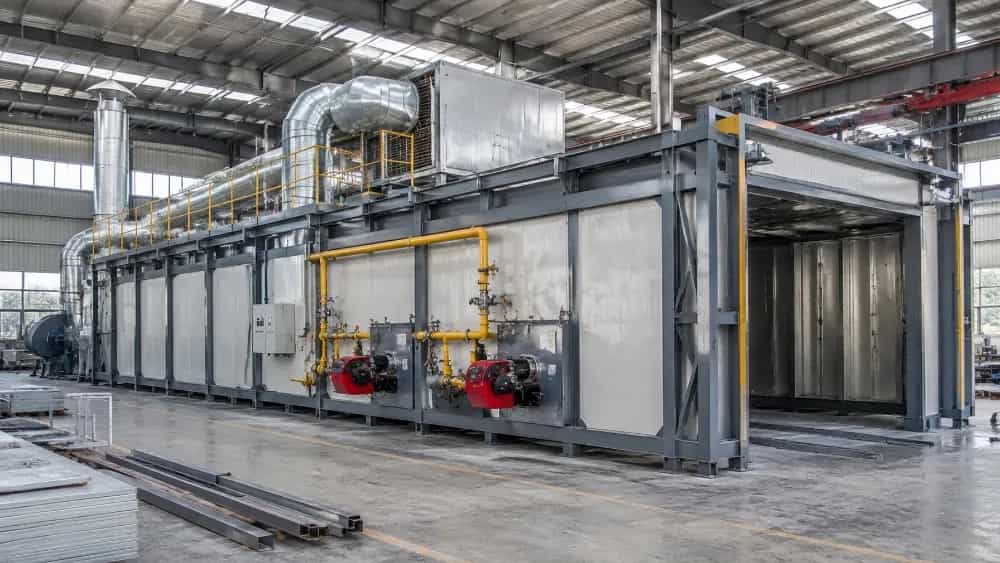
Construction of static furnace is the design and implementation of insulated thermal chambers equipped with indirect air circulation system, which are used for complete curing of electrostatic powder paints in the temperature range of 180 to 220 degrees Celsius. This industrial equipment stabilizes the polymerization reaction of paint particles without causing burns or immaturity on metal parts by creating uniform heat distribution in all parts of the cabin. Isfahan Zinda Roud Company, relying on the standards of combustion engineering and fluid mechanics, localizes and produces these types of furnaces according to the workshop capacity and continuous industrial lines.
Engineering principles in the design of the chamber and insulation of thermal furnaces
The most important factor in the thermal efficiency of a paint curing oven is to prevent thermal bridges and heat leakage into the workshop space. In the field inspections, it has been found many times that the use of integrated metal structures in the body without thermal cutting, causes severe temperature transfer to the outer wall and high fuel loss. In body engineering, the thickness of the walls is determined based on modular sandwich panels with standard density. The inner layer is made of thick galvanized or oil-formed sheets so that it does not deform due to continuous expansion and contraction.
Multilayer insulation with a combination of high-density compressed rock wool and thermal reflective layers prevents the sudden drop in the temperature of the compartment during loading. Careful sealing of the joints and sealing of the entrance door hinges with high temperature resistant silicone fireproof strips prevents the escape of cooking gases and hot air. This structural approach minimizes the depreciation of the furnace in continuous work cycles.
The role of industrial chassis in maintaining the body structure
The foundation and the lower chassis of the furnace must have sufficient mechanical resistance against the weight of heavy parts, conveyor systems or moving carts. The use of heavy industrial profiles with welding under shielding gas prevents any settlement, swaying of the roof and disruption of the air sealing of the doors during the years of operation.
Mechanism of indirect heat transfer and uniform circulation of hot air
The final quality of the paint surface and its uniform gloss is directly dependent on the temperature uniformity throughout the furnace chamber. The direct transfer of heat from the flame to the part causes yellowing, scaling and incomplete combustion of resin particles. Accordingly, in engineered systems, an all-steel heat exchanger with high thermal resistance is used to transfer heat so that the gases from the burner do not enter the cooking space.
Hot air flow is circulated by high thermal class centrifugal fans. These fans suck air from the bottom of the furnace, pass it around the hot exchanger tubes, and direct it back into the cabin through the bottom channels and sidewalls at a regulated flow rate. Installing adjustable dampers along the channels makes it possible to limit the temperature difference between the top and bottom of the furnace to less than five degrees Celsius; The issue that is decisive in the impact and adhesion test standard.
Combustion control and temperature shock prevention
Exactly controlling the rate of temperature increase prevents excessive flow of powder paint before complete polymerization. Calibrated thermocouples at several points in the furnace send thermal data to the digital control panel so that the power of the burner can be precisely adjusted according to the thermal load of the parts.
Types of functional furnace models based on the movement type of parts
The needs of the industries are not the same in the dimensions of the parts and the volume of production. The classification of furnaces based on the method of moving the load determines the layout of the entire coating workshop.
Box or box models are the most used in workshops with a variety of parts. These models are made as single-door or double-door, and the parts are guided into the chamber by manual wheeled carts or external manual conveyors. For very long parts such as construction profiles, the length of the furnace is increased and the air circulation system is strengthened based on the length.
In high circulation lines, continuous or conveyor furnaces are used. In this structure, the parts hang on the air conveyor chain and pass through the thermal tunnel at a certain speed. The design of the entry and exit openings in these models requires industrial air curtains to control the temperature drop from the two open ends of the tunnel.
Open two-sided models to organize the production flow
In factories where the spraying station is located on one side and the cooling station on the other side, the two-door box furnace creates high efficiency in eliminating the interference of raw and cooked parts.
Key materials and parts in the durability of heat exchangers
The heat exchanger or so-called firehouse furnace is under the most thermomechanical stresses. The difference in the expansion coefficient of metals at high temperatures can lead to bursting of welds and leakage of toxic combustion gases into the furnace in the short term.
Using heat-resistant stainless steel sheets with appropriate thickness in the primary combustion chamber increases the useful life of the part significantly. Thermal pass pipes with precise arrangement prevent the accumulation of heat in one point and by increasing the exchange surface, they reduce the temperature of the exit chimney. This mechanical efficiency results in a direct reduction of gas or diesel consumption in the workshop.
Technical and functional characteristics | Manual carriage box oven | Manual conveyor box oven (manual rail) | Continuous tunnel furnace (conveyor) |
Workflow type | Discontinuous / batch loading | Discontinuous / continuous Medium | Fully continuous and automatic |
Suitable production volume | Small to medium workshops | Parts manufacturing workshops Heavy | Continuous mass production factories |
Load transfer method | Workshop floor wheeled cart | Air rail Suspended | Continuous conveyor chain |
Thermal dispersion of the chamber | Below ±5 degrees Celsius | Below ±4 degrees Centigrade | Below ±3 degrees Celsius |
Inlet ventilation type | Hinged door with silicone strip | Grooved rail or hinge door | Dynamic air curtain in openings |
Heat exchange system | Hot air exchanger Indirect | Indirect hot air exchanger | Modular multi-section exchanger |
Considerations for installation, commissioning and optimization of energy consumption
Many functional problems in furnaces come back to errors in placement and workshop ventilation. Inadequate suction of the exhaust chimney or installation of the furnace exposed to the direct wind flow of the hall doors disrupts the temperature efficiency.
Adjusting the fuel-to-air ratio in the burner, continuously monitoring the operation of the circulation fans and checking the sealing of the seams during regular service periods will keep the process efficiency at a standard level. The correct implementation of the air return path from the furnace floor plays a vital role in re-directing the heat and prevents cold layers from settling on the bottom surface of the cabin. Isfahan Zinda Roud company implements all construction stages based on structural compliance with the fuel supply capacity and the limitations of the client's production space.