
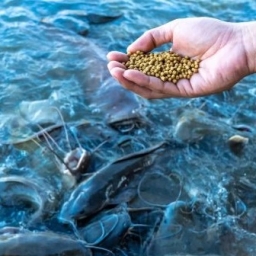

In general, the food that we give to farmed trout must have the nutritional components needed by this fish, the components that the fish needs to grow and produce energy and perform vital activities, the most important food components that should be in the food of farmed trout If there are proteins, fats, sugars, vitamins and minerals or rare elements.
Proteins
It is one of the very important food components that is necessary for building new tissues without fish and its growth. Proteins are made up of small units called "amino acids". Amino acids generally include 20 types, and different proteins are made in different proportions from their juxtaposition. Some of the proteins are rich in several types of these amino acids or in some cases lack one or more types of them, and in order to meet the complete needs of fish for proteins or amino acids, a combination of several types of proteins should be used in the diet. take so that the possible deficiencies of some amino acids in one type of protein are compensated by other proteins. One of the reasons for combining several types of food containing protein for the preparation of salmon diet is for the same purpose.
Fat
The second food component that should be present in the diet of salmon fish and in terms of importance is placed after proteins, are "fats". Their role in providing energy in the body is through burning in the cells that make body tissues and its other role is in making liver tissues and the growth of salmon fish.
Sugars
It is another essential food for the life and growth of fish that should be present in the diet of salmon. When the fish cannot provide the energy it needs by burning proteins and fats, sugars or carbohydrates are burned in the cells of the fish's body. In the natural nutrition of salmon, sugars play a role, but in practice, in the preparation of salmon diet, we use foods that contain sugar; Like grains, the two main sources of fat in the diet of fish include starch (found in potatoes, etc.) and plant fibers (plant stems, etc.).
The problem with the presence of sugars or carbohydrates in the diet There is a problem with trout food is that the fish is limited in digesting them in its digestive system and absorbing and introducing them into its blood, and even in the best conditions, a maximum of 60 to 65% of the carbohydrates (for example, starch) in the food digests it and absorbs it into its body, and if the amount of sugars in the diet of trout exceeds a certain limit, a significant part of it that is digested and absorbed into the body of the fish, passes through the digestive system of the fish and is excreted from the body in the form of feces. it will be makes it easier and faster, therefore, the excessive amount of carbohydrates in the diet does not give the proteins and fats in the food a chance to be digested by the digestive system and absorbed into the fish's body, and as a result, it is out of reach of the fish and the symptoms related to the lack of protein and fat, which include the reduction of growth and diseases caused by the lack of protein in the body of the fish. sugars) which are absorbed by the fish's body and cause problems such as yellowing of the fish's liver.
Vitamins
A kind of organic substances whose presence in small amounts in the diet of salmon is necessary to ensure the growth and health of this fish and they also play a role in some of the complex vital activities of cellulose (as a coenzyme). Vitamins include two types of water soluble and fat soluble.
Minerals (minor)
Trout is one of the other required food components. The role of these substances in burning food, increasing the hardness and endurance of bones, interfering in the water exchange of this fish and the surrounding environment, and being present in the chemical composition of important body fluids. The seven important mineral elements needed by trout are: calcium, chlorine, potassium, sodium, Phosphorus, magnesium, sulfur