

Purchasing cheap and high-quality canopy netting in Karaj requires choosing the percentage of shading according to the use (30 to 50% for agriculture, 50 to 80% for greenhouses and villas, and 80 to 95% for privacy and parking) and measuring the resistance to ultraviolet radiation. For the variable climate of Alborz province with dry summers and strong mountain winds, the greenhouse shade produced from heavy polyethylene (HDPE) with at least 3% UV stabilizer is the most economical and durable choice. The North canopy net collection provides these products directly to the agricultural, residential and industrial projects of the region without intermediaries and with the guarantee of dimensional stability and elasticity.
Technical factors determining the quality and lifespan of canopy netting in Alborz region
The climate of Alborz province in Hashtgerd, Nazarabad, Mohammadshahr and Kordan regions is a combination of sharp summer sun and sudden temperature drop in autumn. This severe thermal fluctuation along with periodic winds is the biggest cause of erosion and tearing of poor quality sheds. High-quality canopy netting must be produced with Raschel Knit technology so that in case of a local cut or puncture, the taropod net will not split and stretch.
Our implementation experience in the garden areas of Karaj has shown that the most important weakness of low-quality market nets is the use of recycled waste granules instead of new petrochemical materials. Poor quality shade becomes dull and brittle at the end of the first season and is torn by the first autumn tornado. Using an anti-UV compound with a standard percentage in the granule core prevents the molecular degradation of polyethylene under the burning rays of the sun and guarantees the flexibility of the structure for at least 3 to 5 years.
The width and dimensions of the roll are also important in engineering. Standard rolls are produced in widths of 2, 4, 6, 8, 10 and 12 meters. Installation engineers in the fields recommend to reduce the seams and joints of the weak point of the wind deflector, always prepare the widest width corresponding to the openings of the structure so that the wind pressure is evenly distributed on the surface.
The methods of distinguishing the standard lace shade from the waste products in the local market of Karaj
Buyers in the local market of Alborz often miscalculate the two categories of quality and price. Cheap non-engineered netting will end up being the most expensive option in the medium term due to the high cost of reinstallation and the loss of greenhouse plants due to burns caused by excessive light passing through.
Appearance signs and simple tests of product authenticity
There are some objective indicators for quality testing before the final purchase:
- Uniformity of texture and non-aggregation of colored mass: First-class lace fabric must be free of thick knots, discontinuities or uneven stretches in the entire area of the roll.
- Cold bending and flexibility test: Fold a 10 cm strip from the edge of the lace firmly and press; If a white line falls or the threads become brittle, the product lacks sufficient stabilizer or is produced from brittle recycled materials.
- Color transparency and lack of burnt plastic smell: Good shade has a uniform green, deep black or dull earth color and does not emit any unpleasant smell of chemical solvents or burnt plastic.
The importance of grammage and exact density per square meter
In bulk purchase, the parameter of weight per unit area (grams per square meter or GSM) is the final scale of lace quality. Some middlemen supply 50% nets with different hole sizes instead of 80%. Measuring the weight of the roll with the meter according to the technical catalog of the North canopy netting, determines whether the thickness of the polyethylene strands is really strong enough to withstand the storms of Karaj or not.
Shading percentage selection formula based on the type of consumption in Karaj gardens and greenhouses
Choosing the greenhouse shade percentage is not a purely decorative or guesswork decision; Plants photosynthesize in proportion to the wavelength and intensity of the radiation, and excessive or insufficient blocking of light both causes physiological growth to stop.
Agricultural applications, cultivation and mushroom production
In areas prone to agriculture such as Mahdasht and Chaharbagh, 30-50% nets are ideal for shading open fields of summer plants (tomatoes, bell peppers, and eggplants), because while preventing sunburn, they provide the necessary heat for photosynthesis. On the other hand, indoor plant production halls and special nurseries need 60-80% shade so that the moisture of the leaves does not evaporate and heat shock does not occur to the seedlings.
Garden spaces, residential villas, terraces and pools
In Sohiliyeh and Tehrandasht villa constructions, buyers focus on 80-90% nets with bold green or beige color. In addition to reducing the comfort temperature by 15-20%, this percentage of shading completely solves the privacy of the visual view (neighborhood view). For covering outdoor pools, over 80% of algae growth is hindered by blocking the light spectrum of the sun and increases the cleanliness of the water several times.
Comparison of technical and physical parameters of canopy net types
The following table presents the technical standards, grammage and industrial uses of high-quality canopy netting for engineering decision making:
Shade Rate | Standard weight (GSM) | Approximate useful life in Karaj | UV resistance (UV Stabilizer) | main and optimal use |
30 to 40% | 40 to 50 grams/square meter | 4 to 6 Year | 2.5% | Protection of summer fields, fruit orchards, anti-hail |
50 to 60% | 65 to 80 grams/square meter | 4 to 6 years | 3 percent | flower and plant greenhouses, vegetables, livestock farms |
65 to 70% | 90 to 100 grams/square meter | 5 years | 3 percent | Covering the roof of sheds, chicken coops, kindergarten yards |
80 to 90% | 130 to 150 grams/square meter | 5 to 7 Year | 3.5% | Villas, swimming pools, privacy, car parking |
95% | 160 to 180 gram/square meter | 5 to 7 years | 4 percent | cooling areas exposed to intense sunlight, temporary camp |
Principles of safe installation and maintenance of shade netting to prevent premature wear in seasonal winds
The lifespan of even the most high-quality laces is reduced by half if they are not used properly. The field investigation of the damaged projects in Karaj proved that 90% of the ruptures started from non-standard metal connection points, not from the middle of the mesh.
Fasteners and polymer clips instead of wire
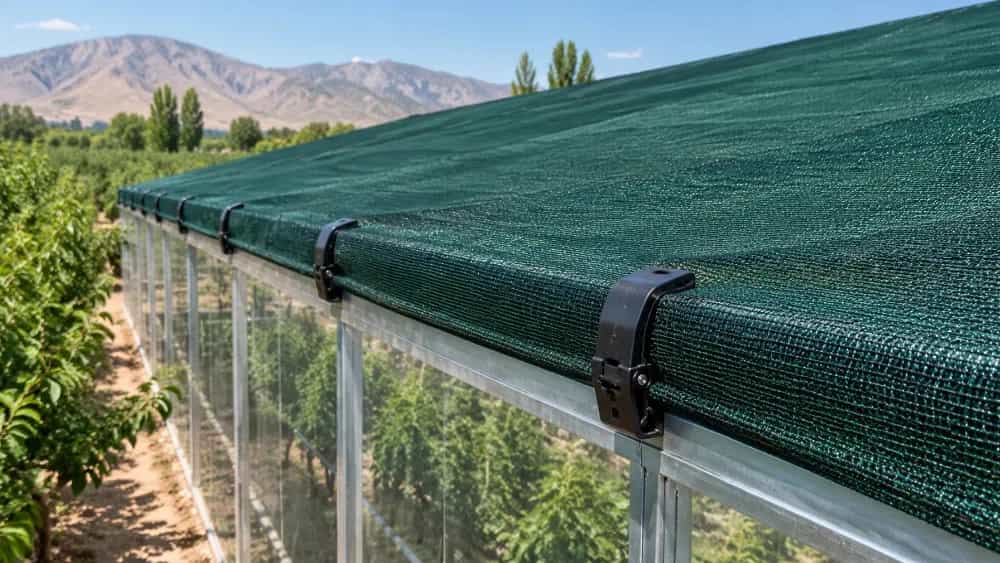
The biggest execution error is to restrain the shed with iron wires or reinforcing wire to metal pipes. Due to the vibrations of the wind, the wire acts like a cutting blade and cuts the taropod of the net. Sunblock polymer locking clips and canvas edging with punched rings (eyelet) should be used to distribute the stress on the edges.
Controlling the amount of stretch and preventing central sagging (bellying)
Canopy mesh should not be under too much tension; Polyethylene shrinks due to cold and expands due to heat. The initial tension of more than 10% of the capacity imposes continuous stress on the tissue. Also, it is necessary to install galvanized bracing wires in a crosswise manner under the shed with a maximum distance of 1.5 to 2 meters to prevent the accumulation of rainwater, the weight of snow or the falling of the mesh wind deflector.
The economic advantages of buying canopy net directly from the production and distribution center
Procuring awning netting from retail stores is usually associated with paying brokerage percentages and the possibility of delivering old warehouse sheds (that have been lying under the warehouse sun for months). A specialized selection center near the project site, such as North Canopy Netting, provides access to freshly produced uncut rolls at the lowest possible price.
Purchasing without intermediaries provides the possibility of access to custom sizes with specific widths and punching and embroidery services according to the dimensions of the openings of the structure. Also, fast delivery throughout Karaj and Saujblag areas will reduce workshop logistics costs and downtime for installation teams to zero.