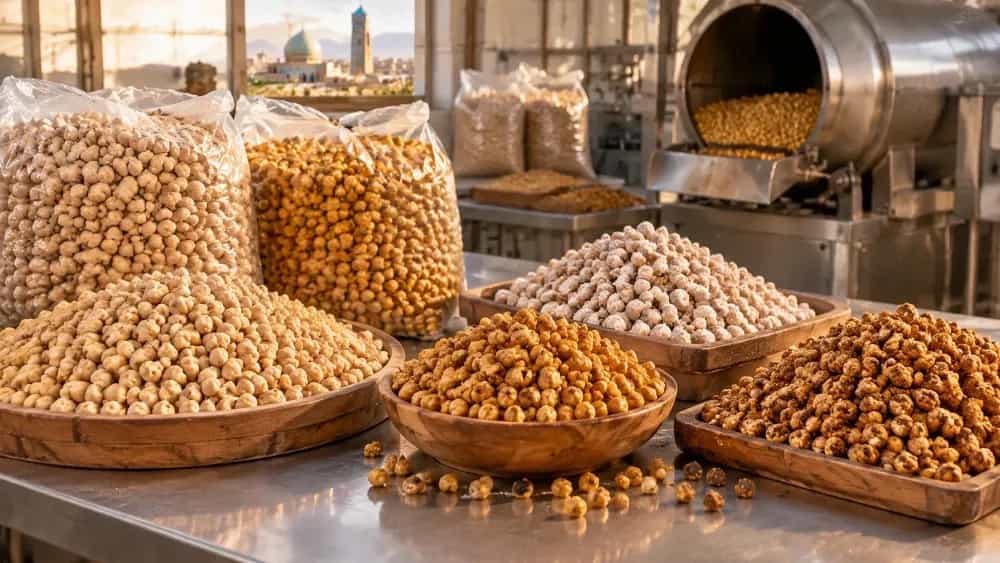

When a nut seller, supermarket or distribution center in Tabriz inquires about buying wholesale chickpeas, he usually faces several different prices; But the price difference does not always mean that an offer is cheaper. The type of chickpeas, cleanliness, percentage of breakage, roasting method, amount of salt, actual weight, packaging and settlement conditions all change the final price.
The root of most of the differences is that the buyer only compares "price per kilo", while salable quality, product loss and preparation cost should be considered alongside price. In Dehghanpour Pea Cooking Workshop, the experience of checking major orders in Tabriz has shown that buying directly from the manufacturer has economic value when the product specifications and delivery conditions are clear from the beginning.
How is the price of bulk chickpeas determined in Tabriz?
The price of bulk chickpeas is not a fixed number and is determined based on the type of product, cargo quality, order volume, packaging type, and payment terms. To reach the producer price, the price of each kilo must be checked along with the net weight, loss percentage, packaging cost, and delivery time.
The price of raw chickpeas, salted chickpeas, and chickpeas are not the same; Because each of them has different preparation stages, energy consumption and target market. Raw chickpeas are usually less processed, but salted chickpeas and two-atishe chickpeas require roasting, heat control, separation, and sometimes flavoring.
In order to inquire about the wholesale chickpea price, this information should be clear:
- Type of product: raw, salted, double flavored or flavored
- Order weight and number of bags or cartons
- Percentage of broken and fine grains acceptable
- Salt level and roasting intensity
- Bulk or special packaging
- Delivery location in Tabriz or shipping to another city
- Cash payment or settlement deadline
- Loading time and conditions Carrying
In bulk orders, the lowest price is not always the best choice. If the product is damp, the percentage of breakage is high, or the taste and crispness decreases during storage, a part of the initial price difference will be lost at the time of sale.
The main components affecting the price and quality of chickpeas
The quality of chickpeas is formed from the combination of healthy raw material, uniform processing and proper packaging. Any change in these three stages can affect the price of chickpeas per kilo, shelf life, appearance of the product and customer satisfaction.
Pea type and seed grading
Uniform, clean and healthy beans are usually worth buying because they cook more evenly when roasted and make a better display. Raw chickpeas with very small, broken or impure seeds may command a lower price, but they are not for all buyers.
In evaluating the raw material, these things are important:
- The uniformity of the size of the seeds
- The absence of stale or sour smell
- The absence of gravel, soil and visible impurities
- The healthyness of the kernel and the absence of traces of insect damage
- The color of the product is consistent with the type of processing
For stores that offer the product in transparent packaging, the appearance is more important. For use in the production of mixed nuts or some workshop uses, a more competitive price with a limited percentage of broken kernels may be acceptable; Of course, this matter must be agreed upon before the transaction.
The difference between raw, salted and two-atisheh chickpeas
Raw chickpeas are suitable for buyers who care about the basic price and the possibility of processing or special combination; Nokhodchi Shur and Do Atisheh are more ready products for direct supply to the consumer. The choice between these models should be made based on the sales market, profit margin and customer taste.
- Raw chickpeas: unflavored or with limited processing; Suitable for packing, combining nuts or workshop consumption. Suitable for nut, dry fruit and retail stores. Suitable for customers who like roasted taste and a stronger aroma.
- Bulk chickpeas: It is usually offered with a lower packaging cost and is used for distribution centers or stores that pack themselves.
Actual weight and type of packaging
The price of bulk chickpeas should be calculated based on the net weight of the product, not the weight of the bag, carton or side packaging. Proper packaging prevents moisture absorption, contamination, breakage and loss of quality during transportation.
For bulk purchases, ask about these items before placing an order:
- Net weight of each unit
- Material and thickness of bag or carton
- Possibility of using special packaging
- How to sew or seal the package
- Storage conditions in the warehouse
- Responsibility for loss or damage during transportation
Order volume and settlement terms
Increasing order volume can spread the fixed costs of production and packaging over a larger number of units, but the discount should be calculated based on actual quality and weight. Payment term, delivery time and shipping cost may also change the final price per kilo.
The buyer should get three separate prices: cash price, term price and price with packaging. This method makes the comparison more transparent and prevents the apparent discount in one sector from being compensated by a hidden cost in another sector.
Comparison table of types of chickpeas for bulk purchase
Product type | Main feature | Suitable for | An important factor in Price | Quality control tip |
Raw chickpeas | Limited processing and natural flavor | Packaging, Composition of nuts and workshop consumption | Type of seeds and degree of cleanliness | Natural smell, absence of impurities and controlled breakage |
Salted chickpeas | salty taste and ready to sell | nut sales and retail | amount of salt and uniformity of roasting | crispness, uniform distribution of salt and lack Bitterness |
Nhodchi Do Atisheh | More roasting and stronger aroma | Direct sales and customers interested in roasted taste | Intensity of heat and processing weight loss | No burning, bitterness or too dry kernels |
Bulk chickpeas | Plain packaging or no packaging Final | Distribution centers and packing shops | Order weight and bag type | Net weight, warehouse conditions and protection in transit |
My field experience: unspoken tricks and costly mistakes
In the bulk purchase of chickpeas, sampling and checking the actual load is more important than comparing a few prices. My experience in the Dehghanpour chickpea cooking workshop shows that many costly discrepancies are revealed after the load is delivered and when it is difficult to modify the order.
I usually advise Tabrizi colleagues not to just taste a small sample before buying in bulk; The sample should be checked for appearance, sound and texture. Fresh and properly roasted chickpeas are crunchy when chewed, do not smell raw or burnt, and should not soften quickly after being stored in a closed container for a few days.
A few common mistakes that increase the actual cost of the purchase:
- Comparing the price of raw chickpeas with salted chickpeas without calculating processing
- Accepting the weight of the bag instead of the net weight of the product
- Ordering a large volume without receiving a sample from the same production batch
- Not paying attention to the percentage of broken seeds
- Keeping the product next to the wet wall or fragrant materials
- Not specifying the responsibility for the cost of transportation and possible damage
- Choosing a very salty product for a market where the customer has a soft taste Likes
In the Tabriz market, storage conditions are very important. Dry and roasted product should be kept away from humidity, direct sunlight, detergents and strong smells. Dryness of the product does not mean complete immunity from contamination; Some pathogens may survive in low-moisture materials, so the cleanliness of the environment, equipment and packaging is essential.
In reviewing quality, I focus on a few observable and agreeable indicators, rather than blanket claims: net weight, grain uniformity, degree of breakage, roast intensity, salt taste, and packaging condition. These indicators are clear to both the manufacturer and the buyer can check them upon delivery.
The appearance of the product should not be limited to the issue of fungal toxins. Raw material control, reliable supplier, warehouse cleanliness and laboratory tests are important in the professional chain; The legal limits of different substances may vary by country, product and current regulations.
Operating framework and direct purchase roadmap
Purchasing directly from the producer is cost-effective and reliable when the order is registered with accurate specifications, approved samples and written or clear delivery conditions. This framework helps the buyer compare the price of chickpeas per kilo with the actual quality of the product.
First step: determine the application of the product
The type of consumption determines the choice of chickpea type and avoids paying extra for unnecessary features. First determine whether the product is purchased for bulk sales, packaging, mixed nuts, catering, chain store or workshop consumption.
Second step: Write the technical specifications of the order
The term ``prime chickpeas'' alone is not enough to make a deal and must be supplemented with verifiable criteria. Specify product type, weight per package, salt content, grain size, percentage of breakage, packaging and delivery time.
Step 3: Take a sample and confirm the same sample
The sample should be confirmed in terms of taste, crispness, color, smell and the amount of breakage so that the final product is in line with the buyer's expectation. If the order is large, it is better to record the sample with the specification or internal code so that it is easy to compare when delivered.
Step 4: Calculate the final price with all costs
The actual purchase price is equal to the invoice amount plus shipping, packing, handling, and preparation costs. A cheaper offer is better when its net weight and salable quality are equal to other offers.
Step 5: Check the conditions of storage and delivery
Chickpeas should be delivered in healthy packaging and in a dry environment so that the quality of roasting is not lost during transportation. When receiving the cargo, check the health of the packages, weight, quantity, appearance of the product and any possible discrepancies.
In the Dehghanpour pea cooking workshop, the main value for bulk orders is not only product processing; Coordinating the type of chickpeas with the buyer's application, the possibility of sample checking, the separation of raw, salty and two-fat models and clarifying the order conditions are also part of the professional supply process. This approach is more important for Tabriz sellers who need repeatability of quality.
summary
The best wholesale purchase of chickpeas is not the cheapest offer; It is a proposal that covers salable quality, actual weight, delivery conditions and stability of supply at the same time. Tabriz buyers can measure the price more accurately and order according to their market by separating raw, salted, two-atisheh and bulk chickpeas.
I believe in Dehghanpur Pea Cooking Workshop that a professional cooperation starts with a clear inquiry: the type of product should be clear, the sample should be able to be checked, and the price should be announced based on the net weight and actual conditions of the order. To make accurate decisions, prepare product specifications, required quantity and delivery location, and have a clear discussion about quality, packaging and loading time.
همین حالا تماس بگیرید!
پاسخ فوری و مشاوره رایگان در انتظار شماست.