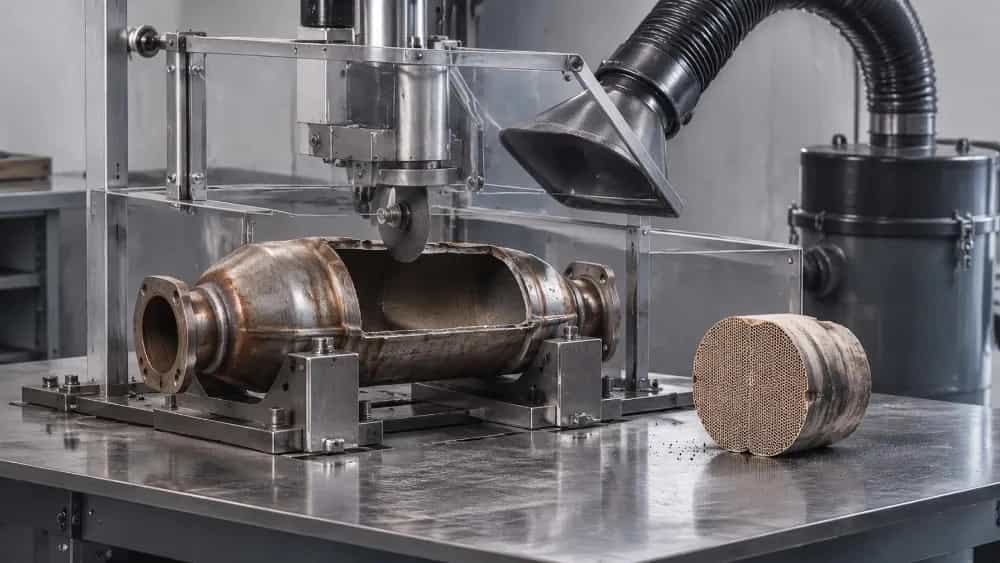

When the metal shell of a used catalyst is opened, a few seconds of cutting can change the fate of the whole work: the ceramic core comes out intact or crumbles, and part of the material is scattered in the workshop in the form of dust. For the catalyst collection and processing activists in Tehran, the issue is not only the speed of opening the shell; It should be seen how much traceable material remains after cutting and under what conditions the operator worked.
The root of many inappropriate choices is not defining the work of the device before making it. A machine that is going to open several different types of shells daily does not need the same clamp, cutting path, and discharge method as a machine designed for relatively uniform parts. Building a catalyst cutting and separating device starts from knowing the desired input and output parts, not from choosing an engine or blade.
What exactly is a catalyst separator supposed to do?
The main function of the device is the controlled opening of the metal shell and the separation of the internal content of the spent catalyst. A successful design simultaneously pays attention to the maintenance of the internal material, dust containment, operator safety and reproducibility of the result.
In automotive catalysts, the internal structure may have a honeycomb ceramic core or a metal substrate. The method of keeping and opening these two types is not necessarily the same. Even among ceramic pieces, the shape of the shell, welding location, metal thickness and brain state change; Therefore, a fixed cut for all parts is not a good criterion for design. A study on the preparation of used catalysts also emphasizes that significant damage can occur when removing the brain from the shell, and the subsequent transfer also causes a loss of material.
Cutting and separation is not the same as recovery of precious metals. This machine performs the preparation step: it converts the husk, core and material collected in the dust collection system into separate and traceable streams. Determining the composition of materials and recovering metals are the next specialized steps; The healthy appearance of the brain or its weight alone does not determine the amount of platinum, palladium or rhodium.
Which variables change the design of the device and its price?
The price of the catalyst device is not an indicative number without specifying the range of input parts and expected output quality. The type of cutting mechanism is only one of the cost factors; Fixture, protection, dust collector, setting time and serviceability are also part of the decision.
The diversity of the shell and the method of holding the piece
If the piece is not fixed before cutting, even the right blade can go the wrong way. The fixture should hold the target shells without damaging pressure to the brain, and at the same time, it should not make replacing the part a difficult and time-consuming task.
To define the fixture, it is better to use several real samples: the smallest and largest shell, round and oval piece, sample with long inlet pipe and sample with deformed body. Then it should be determined from which side the operator takes the piece, how the possible place of the cut is seen, and after opening the shell, which way the brain will come out. Easy access to the piece should not mean hand access to the dangerous cutting area.
If the workshop mainly works with a specific family of parts, a dedicated fixture can simplify setup. In contrast, for varied inputs, the tuning range is more valuable; Of course, it should be tested that this flexibility does not reduce the strength of the harness.
Cutting quality, material collection and safety
A good cut doesn't just produce a smooth metal edge; It should also control brain discharge and debris collection. Before choosing the mechanism, the direction of movement of the blade or tool, the possible place of contact with the brain and the possibility of collecting materials after cutting should be checked.
In the construction of a cutting machine, the important difference is between "dust is less visible" and "dust is contained at the source". Adequate containment and local suction should be designed with the device, not added after commissioning and observation of contamination. OSHA's safety guidelines also prioritize engineering controls such as containment and local ventilation over reliance solely on respiratory protective equipment. This resource is useful for understanding the principles of risk control, not a substitute for the safety assessment and requirements of the workplace in Iran.
Decision criteria | Manual cutting with general tools | Semi-automatic machine with fixture | Automatic system suitable for specific parts |
Compatibility with workload | Limited quantity and non-repetitive work | Medium volume with variety Manageable | High volume and fairly defined input flow |
Result dependence on the operator | High | Moderate; Dependent on initial setup | Less, subject to proper setup and maintenance |
Shock control and orientation | Mainly dependent on individual skill | Can be designed and repeated | Can be standardized for target parts |
Possibility of dust collector integration | Requires separate preparation | Predictable in design | Integratable with machine cycle |
Initial cost | Typically lower | mechanism function and accessories | usually more; Needs justification with workload |
Key question before selection | Is risk control and output quality sufficient? | Is setup for common parts fast and reliable? | Does component diversity reduce automation productivity? |
This is a utility comparison table, not a price list. To compare two construction proposals, it is necessary to see what parts each one covers and whether fixtures, suction, protection, installation, training and after-delivery services are defined in their scope of work or not. A lower initial price does not necessarily mean a lower final cost when a fixture needs to be modified or a dust collector added.
Conclusion and final opinion
From my point of view, a good device is not one that only opens the shell quickly; It must provide traceable output and safe working conditions for actual workshop parts. Before placing the manufacturing order, put the parts sample and the acceptance criteria on the table and then decide on the mechanism and the price.
If you are considering making a catalyst cutting and separating machine for your workshop in Tehran, start the conversation with a description of the input parts, workload and desired output. This information is a more accurate basis for evaluating the plan and preventing the cost of subsequent modifications.
تماس با ما