

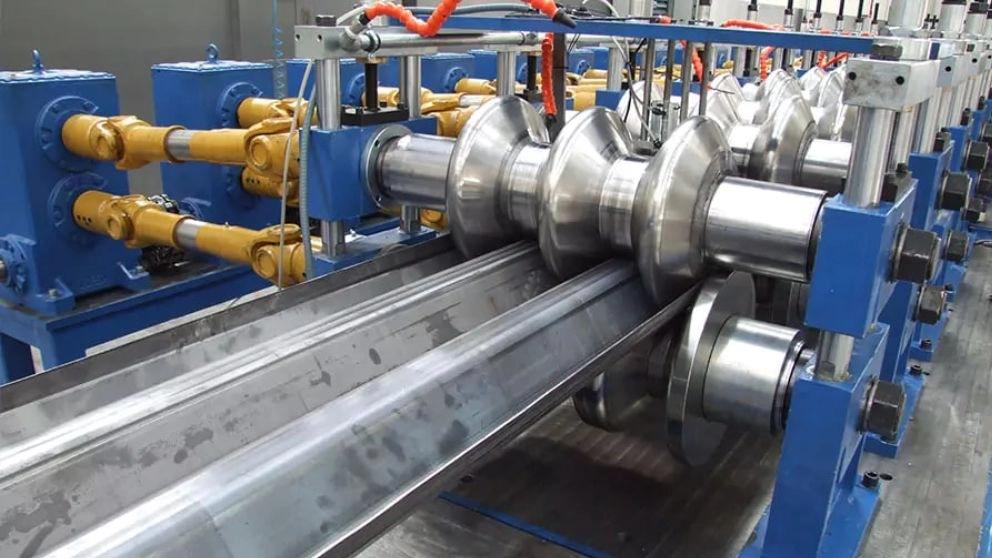
Sheet rolling process
Roll forming is the activity of shaping the sheet and turning it into sections such as profile cans, pipes, etc. During this process, the thickness of the sheet does not change, and then the continuation of this operation takes place at a certain temperature. . The products produced in this process are usually curved and are done with the angle of the bending lines at 90 degrees. As we said, after this process, the thickness of the sheet remains the same; But in the curved parts, the thickness is usually less. The roll forming machine has rollers that reduce the thickness of the sheet if needed. The temperature of the working environment does not affect the work process. But it is necessary to heat the created bending lines before they are placed on the forming roll to prevent the color from cracking.
Advantages of rolling process
forming different types of sheets
accuracy, quality and consistency
no limit for production of any size
volume High with low cost
Types of sheet forming
Hot forming (thick sheet)
Cold forming (thin sheet)
Forming format templates
In the aviation industry: to cover the interior parts of airplanes and spacecraft
In agriculture and animal husbandry: for planting containers and pots and greenhouses, in animal enclosures, in parts of agricultural machinery and machine covers.
In architecture, to produce models and prototypes
In the automotive industry: for the production of internal parts of cars, internal parts of heavy and semi-heavy machines, for parts of bicycles, scooters and the like
In the construction industry: for the production of PVC panels, false ceilings, doors, windows and...
in Food industry: for the production of pastry molds and their packaging In computer accessories: to produce keyboards, frames, frames and other computer peripherals In the film industry: for the production of computer models and special plastic clothing In medicine: for the production of masks, packaging of ampoules and pills and medicines, wheelchair parts, dentistry, prostheses, etc.