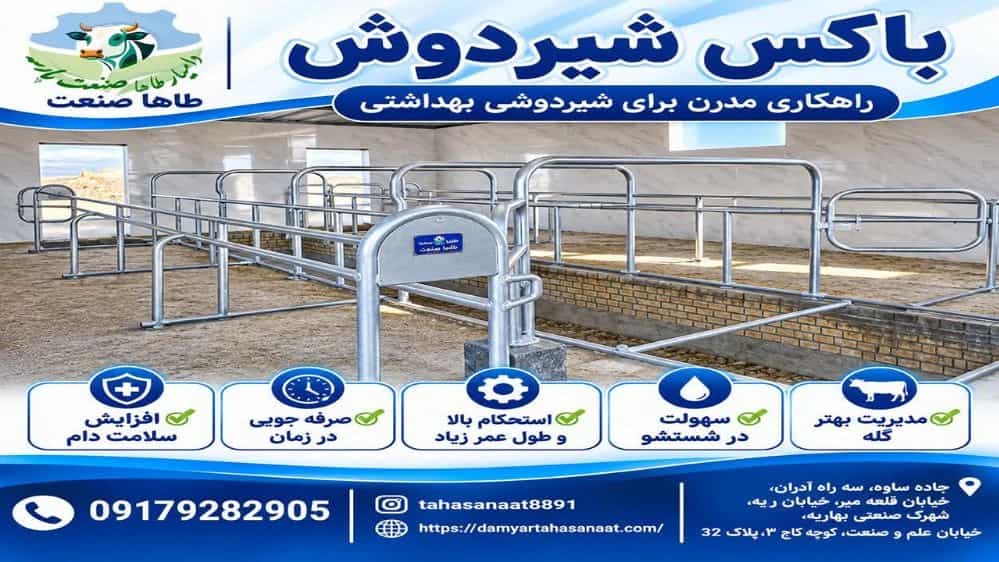

The price of milking box for milking cows in small and large industrial capacity is determined based on the type of metal structure, grade of sanitary steel, space layout and degree of automation of washing and exiting livestock. These infrastructure equipments are engineered and implemented in rural and semi-industrial units in the form of low-unit fixed frames and in large farms in the form of parallel, herring or rotary lines. The hot galvanized quality of the frame and the durability of the milk flow control devices play a decisive role in reducing milk waste and maintaining the health of the animal's udder.
Technical factors affecting the price of the frame and the mechanical structure of the milking machine
The production cost of the milking box is directly affected by the thickness of the pipes, the hot galvanizing process and the connecting fittings. During field inspections, we have noticed that the units that use black painted iron structures or weak industrial sealed pipes, within less than three years, face the phenomenon of rusting, changing the angle of livestock placement and incurring heavy costs. Acidic vapors caused by animal excrement, daily washing with hot acid and base, and constant movement of cattle require a resistant body. The use of steel grade 304 or 316 in the milk transmission lines and the use of uniform immersion galvanization with controlled thickness increases the initial value of the box compared to various workshop frames, but guarantees the stability of the structure in the long term.
The quality of the pneumatic jacks and arm closing systems of entry and exit gates is another factor that directly affects the price of the system. The smoothness of the pneumatic gates reduces the mental pressure of the cattle when entering and increases the work efficiency of the workers in the milking cycle significantly.
Comparison of small capacities and farms with medium density
Livestock breeding units with small to medium herds often require systems with a low number of units such as 2 to 8 fixed milking units. In these capacities, simpler systems are usually used to reduce depreciation and repair complexity. The price of these systems will vary depending on the need for a central vacuum pump, a mobile trolley or the installation of a fixed base frame.
Specific challenges of low-density capacities
On lighter farms, the big challenge is maintaining the balance between ease of use and milking hygiene. If the frame is not adjusted correctly, the cow will make sudden movements during milking and there is a risk of the milking paw falling. For this reason, even in compact systems, the engineering of support arms and height adjustment plays a key role, and the cost of making these adjustable tools is one of the basic parameters of the cost structure.
Requirements and mechanism of milking structures in large industrial farms
In cattle farms with a population of hundreds of dairy cows, the speed of cattle entry and exit and the stability of the vacuum level are considered the main indicators of return on investment. In these dimensions, rotary halls, dense herring systems or parallel lines with fast exit capability are usually designed. In quick exit models, the entire row of cattle is released at the same time after the end of the milking cycle, which requires a heavy chassis, durable locking systems and powerful industrial pneumatic tools.
In addition to the structure, the addition of flow measurement sensors, electronic recording system and automatic crab separation mechanism transforms the price of the system from a mere metal structure to an integrated livestock monitoring system. The difference in the price of milking lines in large projects is defined due to the need for intelligent control panels, all-steel CIP closed piping and simultaneous drainage system.
Analysis of the effects of the layout of the hall on operational costs
Choosing the hall model such as parallel, herringbone and rotary determines the mechanical type of the box and concrete pouring dimensions. In the herringbone design, the angle of the cow reduces the length of the milking trough, but it occupies more space than the parallel one. With the possibility of direct access of the operator to the breast from between the rear legs, the parallel arrangement increases the speed of work and the safety of the worker, but it imposes a higher mechanical pressure on the restraining gates.
The complexity of connections and the type of support structure reaches its maximum in rotary models; Because a heavy turntable along with numerous vacuum connectors and electrical lines must carry a load of tens of tons without vibration. Executive experience has proven that choosing a design without evaluating the geometry of the hall will impose rework costs and modify steel piping routes.
Technical and executive characteristics | Small and workshop capacity | Medium semi-industrial salon | Large industrial capacity |
Type of frame and arrangement | One or two movable/fixed rows | Herringbone Plain | Parallel quick exit or rotary |
Type of lines and fittings | Light galvanized with screw connections | Heavy hot galvanized and 304 steel | 316 stainless steel with double chassis |
Gate opening and closing mechanism | Manual Mechanical | Lever with spring or pneumatic assistance | Automatic pneumatic with central electric valve |
Track washing system | semi-manual washing or simple circuit | semi-automatic washing circuit | fully automatic intelligent CIP washing |
disconnect and exit Lobster | Manual by operator | Optional with flow sensor | Coordinated fully automatic separation |
Principles of hygiene and depreciation of parts in estimating the cost of ownership
The cost of a milking station is not only related to the day of launch; Rather, its real price will be revealed in the period of 5 to 10 years of operation. Improper design of the box and non-standard curves in the path of the steel pipes by creating turbulence in the milk flow, causes the destruction of fat globules and precipitation of milk protein, which leads to a decrease in the quality grade of the raw milk produced.
Also, the dimensional error of the box and its incompatibility with common dairy breeds, causes excessive stretching of the teats, increase in clinical mastitis statistics and frequent drug treatments of the herd. Investing in engineered frames with soft edges, seamless connections and proper harness ergonomics will reduce total livestock depreciation and ensure the line's economic survival rate by preventing frayed cables and broken air hoses.