

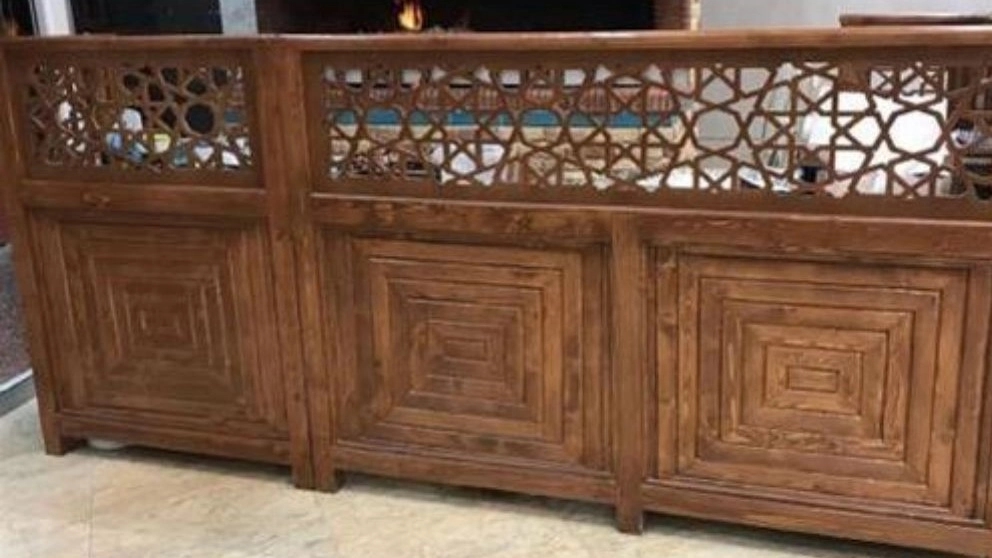
What is wooden artifacts?
The time of making the first wooden artifacts is not certain; Because wood is a vulnerable material that various atmospheric, environmental conditions and the passage of time have a direct and indirect effect on it, it wears it out and destroys it gradually. Therefore, there is no specific date and time for human use of this material. But there are evidences of its use during the Achaemenid era; Dariush says in the order of the foundation of the city of Susa: "Boards and wood were brought from Gandra and Kermania." The word (yaka) in Persian language is the jag tree, which has a brown and hard wood. From this relief of the Apadana palace in the Achaemenid period, it is clear that wood was used for practical and decorative use in the Medes as well. In a part of this relief, a Median courtier is seen carrying a wooden chair, which dates back to the 5th century BC. During the Sassanid period, the use of wood in building was very popular. In particular, it has been common to use wooden coils between the walls in order to strengthen them.
⚫️ Inlaid Work:
The word ``manbat'' is derived from ``nabat'' which means plant, and in the term it is called relief and carving on wood.
One of the most important tools and equipment needed in carving can be mentioned the cave and the wooden hammer (takhmaq).
Maghar: It is a steel blade with a wooden or compressed plastic handle that is resistant to impact. Caves are divided into four groups:
1. Flat chisels: which have a flat blade with a smooth cutting edge and are used for cutting lines and carving the background.
2. Semi-vaz cavers: which has a gutter-shaped blade with a crescent-shaped cutting edge and is used to remove the curved parts of the shape and construction.
3. Lego caves: it has a gutter-shaped blade and a semi-circular cutting edge, and it is used to remove circular parts and build motifs.
4. Maghar Shafrah: with a gutter blade with a cutting edge in the shape of a seven and it is used for making grooves and removing the initial motifs.
⚫️ Wooden hammer:
A wooden hammer is a tool made of a handle and a wooden head, and carvers use it to hit the head of a cave.
Inlay production steps:
1. Selecting and preparing the design and piece of wood suitable for carving;
2. Transferring the design on the wood: which is done by pasting the design on the wood, direct drawing, copying the design, pollinating the design on the desired wood.
3. Durbari: To form the inlaid pattern, first the Durbari and then the background around the motifs are carved.
4. Carving: Using a flat head, they first remove the extra wood from the sides of the work area and finally the extra wood from the middle parts of the area.
5. Construction and paving: after clearing the work area, they start the construction with a suitable cave.
⚫️ Wood mosaic
Wood veneer is a combination of different types of self-colored wood, materials and materials such as bone, shell, zinc, copper, ivory, inlay, etc., which creates a pattern on the wooden surface.
The materials and materials used in the production of wood are divided into two groups: wood and non-wood:
1. Wooden materials and materials:
In wood carving, various types of self-colored wood such as walnut, plantain, jujube, orange, elder, sparrow tongue, beech, pear, betel and many other woods are selected and used according to the desired design and taste of the work.
2. Non-wooden materials and materials:
An inlaid artist can use other materials such as ivory, bone, oyster, artificial fibers, inlay, copper and brass according to his taste and design.
The tools and equipment needed to make a wooden vase:
1. Work table: which should be proportional to the height of the work.
2. Peshkar board: It is a small board, usually chipboard or seven layers, with a seven-shaped slot in front of it.
3. Saw bow: on which a chainsaw is tied.
4. Hacksaw: It is a winning and very delicate blade that has different sizes.
5. Other tools and equipments are used in woodworking, such as saws, hammers, nails, nail pullers, sharpeners, and graters.
Method of producing wood syrup:
1. Color classification: The desired design is color coded according to the color, texture and material used in the mosaic.
2. Marking and crushing the design: according to the color classification, the desired design is marked and numbered, crushed, and classified according to the type of material.
3. Cutting work: Each piece of the design is carefully cut with a hacksaw.
4. Pairing: All the parts of the design are put together according to the markings, glued to each other, then pressed in the corresponding place on the work surface.
5. Filling the background with wood: The background of which is filled with wood is called "wood background".
What is the mosaic inlay?
A maraq with prominent patterns is called an inlaid maraq. In order to make the inlaid mosaic, first all the pieces are cut like a mosaic, and then they are constructed separately in the inlay method, and then they are paired together. At the end of the work, the parts are installed on the work surface in the corresponding place.
What is my care?
The art of decorating the surface of objects, like a mosaic, with small triangles and various designs, is inlaying. Khatam has always been in the form of regular geometric shapes. These geometric shapes are made by placing small triangles together. The finer and more delicate the triangles are, the better the inlay is.
Among the final masterpieces of the Safavid era, we can mention the coffin of Imam Musa Kazem (a.s.), the coffin of Imam Hassan Askari (a.s.) and the shrine of Hazrat Seyyed Alauddin Hussein in Shiraz.
What is the Chinese knot?
Wooden knot is one of the delicate arts that has been common in Iran since the beginning of the Islamic school. Knots are small joints of wood that are locked to each other in the form of tongues and create beautiful patterns, the more delicate they are, the more artistically valuable they are.
Tools and equipment needed to make knots:
Plantain, walnut, orange, pear and jujube wood are used to make Chinese knots. The tool that is used to make the knot is almost the same tool that exists in a sewing workshop; Such as: types of saws, graters, clamps, work tables, rulers, etc.
Chinese knot production method:
1. Determining the size of work;
2. Designing and drawing the desired knot based on the size of the work, which requires experience, mastery, and time.
3. Pattern removal: A pattern or mold is removed from the required parts of the drawn knot.
4. Making the frame: The frame is made in the desired size.
5. Cutting the wood of the instruments: To create the pattern of the knot, the wood is cut to the thickness of the drawn band.
6. Taking the mold on the wood of the instruments: The required number of the mold is prepared from the prepared molds.
7. Showing the devices: the corners of the joints on the wood of the devices are cut by means of a band saw.
8. Putting tools on the penis: They use a tool grater on the penis.
9. Making the connection of the devices: the two ends of each of the devices are made with crotch and tongue.
10. Picking up tools: Picking up knots and connecting the made connections is the last step of the Chinese worker.
⚫️ What is the art?
Kharati is making objects from wood, which has a very long history. The remains of the reliefs of Dariush's palace in Takht Jamshid show that the bed, its four legs, and its burning incense were made using a lathe.