

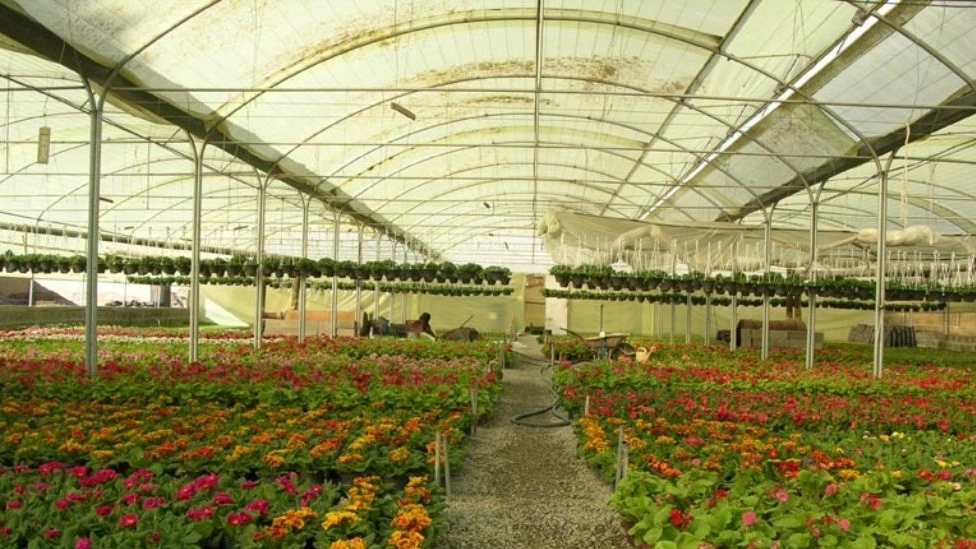
Types of Greenhouses in terms of application:
A) Teaching greenhouses: (Teaching greenhouse) The construction of educational greenhouses provides an opportunity for practical learning of important subjects for interns and students. The distance between rows of crops in educational greenhouses is more than other greenhouses. Also, these greenhouses are available to trainees in different seasons of the year. The covering used for the construction of educational greenhouses is generally made of glass or polycarbonate. b) Research greenhouses: (Research Greenhouse) Research greenhouses have 6 main goals: identification, conservation, chemical and genetic analysis, documentation of biological processes, scientific imaging and photography, recognition of pests and diseases in flowers and plants. Commercial Greenhouse: (Commercial Greenhouse) The main purpose of building a commercial greenhouse is to grow crops outside the production season, reduce costs, etc. Most commercial greenhouses are high-tech facilities specifically equipped to grow the desired crops. d) Hobby Greenhouse: (Hobby Greenhouse) The purpose of building recreational greenhouses is to maintain ornamental plants and grow home vegetables. The internal area of these greenhouses is smaller than other greenhouses.
greenhouse classification by appearance:
a) Peak greenhouses:
Peak greenhouses are one of the most popular and common types of greenhouse structures in areas where there is a lot of snow and rain. Their roof is in the form of a gable or similar to the English letter A. Due to the sloping and flat roofs, a lot of sunlight reaches the area. Generally, glass or plastic panels are used for the roof to build greenhouses. Rooftop greenhouses provide plenty of space for plants. Peak greenhouses are an excellent choice for plants grown in rows. Glass greenhouse is one of the types of summit greenhouses. The material of these greenhouses is generally tempered glass. Glass greenhouses are considered one of the most expensive and resistant types of greenhouses. The glass greenhouse has a long lifespan. It is more effective in cold and low-light areas and is resistant to strong winds, snow and rain. b) Tunnel greenhouses:
Other types of greenhouses include tunnel greenhouses. The dimensions of this structure are approximately 6 to 12 meters in width and 2 to 4 meters in height depending on the cultivation of crops, climate, region, etc. Due to the smaller size of the greenhouse, the tunnel greenhouse heats up faster than other greenhouses. to be Energy and fuel consumption is less in these greenhouses. Tunnel greenhouses are mostly used for growing apartment flowers, aloe vera and medicinal plants. The total price of this structure is lower than other types of greenhouses. Galvanized pipes are often used in the construction of tunnel greenhouses. c) Circular greenhouses:
Types of structures of circular greenhouses have an arched roof. Circular greenhouses are mostly built in tropical areas where the wind is strong. In circular greenhouses, most summer crops are cultivated. The resistance of these structures against wind, rain and snow is high. The cover of circular greenhouses is usually made of plastic.
d) Gothic (Spanish) greenhouses: The structure of Gothic greenhouses is a combination of peak and circular greenhouses. Its roof is arched and angular. The height of these structures is 6-12 meters and its width is 8-12 meters. The frame material of these greenhouses is made of galvanized pipes. The Gatik greenhouse structure is suitable for growing all kinds of greenhouse products that grow at a height (such as tomatoes, cucumbers). One of the features of the Gothic greenhouse structure is its resistance to wind, snow and rain. The special shape of this structure allows snow and rain to be directed down easily.
Greenhouse Flooring Based on its Gender
Plastic pipes are the least expensive material, but they lack the necessary strength for a large structure.
Wood is a good thermal insulator, which is important in cold climates.
Metal pipes (aluminum or steel) are durable and long-lasting, but they are not good insulators. Especially aluminum.
Large greenhouses often have glass walls and ceilings with proper insulation. But clear polycarbonate, acrylic, and fiberglass also work, especially for smaller structures.
Glass is a traditional greenhouse material. It is expensive, difficult to install and prone to cracking. But it insulates well, has the best appearance and transmits light in the best way.
Acrylic is also expensive, but it is durable and, unlike glass, it can be bent and shaped (to a degree) to accommodate a curved frame.
Polycarbonate is a strong and lightweight material. It is lightweight and cost-effective compared to glass and acrylic. It is available as a flexible sheet and tends to emit light rather than transmit light directly. Fiberglass is the least expensive greenhouse material. It works well in extreme weather and is almost as clear as glass when new. But over time, it turns yellow and reduces light transmission.