




- Shokul
- Iron bar and Wooden Kari >
- bucket
- shovel
Many advances have been made since the initial use of cement in various industries. Cement is used to help separate areas and provide protection for some coatings. Basically, this construction of cement mortar can be divided into two major mechanical or chemical groups. The facility of mechanical cement production has been made in the updating of equipment, tooling, coating and many other accessories.
Chemical advances include many special additives for cement to control fluid loss, grout weight, setting time. And thickening, air circulation is lost and other properties of the slurry are important for improving cement works.
What is cement?
Cement is generally a sticky material, which in a narrower sense is a binding material used in building and civil engineering constructions. These types of cements are finely ground powders that turn into a hard mass after mixing with water. Setting and hardening results from hydration, which is a chemical combination of cement compounds with water that produces submicroscopic crystals or gel-like materials with a high surface area. Construction cements that harden even under water are often called hydraulic cements because of their hydration properties.
One of the latest developments in materials is the use of The use of friction reducing additives in cement. These chemicals apparently reduce the strength of the slurry and allow turbulent flow at lower pumping rates and pressures than conventional slurries. This action is eliminated in step 1,2,3.
It is better to use the flowable mortar from the throat during cementing to avoid the coating and the holes that are formed, which makes complete uniformity possible easily. More recent mechanical advances include the introduction of sonic logging techniques to evaluate cementing results in terms of bonding at pipes and cement formation interfaces. Many questions have been raised about these reports, as several factors affect their correct interpretation.
Cement applications
Cement may be used alone (i.e. as an injection material), but there is also a common use. Concrete mortar in which cement is mixed with inert materials called as The whole cement mortar mixed with sand or crushed stone and its size should be less than 5 mm (0.2 in).
Concrete is a mixture of cement, sand or other fine aggregates and coarse aggregates used for most Its size ranges from 19 to 25 mm (0.75 to 1 inch), but coarse aggregate may be as large as 150 mm.
When concrete is placed in large masses such as dams, it is possible It can reach 6 inches. Mortar is used to stick bricks, blocks and stones in walls or as a surface coating. Concrete is used for various construction purposes.
A mixture of soil and cement is used as the foundation of construction. Cement is also used in making bricks, tiles, shingles, pipes, beams, railway ties and various products. Prefabricated products are supplied in factories and ready for installation. Making cement is very widespread, because concrete is the most widely used of all building materials in the world today.
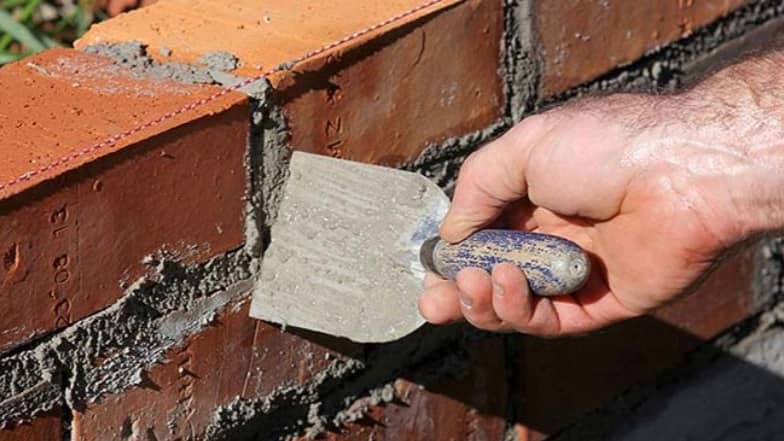
Appliances required for cement
The steps of cementing and its implementation
It is better to start the cement work first to make sure that the surface you are looking for is completely smooth. In the first stage, the smoothness of the lower surface will make you have a smooth surface at the end of the work. This work is very important to make the final cement more beautiful and clean. In the second stage, with the help of a plumb line, the master will start the cement work, the plumb will prevent the work from falling off at the time of completion. Hang the cement on the wall, then start cementing the gap between the string and the wall. After completing the wall between the two chromes, he cemented it again. In the third step, after making sure that the crowns are dry, it is better to prepare the desired mortar using soft sand, water and cement. The next step or the fourth step is lining. Lining is a well-known word among the general public. Streakshi basically refers to a thin layer of cement spread on the wall, which caused all the seams to be covered. The last step is to draw the cement layer again. It is enough for you to use all your precision in the second step of cementing. With sufficient care in this step, you will have a smooth and perfect wall after finishing the work.
Published on:Behzi
Zahra Motaghi
Post Author
2372Post
View PageYour reviews and experiences
What do you think?
Help us create better content by submitting your rating.