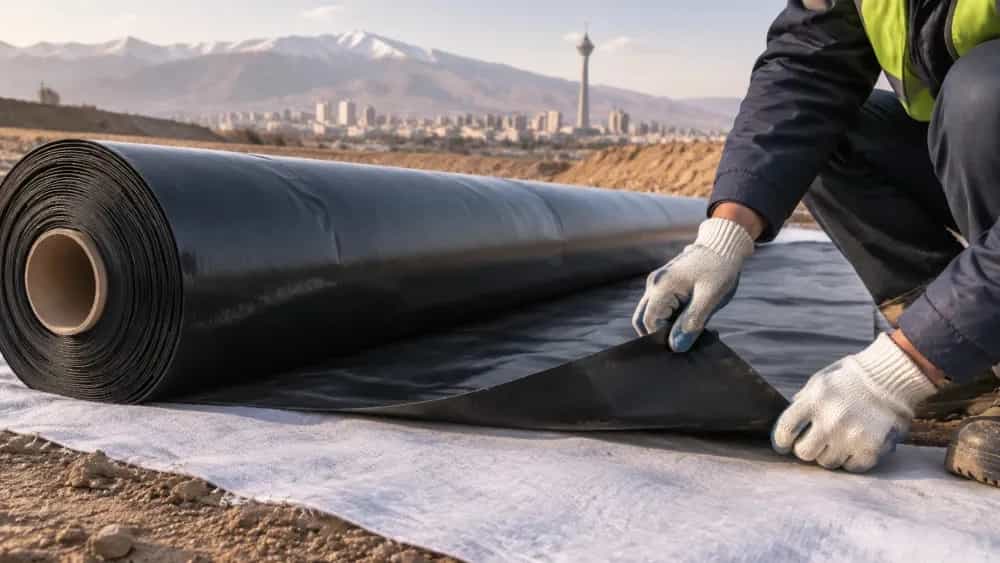

Two price offers for a waterproofing project in Tehran are on the table. Both are apparently for "geomembrane sheets", but one has a specific thickness and material, and the other only one per square meter. The price difference is tempting; The problem is that until the sheet type, geotextile specifications, quality documents and delivery conditions are clear, these two offers are not really comparable.
In selling and distribution of geomembrane sheet, geotextile and geosynthetic products in Tehran, the right choice starts from defining the function of the product, not from asking for the cheapest price. A sheet that is supposed to prevent the passage of fluid, a cloth that should separate soil from stone materials, and a product that is used for drainage or reinforcement, do not have the same purchase criteria.
To choose geosynthetics, what should we determine first?
The first question is what the product should do in the project: sealing, separation, filtration, drainage or reinforcement. After this role is determined, the material, technical specifications, required quantity and price can be compared with similar offers.
For example, "a roll of geotextile" without information about texture type, mechanical properties, and filtration characteristics is not a sufficient description for a technical decision. In the same way, when inquiring about the geomembrane sheet, it should be clear what polymer, what thickness and what type of surface we are talking about.
What variables change price and performance?
Geomembrane sheet price, geotextile price, and geosynthetic product price make sense when specifications are comparable. Differences in material, thickness, performance properties, and delivery requirements can turn two seemingly similar prefactors into two completely different offers.
Material and characteristics of geomembrane sheet
In querying geomembranes, the product name alone is not enough; The type of polymer, nominal thickness and smooth or textured surface should be specified. The final choice should also be compatible with the conditions of contact with the fluid, slope, substrate and project execution plan.
For HDPE geomembranes, the GRI-GM13 specification defines test criteria and properties for smooth and textured sheets; The thickness range of this specification is 0.75 to 3 mm. This range does not mean that all thicknesses are suitable for all projects. In the evaluation of the offer, put the technical specifications sheet and quality control documents of the shipment next to the design requirements, not just next to the price per square meter.
Type and function of geotextile
For geotextiles, weight per unit area is only one of the purchasing information and does not alone prove the performance of the product. If the purpose is filtration or separation, the water passing characteristics, pore size and resistance required during implementation should also be considered.
For example, in a layer that is placed between fine-grained soil and stone materials, the product must be compatible with the conditions of the soil and water flow and withstand the stresses caused by the implementation of the upper layer. In the application of protection under or on geomembranes, the selection criteria can be different. The US Federal Highway Administration technical manual emphasizes that the selection of geotextile properties depends on performance and site conditions.
Product | Common Function | Required Information | price comparison error |
geomembrane sheet | creating a barrier layer to control fluid passage | polymer, thickness, surface type, roll dimensions and documents Quality | Comparison of sheets of different materials or thickness based on price per square meter |
Geotextile | Separation, filtration, protection or drainage, depending on design | Type of product, surface unit weight, mechanical properties and required hydraulic features | Selection only based on grammage |
Geogrid | Strengthening in applications Designed | Type of structure and tensile properties suitable for the design | Replacing it with isolation geotextile |
Drainage geocomposite | Assisting water transfer in a multilayer system | Drainage capacity under loading conditions and component specifications | Ignoring pressure on the product after installation |
This table is for the initial screening of proposals, not a substitute for approved project drawings and specifications. The different functions of geotextiles and geogrids and the importance of matching the properties to the application site are also described in the FHWA guide.
My field experience: mistakes that increase the purchase cost
In my experience, the most costly mistake in reviewing a supply request is to compare prices before agreeing to technical specifications. The next mistake is to check the quality of the product upon delivery, but leave the quality of the substrate, connections and implementation to an unknown stage.
I, Arman Gudarzi, looking at the inquiries from the field of work of Fidar Coating Company, I suggest that before discussing the price, three issues should be clarified on one sheet: what exactly is the function of the product, what documents are required to match it with the order, and who controls the quality of the execution. This arrangement helps not to mix the technical discussion with the price discussion.
- Do not confuse the required square meter with the orderable square meter. Roll dimensions, cutting pattern and placement map can affect the order quantity; The final amount should be obtained from the execution plan and actual workshop conditions.
- For geotextiles, don't just ask for grammage. The product that is supposed to act as a filter should be checked for hydraulic properties and soil compatibility.
- For geomembranes, don't consider safe delivery the end of quality control. Substrate, how to spread the sheet, seams and connection control tests are part of the final performance of the system. are.
The EPA technical guide also emphasizes sheet inspection after shipping, substrate preparation, quality control documentation, and inspection of executed connections. Therefore, even a product with the right specifications is not the answer to the project without a controlled implementation.
Inquiry and delivery roadmap for Tehran projects
To get a reliable quote, convert the technical information of the project into a short and uniform request description and send it to all suppliers. Then put the prices together only after matching the specifications, quantity, documents and delivery terms.
- Define function: Specify whether the purpose is sealing, protection, isolation, filtration, drainage, or reinforcement. If several functions are required, name the layers separately in the map and inquiry.
- Provide the project conditions: Write the delivery location in Tehran, dimensions or scope map, bed condition, contact conditions with water or fluid and required time. The final choice of thickness or type of product must be made with the opinion of the project designer.
- Ask for the same specifications of each item: for geomembrane, polymer, thickness and type of surface; For geotextiles, type and performance-related characteristics; And for other geosynthetic products, request the properties defined in the plan.
- Match the documents to the product: The specification sheet and quality control documents should be relevant to the proposed product. During delivery, the roll label and possible damage caused by transportation should be checked.
- Clarify the boundary of supply and implementation: In the pre-invoice, it should be clear how the cost of transportation, unloading, installation, connection, tests, and possible deviations are calculated. If installation is not part of the proposal, record it separately for project planning.
In a conversation with Fidar Ferin Covering Company, the same description of the request can be the starting point for examining the supply of geomembrane sheets, geotextiles and other geosynthetic products for Tehran projects; Without the price of an uncertain product being the basis of the decision.
summary
If I were to suggest a criterion for purchase, that criterion would be "the price of the product suitable for the specified function", not the lowest price of a general title. Clear technical specifications, applicable documents and strict demarcation of supply and execution make the decision for the project more defensible.
I, Arman Gudarzi, suggest that you put together a map or description of the application, the desired specifications and the delivery location of the project in Tehran before the final inquiry. With this information, the conversation about supply at Fidar Ferin Covering Company can start with the right question: "Which product is compatible with the needs of this project?"
همین حالا تماس بگیرید!
پاسخ فوری و مشاوره رایگان در انتظار شماست.