
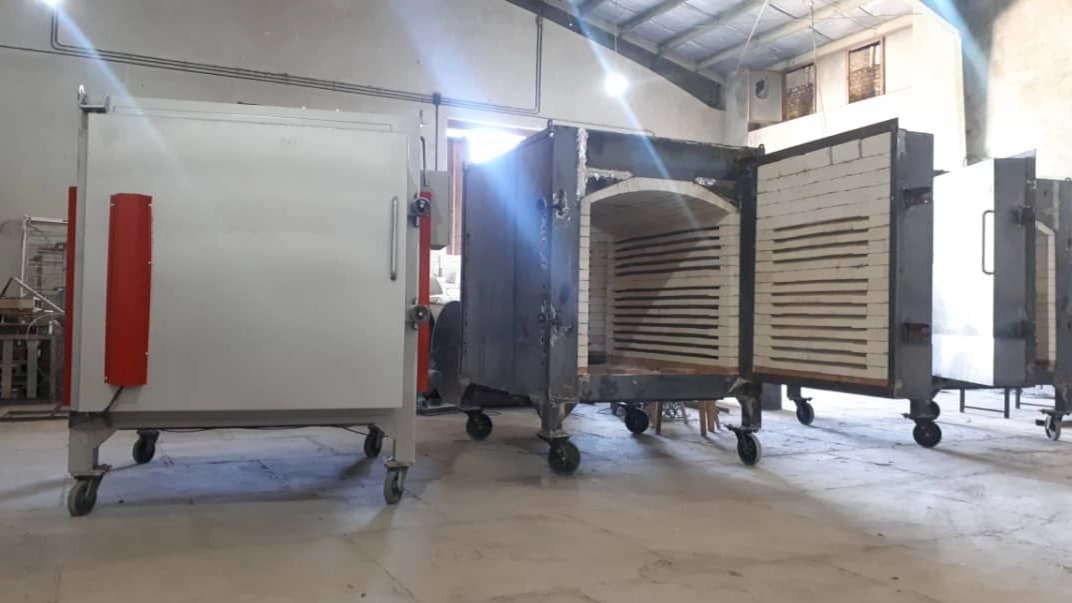
There are different types of kilns used in the pottery and ceramics industry, such as tunnel kilns, traditional kilns, cylindrical kilns, laboratory kilns, etc., but the kilns that are used for pottery in a small workshop and not an industrial workshop are like this. :
Box kilns: Box kilns, whose door opens from above like a chest, have more space, but it is more difficult to put and remove pottery in it.
Refrigerated ovens: Refrigerator ovens are ovens whose door opens from the front like a cupboard or a refrigerator. The inner space of these furnaces is matched with the base and stone plates, and these floors are removable. Also, all points inside the furnace are accessible, so it is easier to fill and empty it.
Gas or electric furnace
The furnaces that work with electricity are more suitable for home or workshops with little work, because they can turn on the furnace by just pressing a button on a digital screen. Turn off, turn on and even adjust. There are single-phase, two-phase, and three-phase electric furnaces, which depends on the amount of heat required and the electric meter you use.
Custom or Ready Furnace
The unit of oven capacity is liter, and ready-made ovens are available from 110 liters up. To get a better idea of the size of a 110 liter oven, consider a 40x50x50 cube. These dimensions include the length, width and depth of the oven. In fact, about 26 15 cm plates are placed inside a 110 liter oven. If you have a furnace with specific dimensions in mind, you can order it. There are reputable companies that can prepare your furnace.
The difference between enamel and baking body
There are two types of baking for pottery, one is body baking (or biscuit baking) and the other is glaze baking. Biscuits are of two types, clay bodies and white bodies or ceramics that are mostly used in China, Japan and Europe. For firing clay bodies, a temperature of about 900 degrees is needed, and for firing ceramics, a temperature of about 1000 degrees is needed, which usually all furnaces cover this level.
There are some points in firing the glaze. If the glaze is on a clay body, it is baked at a temperature of 700 degrees and the color will lighten, but if the glaze is on a white body, this temperature should also reach 1050 degrees. Glaze firing has a direct relationship with heat. For example, for firing glaze on ceramic bodies, one must be patient to reach the desired temperature because the temperature of 1050 must be advanced for a much longer period of time. This process of firing and removing the color of the glaze should take more than 10 hours to reach the desired result.Therefore, the glaze and enamel glaze require different ovens that They produce more heat.