
The importance of choosing the right brick in the construction process
Pressed brick: the myth of resistance and traditional use
The production process of pressed brick and its distinctive features
The production of pressed bricks begins with the extraction of clay. This soil must have a certain percentage of aluminosilicate material to obtain the necessary strength after baking. After preparation, the soil is injected into molds and compressed under hydraulic or mechanical pressure. The firing stage, which is carried out in traditional or industrial furnaces, is the final determinant of brick quality.
Compressive resistance is one of the most important characteristics of compressed brick. In optimal firing conditions, this brick can achieve acceptable compressive strength, which makes it suitable for load-bearing walls and structures that need to bear heavy loads.
Key features of pressed brick:
- High compressive strength: Suitable for main walls and foundations (although today its use in foundations has decreased).
- Suitable density: High density that leads to reduced porosity and increased resistance.
- Standard dimensions: Although it may have more tolerances than modern bricks, it is accepted in traditional projects.
- Uniform baked color: indicates complete baking and reaching the desired oven temperature.
In traditional construction, pressed brick is still used due to its easy availability and relatively lower cost than some other materials, especially in interior wall coverings and facades that require secondary facades.
3-flower brick: innovation in reducing weight and improving insulation
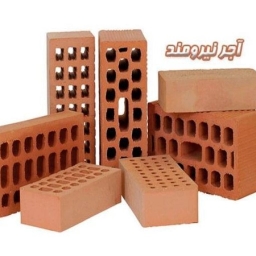
3 flower brick, named because of the presence of three large holes in its internal structure, is an example of evolution in the design of wall bricks. This intelligent design is aimed at improving the thermal performance and reducing the total weight of the structure.
The difference between 3-wall brick and pressure brick: focusing on insulation
The main difference between 3-flower brick and pressure brick lies in their internal structure. The holes in the 3-flower brick (sometimes arranged in triples) create voids that effectively reduce heat transfer. This issue is a great competitive advantage in areas with extreme temperature fluctuations or areas that need to save energy.
The air trapped in these cavities also improves the sound insulation performance. While pressure brick is a better sound insulation due to its high density, 3-flower brick creates a balance between structural strength and insulation.
Main applications of 3 flower bricks in construction:
The quality of baking 3 flower bricks is also very important. Improperly fired brick, even with voids, may be vulnerable to moisture.
The role of strong brick in Isfahan: quality assurance and sustainable supply
Isfahan, as one of the historical and industrial centers of brick production in Iran, has always been the cradle of quality brick production. The brick factories in this region have been able to produce products that meet national and international standards by using high-quality clay and using up-to-date technologies.
The collection of "Strong Bricks in Isfahan" is one of the pioneers in this industry, which focuses on the production of bricks with high strength and precise technical specifications. Our focus is on the durability and economic efficiency of the products, so that builders can use their materials with complete confidence. We understand very well that the success of a construction project begins with the quality of the primary materials.
Why "strong brick in Isfahan"?
- Strict quality control: Our production process includes repeated tests on raw materials and finished products (including compressive strength and water absorption test).
- Product diversity: Offering a wide range of bricks, including classic compression brick and various perforated bricks such as 3 flower brick.
- Timely supply: Strategic location in Isfahan and a wide distribution network enable fast and reliable delivery to projects all over the country.
- Expertise in strong bricks: We focus on the production of bricks whose name proves their strength and durability.
Introducing the key products offered by Ajar Niromand
To cover the diverse needs of modern construction projects, our collection offers a complete portfolio of brick products, each designed for a specific application.
1. Strong pressure brick
This product is a faithful replication of traditional quality, but with more careful monitoring of the baking process and dimensional tolerance. This pressure brick is an ideal option for retaining walls, interior panels that require high strength, or as an underlay material. The high resistance of this brick against erosion makes it suitable for harsh construction environments.
2. Standard 3 flower brick
As mentioned before, our 3 flower brick is produced with high precision to maintain the optimal ratio of porosity and strength. These bricks help to reduce construction time and improve thermal insulation.
3. Roof blade brick (block blade)
In the construction of block beam roofs, it is necessary to use light and resistant bricks. The roof blade brick produced by us, with suitable weight and sufficient strength to withstand concreting and execution phase loads, acts as an important structural element in concrete slab roofs. Reducing the weight of the roof directly affects the reduction of the dead load of the entire structure and thus reducing the dimensions required for the foundation.
4. Lefton brick with 10 holes
Lefton brick has a very high strength-to-weight ratio due to having many holes (usually 10 holes along its length). These bricks are very popular due to their beauty after installation as well as suitable thermal and acoustic properties. Lefton 10-hole brick is very suitable for external and internal walls that need a final look. The holes allow the mortar to bond better to the brick body and increase structural integrity.
Important technical parameters in the evaluation of brick quality
To ensure the quality of the product you use in construction, you need to pay attention to some key technical parameters. These parameters are continuously monitored in the quality control laboratories of "Ajar Niromand in Isfahan".
Compressive strength (R)
This parameter, usually expressed in megapascals (MPa) or kilograms per square centimeter ((\text{kg/cm}^2)), indicates the brick's ability to withstand a load without crushing.
[ R_{\text{brick}} = \frac{F_{\text{final}}}{A_{\text{surface}}} ]
where (F_{\text{final}}) is the final applied force and (A_{\text{area}}) is the area of the contact surface. For a standard compression brick, this number should be above 15 MPa, while blade bricks may have less strength but are still adequate for their role due to load distribution.
Water absorption (W)
The percentage of water absorption has a direct relationship with the durability of bricks against frost and environmental factors. Bricks with less water absorption usually show more resistance to freeze and moisture cycles. High quality bricks should not absorb more than 15% of their dry weight. 3 flower brick due to having holes, must be carefully controlled during production to minimize surface water absorption.
Dimensional homogeneity and tolerances
The lack of uniformity in the dimensions of the bricks causes many seams between them. This not only reduces the beauty of the work, but also increases the need for more mortar and affects the final strength of the wall. We at "Ajar Niromand in Isfahan" try to maintain dimensional tolerances within the standard range to ensure the speed and quality of construction operations.
The role of bricks in sustainability and green building architecture
In today's world, the concept of sustainable construction has become a necessity. Bricks have significant sustainability benefits, especially if they are made from local raw materials such as Isfahan clay.
First, the very long life of bricks means less need for frequent renovation and replacement of materials. Second, many traditional bricks, such as pressed bricks, are recyclable. Thirdly, good thermal performance (especially in the case of 3-flower brick) effectively reduces the heating and cooling energy consumption of the building.
Using indigenous materials such as bricks shortens the supply chain and minimizes the carbon impact of transportation. "Niromand Brick in Isfahan" is committed to complying with these principles in its production.
The correct techniques of using bricks in the building: from mortar to strapping
Irrespective of the high quality of pressure brick or 3 flower brick, poor execution can waste the entire quality production effort. Choosing the right mortar and the correct execution method guarantees the correct transfer of forces from the brick to the entire structure.
Choosing the right mortar
Mortar should be selected according to the type of brick and environmental conditions. For bricks with high water absorption (such as some traditional pressed bricks), using mortar with a finer grain size and a slightly higher percentage of cement can help with better adhesion. For perforated bricks such as Lefton 10-hole brick, it should be ensured that the holes are completely filled in areas that need to be filled (such as load-bearing walls).
Impregnation of bricks (moistening)
One of the common mistakes in construction is that the bricks are dry when laying them. Dry bricks quickly absorb mortar water and this prevents complete hydration of cement and creates a weak bond between bricks and mortar. Therefore, before use, pressure brick and 3 flower brick should be moistened a little.
Basic strapping
Stringing or execution of seams should be done with the same depth and thickness. In the front walls, the accurate strapping not only creates visual beauty, but also prevents water from penetrating into the wall.
Economic review: long-term savings with quality bricks
At first glance, the price of a strong brick may seem a bit higher than the low grade bricks on the market. However, the economic evaluation should be done during the useful life of the structure.
Using quality bricks, especially bricks with high compressive strength and low water absorption (such as our first-class compression brick), means reduced future costs due to cracking, sagging, and the need for re-insulation. In fact, the difference in the initial price will be compensated by savings in repairs over many years.
For example, 3-flower brick directly reduces occupants' energy costs due to improved thermal insulation, which is a direct and ongoing savings in building operating costs. This intelligent approach is the basis of the philosophy of "strong brick in Isfahan".
The future perspective of bricks in modern construction
Despite the introduction of new materials, brick still holds its place, because no other material has been able to simultaneously offer the three characteristics of historical durability, excellent resistance and natural beauty. The future focus of the brick industry in Isfahan will be on increasing energy efficiency in kilns and producing smarter bricks with higher insulation properties. We are doing research and development to improve our products including Lefton 10 hole brick and Roof blade brick to always remain at the forefront of this industry.
Finally, for any construction project that needs to ensure the strength and quality of materials, contact "Ajar Niromand in Isfahan"