
جهت کسب اطلاعات بیشتر تماس بگیرید.
A commemorative coin may look impressive the day it is delivered, but months later the edges may be discolored or the fine writing hard to read. This concern is familiar to the customers of Tehran: it is not possible to know how long the final product will last from the initial image. The root of the problem often lies in the inconsistent choice of design, metal, manufacturing method and surface finish, not just the appearance of the coin. In order to produce lasting coins, these four decisions must be reviewed together before making the mold and the final circulation.
What exactly are the characteristics of a durable coin?
A lasting coin is a coin whose design remains legible and its material and finish are compatible with the way it is used and maintained. Durability does not mean that the appearance of the metal does not change at all; It means that the product for the defined application maintains an acceptable quality over time.
Before any decision, it should be clear whether the coin is intended to be an organizational memento, a special gift, a membership badge, or a customized collector's item. A coin that is moved in the hand every day does not necessarily need the same treatment and packaging as the sample that will be kept inside the frame.
In this article, coin production means making custom commemorative pieces; Not minting currency or recreating historical coinage. This distinction is important, because the custom coin design and pricing criteria are different from the old coin buying and selling market.
What factors determine the quality of making metal coins?
The quality of a metal coin is not the result of a single choice, such as "more expensive metal". A design that is not prepared for small dimensions, even with a suitable mold and finish, may not look good in the real sample.
What is the effect of design and format on the result?
The details of the design should be recognizable in the actual size of the coin. Very small text, lines that are too close, and shallow bumps may not retain the sharpness they have on the screen after rendering.
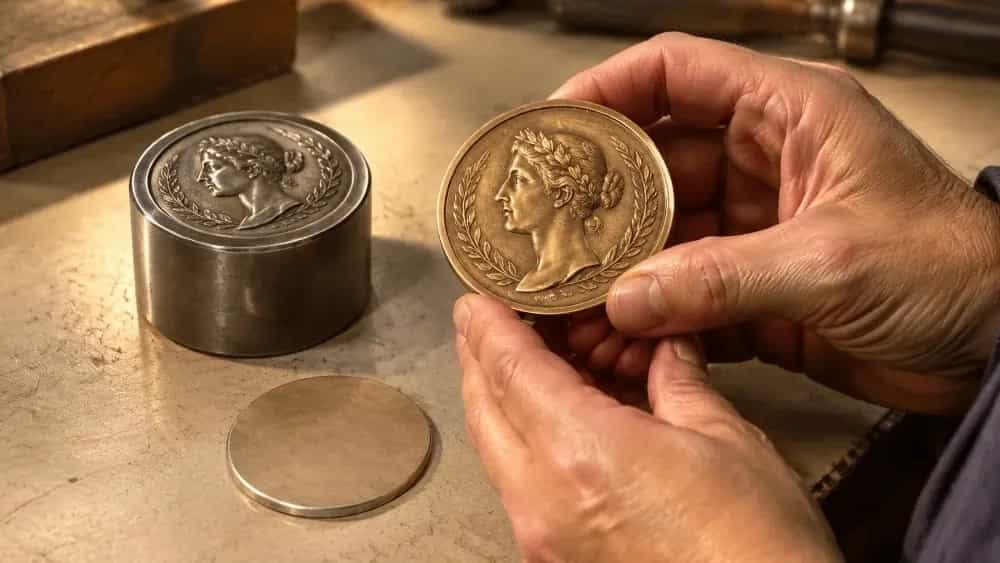
For this reason, the approval of the graphic file is not the end of the design. One should see the physical sample under normal light, check the legibility of the writings and touch the edges and ridges by hand. In the process of minting coins, preparing the design, the raw metal piece and the minting molds, the steps are interdependent.
What is the difference between metal material and surface finish?
The type of metal affects the weight, the feeling of the piece in the hand, the appearance and the choice of the finishing method. The final payment should also be selected according to the amount of hand contact, packaging method and storage environment.
For example, the glossy appearance in the initial photo may be attractive, but if the surface of the product is touched a lot, the appearance of fingerprints and fine lines should also be considered in the final selection. Regarding protective coatings, it is better to specify the type of coating and its test criteria instead of the vague promise of "anti-corrosion". The standard related to salt spray test methods examines corrosion resistance and some coating defects; However, the result of this test alone does not predict the actual life of the product.
Selection in the order | The main advantage | A point to check before approval |
|---|---|---|
Design with simple lines and prominence Specific | Better readability in small dimensions | The appearance of a real sample, not just a digital image |
Design with very fine writing and details | Possibility to display More info | Risk of fading detail in final sample |
Glossy finish | Dimensioning effect when presenting | Visibility of contact and line effect Surfaces |
matte or textured finish | a calmer appearance and the possibility of hiding some traces of contact | coordination with design and packaging details |
Protective packaging | Reducing direct contact during transportation and storage | Proportion of packaging material with the weight and dimensions of the coin |
Costly mistakes in ordering commemorative coins
The most costly mistake is approving circulation based on a nice picture without checking the actual sample. The second mistake is that the appearance of the delivery day takes the place of the durability and application criteria of the product.
I, Saeed Haghighi, when reviewing an order at Haghighi Industrial Group first ask this question: Is the coin going to be seen, touched or left in the packaging for a long time? The answer changes the way decisions are made about design details, payment and packaging. In orders related to Tehran, access to a sample, the possibility of checking it in person and confirming it step by step is more reliable than guessing the result based on a photo.
The tip I recommend to the customer is this: Ask for the sample, not just the promise of quality. See the sample from several angles and under normal lighting; Check the edge, back of the coin and the smallest writing. If the durability of the coating is important to you, ask about the quality control method and the manufacturer's claim range. Even the standard corrosion tests do not give a definitive answer about the life of the product without the conditions of its use.
Another mistake is to confuse a newly minted commemorative coin with a historical coin. The price of old Iranian coins depends on factors such as authenticity, appearance, rarity and market demand; Therefore, the cost of making a custom coin is not a good basis for estimating the value of an old coin. The state of maintenance and surface damage are also important in the evaluation of collectible coins.
What is the roadmap for ordering and producing long-lasting coins?
The low-risk path starts from the definition of the application and continues with the approval of the physical sample, the final specification and then the circulation production. Every decision that is made clear before construction reduces the possibility of differences between the customer's mental image and the delivered product.
- Specify the use: Write down the occasion, audience, quantity required and the way the coin will be presented or stored.
- Ask for reviewable specifications: Record the diameter, thickness, material, color or finish, double-sided design, edge type and packaging in the order description.
- Review the design in actual size: Don't just settle for the enlarged image on the screen; Measure text legibility and detail spacing.
- Approve the physical sample: Check color, weight, edge quality, bumps, and matching of the two sides of the coin before minting.
- Clarify the delivery criteria: Use the certified sample as a basis for comparison and agree on acceptable changes in appearance.
In Haqiq Industrial Group, the value of a technical discussion before the order is in the clarification of the criteria: the customer knows what he approves and the manufacturer knows for what conditions the product is made.
To study related topics, three key phrases suitable for internal linking are "custom metal coin manufacturing steps" for the production process page, "commemorative coin selection and payment guide" for the product guide page, and "guide to checking the price of old Iranian coins" for a separate page about historical coins. This separation helps the reader not confuse new product order information with old coin market information.
Summary and final view
Producing lasting coins starts with conscious selection, not just picking the shiniest specimen image. If the application, technical specifications and sample approval criteria are clear, the decision about the design and manufacturing method will be more accurate.
From my point of view, Saeed Haghigi, the main question before placing an order is not "Which coin is more beautiful?"; You should ask "Which design and construction is more suitable for our way of use?" If you have a plan for a commemorative coin in Tehran, start the conversation by explaining the usage and reviewing the actual example.