
⚫️ What is the meaning of battery recycling?
Reusing and reprocessing batteries aims to reduce the number of batteries as material waste. Batteries contain several toxic chemicals and heavy metals, and release into nature has attracted environmental concerns due to water and soil pollution. For this reason, batteries need to be recycled to meet environmental and health benefits.
Recycling old batteries reduces waste, and according to research, up to 99% of lead-acid batteries can be recycled. They also greatly reduce the need to use raw materials and new parts. Instead of keeping your old battery, make sure you recycle it when you buy or exchange it by taking it to a battery dealer.
Also, according to the type of job, car dealers should keep this point in mind and prioritize the recycling of their used batteries. When using or replacing your old battery, observe all safety measures.
⚫️ The necessity and importance of recycling of worn out battery
Despite all the uses and benefits that batteries have in industries, their toxicity and risks for human health and the environment are very high. Therefore, due to the presence of harmful and toxic substances, including various heavy metals, in the manufacture of batteries, it is very necessary to comply with health and environmental requirements and use up-to-date technologies in their collection and recycling processes.
The plates of the batteries are made of lead oxide, which turns into lead sulfate, which is very polluted, over time and repeated use and charging. Of course, at this time, in addition to lead sulfate, lead oxide accumulates at the bottom of the battery, at which time the battery loses its ability to charge and has the highest level of pollution and must be sent for recycling.
⚫️ Production of Lead Battery Recycling
Currently, the recycling of used lead batteries is done in two traditional and principled ways in the country, and experts believe that the principled methods should be improved by using new technologies and environmental principles.
Studies show that today about 60% of the total production of refined lead comes from supply lead mines and the remaining 40% comes from the recycling of scraps and slags from used batteries, which is one of the most important sources of obtaining pure lead all over the world.
⚫️ Worn Battery Recycling Method
According to the technical guidelines of the Basel Convention, the battery recycling process must be done in three stages; Breaking batteries, lead recovery and lead purification. In these methods, humans have the least contact with toxic substances inside the batteries at each stage, and the batteries are transferred to the shredders and other stages by automatic plates.
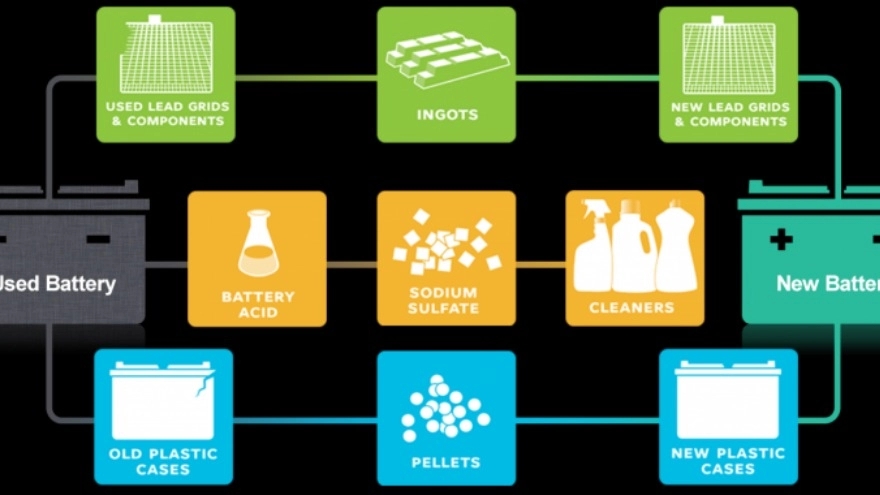
Battery parts are placed based on the density of the three layers; Light parts include plastics, followed by lead oxide and sulfates, and in the third layer, heavy lead plates and connectors. In the next stage, lead recovery is done and in the third stage, lead purification is done.
If the smelting workshop is for lead recovery, what is produced is hard lead or antimony, but if the purpose of the workshop is to produce pure lead, all other metals including copper, antimony, arsenic and tin are separated from lead.
< /p>
⚫️ How are the types of batteries recycled?
You may have asked if we are able to recycle all types of batteries? The answer is yes! But it should be said that recycling any type of battery is possible with its own method, and in this article we will briefly describe the method of recycling batteries. Stay with us to learn how to properly transfer different batteries to the recycling process, instead of sending them to the landfill.
First, the batteries are collected from different places and transported to the recycling place. The video below shows how to recycle a used battery simply, don't miss it.
⚫️ Recycling Lead Battery Recovery
After the batteries are collected, they are broken and crushed in a hammer mill, a machine that breaks the battery into smaller pieces. The broken battery parts are then placed in a tank, where the lead and heavy materials sink and the plastics float because they are lighter. At this stage, polypropylene parts are destroyed and liquids are removed, leaving lead and heavy metals. Each of these materials is placed in a different recycling circuit.
⚫️ Plastic Battery Battery
The polypropylene parts are washed, then dried and sent to a plastic recycling machine, where the parts are combined almost liquid. they melt Molten plastic is fed into an extruder, which produces small plastic pellets of uniform size. The pellets are put back into the battery and the cycle begins again.