

Dentistry is one of the oldest applied sciences that is as old as the life of a wise man on earth. Naturally, all humans have struggled with oral and dental problems since the beginning, and pulling loose and damaged teeth has been one of the major problems. Over time, the wise man realized that pulling teeth with tools such as tree fibers, thread, and cloth can reach his goal with minimal damage; Therefore, it was from here that the use of dental tools began. According to the documents that have been obtained, humans have been familiar with dental problems since 25,000 years ago and tried to solve these problems.
The first modern dental tools appeared after the industrial revolution in Europe in 1728, which were tools for pulling teeth. . The final evolution of these devices lasted until 1840, and finally, safe methods for doing this work were developed and taught to dental lovers. Since then, dental tools have undergone tremendous changes so that there are less oral and dental problems that dental tools do not have the ability to access and treat. In the following, we will get to know the names of some dental equipment.
Dental chair
Perhaps the first thing that attracts attention in any dental office is the dental chair. This chair is actually a part of the dental unit and is used to give the patient the right position during examination, treatment and restoration.
Dental lights
It is another dental tool that is very important in the accuracy of work. The space inside the mouth is very limited and it is difficult for the dentist to see the desired parts without tools, so a light with a specific lighting range is placed on the dental chair and makes this work easier for the dentist. It should be noted that the dental light is also a part of the unit.
Craft bowl
Doing dental procedures requires the comfort of the patient and keeping the patient's head steady. The back of the dental chair does this; But this is not enough. The patient, like any other person, has several salivary glands inside his mouth and it is necessary to empty his saliva during the dental procedure. Since the patient's head must remain still, it is necessary to remove the contents of the patient's mouth, including saliva, blood, or other secretions, using a suction device. These secretions are drained into a container next to the dental chair, which is called a crash bowl.
Monitor (Negatoscope)
Some professional dental units have a monitor and mouse to check OPG or other images of the patient, which is placed at a distance from the unit and the dentist can use it when necessary. This monitor is usually placed on the dentist's table or tablet.
Pedal
A dental instrument is an adjustment by means of which the position of the dental chair or the water pump and suction can be adjusted. Pedals may be wired or wirelessly connected to the unit. Wireless models are more portable and will make the work easier for the dentist.
The base or arm
The unit has one or more arms. The arm is placed in such a way that it distributes the weight of the unit equally at all points and creates the most balanced state. Also, the dental light is installed on the arm.
Dental desk (cable)
A tablet or table is placed next to the dental chair. This tablet has a number of buttons and operators (screen) that are used to better control the unit. It should be noted that dental instruments (such as turbine) are placed on this tablet, which are activated as soon as the dentist removes them from the tablet.
Assistant desk
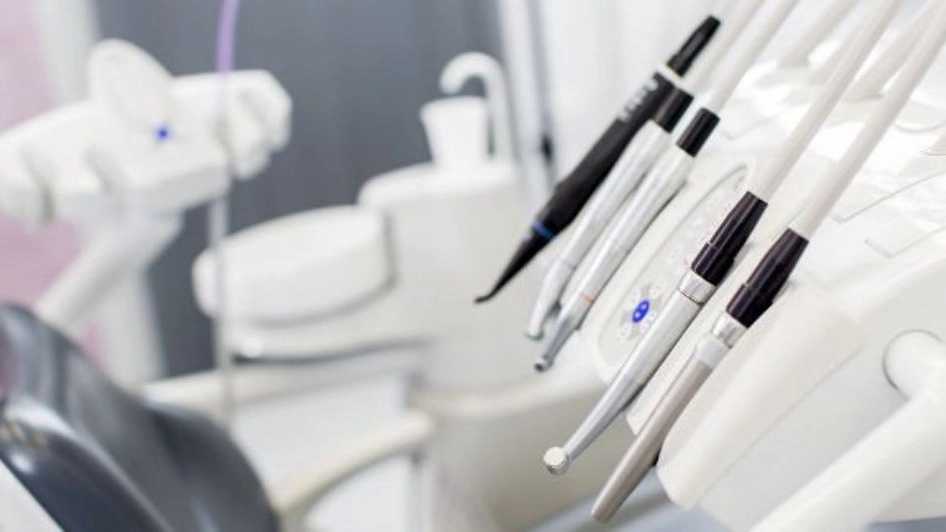
This part is placed next to the chair like the dentist's table and often has the same buttons as the tablet. This table may be fixed or portable. Holders for dental instruments such as handpieces and turbines are placed on this table, and the suction and turbine tubes pass through it.
Suction machine
Every dental clinic needs a suitable suction system for greater comfort for the patient and the dentist. Cheaper and older units have weaker suction systems that are mostly only suitable for saliva suction and have difficulty suctioning blood and other secretions. These suctions usually work based on air or water pressure and are known as saliva ejectors. If we want to remove more contents, it is better to use more advanced devices that are equipped with central suction. This type of suction has the ability to remove solid particles. Two types of series can be connected to the suction pipes in the head. The first type is called LVE, which is for emptying a small volume of liquids, and the second type is HVE, which removes materials with a larger volume from inside the mouth.
Box of Unit Floor (Floor Box)
This part of the unit is placed under the seat and the power supply and connections to the urban water and sewage network are made from this area. Also, in some cases, the pressure regulator is in the Floor Box.