

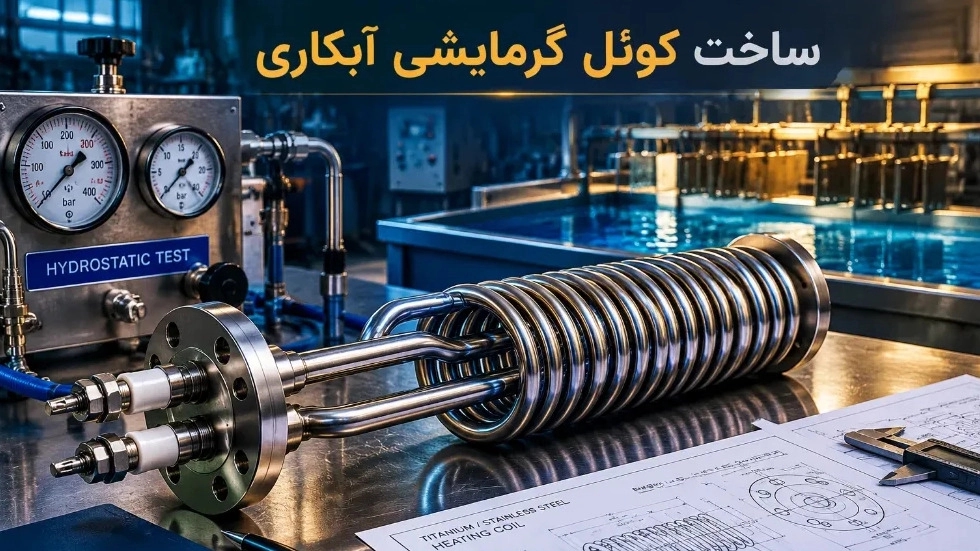
Making electroplating heating coil is one of the most important parts of designing and equipping electroplating lines and industrial chemical processes. Many baths for electroplating, degreasing, phosphating, washing and other surface processes require precise temperature control to achieve proper working conditions. In such a situation, a suitable plating heating coil should have sufficient resistance to the chemical conditions of the environment in addition to the optimal heat transfer.
The design and construction of this equipment is not limited to bending a few meters of pipe. Choosing the type of pipe, its diameter and thickness, calculating the heat transfer level, determining the heat capacity, choosing the connection method, how to install it in the tub, controlling the temperature and finally performing quality control tests, are all part of the professional process of making a plating heating coil.
In this article, we will examine the stages of electroplating heating coil construction, from the project requirement review and initial design to manufacturing, welding, quality control, and coil leakage testing, and at the end, we will get to know the services and capabilities of Farasanet Group.
What is a plating heating coil?
The electroplating heating coil is a tubular heat exchanger that is installed inside or near the process tub, and its function is to transfer heat from a hot fluid to the solution inside the tub.
The hot fluid can be hot water, thermal oil or steam depending on the system design. In different processes, the choice of fluid and heat transfer method should be done based on the required temperature, the nature of the solution, the capacity of the tank and the operating conditions.
In simple words, the hot fluid moves inside the coil and its heat is transferred to the solution inside the tub through the pipe wall. Therefore, the design quality of plating heating coil will have a direct effect on the heating speed, temperature uniformity and process stability.
Why is it important to make electroplating heating coil?
In many electroplating processes, temperature is one of the important parameters of the process. Temperature changes can affect the speed of chemical reactions, surface quality, coating uniformity and bath operating conditions.
For this reason, using an unbalanced coil can cause problems such as slow heating of the tub, creating hot spots, excessive energy consumption or premature corrosion of the equipment.
A plating heating coil that is designed and built in principle should be able to:
- Create proper heat transfer.
- Raise process temperature uniformly.
- Be resistant to chemical environment.
- Tolerate desired working pressure and temperature.
- Have proper maintenance and repair.
- Minimize the possibility of leakage.
As a result, making a plating heating coil should be an engineering process and appropriate to the actual conditions of the project.
The steps of making the electroplating heating coil
The construction of a standard industrial coil can be divided into several main steps. Each step plays an important role in the final quality of the equipment.
1. Checking the needs of the project
The first step in making a coil is to know exactly how to use it.
Before designing, information such as the following should be specified:
- Volume of the plating bath
- Type of solution inside the bath
- Working temperature
- Initial temperature of the solution
- Required temperature
- Time required for heating
- Type of heating fluid
- Working pressure
- Dimensions of the bath
- Usable space for coil
- Environmental corrosion conditions
This information is the basis of design calculations.
For example, a coil designed for a small hot tub will have different specifications than a coil used in a high-volume industrial tub with corrosive solutions.
2. Calculation of heat capacity
One of the most important steps of making a plating heating coil is calculating the capacity required for heat transfer.
In general, the energy required to heat a fluid depends on the mass of the fluid, its specific heat capacity and the required temperature difference.
The design of the coil surface should be done in such a way that the required heat capacity is provided, without making the equipment too large or expensive.
Choosing the right material for the electroplating coil
Choosing the type of pipe is one of the most sensitive steps in the making of the electroplating heating coil; Because the coil is usually located in an environment that may contain acidic, alkaline or other chemical compounds.
The type of coil should be selected based on the type of solution and working conditions. In different applications, materials such as stainless steel, titanium or other corrosion-resistant alloys may be used.
In harsh chemical environments, corrosion resistance is particularly important. Choosing the wrong material can reduce the life of the coil, create a hole and eventually leak hot fluid into the tub.
Therefore, in making a plating heating coil, you cannot make a decision based solely on the initial price of the tube; Rather, the compatibility of the material with the process solution should be a priority.
Choosing the diameter and thickness of the pipe
The diameter of the coil tube affects the flow rate, pressure drop and heat transfer level. The thickness should also be chosen according to pressure, temperature, pipe material and mechanical conditions.
Very thin pipe may not have enough resistance in inappropriate working conditions, and excessively thick pipe can also increase the cost of construction and thermal resistance.
For this reason, the choice of diameter and thickness in the making of the electroplating heating coil should be based on engineering calculations.
Design of the shape of the heating coil
After determining the main specifications, the coil geometry is designed.
The coil can be designed spirally, back and forth or according to the specific geometry of the tub. The main goal is that the appropriate surface of the coil is in contact with the solution and the heat transfer is as uniform as possible.
In the design, the distance between the rings, the radius of the bends, the path of fluid entry and exit, and holding points should also be considered.
A suitable design, in addition to increasing thermal efficiency, also simplifies the installation and removal of the coil for repairs.
Pipe bending in the coil making process
After the plan is determined, the pipes enter the bending stage.
Bending should be done with proper equipment to avoid crushing, cracking, excessive thickness reduction or undesirable deformation of the pipe.
In making electroplating heating coils the quality of the bends is very important; Because the bent points can become mechanical weak points in case of improper implementation.
Also, the bend radius should be selected according to the diameter and material of the pipe.
Welding and connecting coil sections
In some designs, the coil may consist of several parts that must be connected to each other. Welding quality is very important in this area.
Welds should be checked for appearance, proper penetration and absence of visible defects. Depending on the importance of the project and quality control requirements, non-destructive inspection methods can also be used.
Improper connection can be one of the most important causes of leakage during operation.
Connecting the input and output of the coil
The input and output connections should be designed in such a way that the coil can be connected to the heating network easily.
The location of these connections is also important; Because mechanical stress on the pipe should be avoided.
Also, in industrial design, it is better to have a way to go back and forth in such a way that it is possible to ventilate, drain and service the equipment.
Installing the coil in the plating bath
After construction, the coil should be installed inside the bathtub or in the designated place.
How to place the coil is very important. If a large part of the coil surface is outside the solution, part of the heat transfer capacity will remain unused.
On the other hand, the coil should not be installed in a way that interferes with parts, transmission system or other equipment inside the tub.
Therefore, in making a plating heating coil, the actual dimensions of the tub and its surrounding equipment should be included in the design from the beginning.
coil leakage test; An important stage of quality control
One of the most important steps after construction is the cooling leak test.
A leak in the electroplating coil can have serious consequences. If hot fluid enters the process bath, the composition of the solution may change and even damage the equipment and product.
For this reason, the pressure and sealing test must be done before the delivery of the equipment. In thermal equipment and converters, pressure tests are used to check integrity, connections and the possibility of leakage.
Hydrostatic coil test
In a common method, the coil is filled with suitable fluid and after removing the trapped air, it is subjected to test pressure.
Then the joints, welds and pipe body are checked for leakage and deformation.
The test pressure should be determined based on equipment design, working pressure, project requirements and technical instructions, and should not be arbitrarily considered a fixed number for all coils.
Visual inspection of connections
In addition to pressure testing, all connections should be visually inspected.
The presence of cracks, weld porosity, unusual deformation, or signs of corrosion can be a sign of a structural problem.
In sensitive projects, the use of non-destructive inspection methods can also help detect defects that are not visible to the naked eye.
Heating coil performance test
Leakage testing alone is not enough. After ensuring the sealing, the thermal performance of the coil should also be checked.
In performance testing, things like the following can be checked:
- Solution temperature rise speed
- Temperature uniformity
- Return path operation
- Pressure drop
- Connection condition
- Temperature control system operation
- Probability of creating hot spots
The goal is to determine that the coil, in addition to not leaking, also provides the expected thermal capacity.
Factors affecting the price of electroplating heating coil construction
The price of making a plating heating coil depends on various factors, and announcing the price without project specifications cannot be an accurate measure.
The most important factors are:
Pipe material
Using steel, titanium or other alloys will affect the final cost.
Coil dimensions and length
The higher the level of heat transfer required, the more the pipe and construction work will increase.
Pipe thickness
More thickness usually increases material consumption and construction cost.
Contacts type
The type of flange, connections, inlet and outlet and connection method also affect the price.
Design complexity
Coils that must be designed exactly to fit a specific tub may require more design and manufacturing time than simple models.
Testing and quality control
Pressure testing, welding inspection and other quality controls should also be considered according to the sensitivity level of the project.
The difference between a customized coil and a ready-made coil
One of the common questions is whether it is better to use a ready coil or to make a custom coil?
The answer depends on the conditions of the project.
If the tub dimensions, heat capacity and process conditions are standard and specific, a ready-made model may meet the need.
In custom design, the coil is designed based on the available space and the project's thermal needs, and it is possible to coordinate better with other line equipment.
Why is it important to choose the right manufacturer?
The construction of the coil is not only limited to providing the pipe and bending it. Design quality, manufacturing accuracy, material selection and final testing all affect the performance of the equipment.
For this reason, when ordering plating heating coil production, it is better to check the history of the manufacturer, custom design ability, manufacturing quality, testing facilities and technical services.
Professional manufacturer should get the process information and determine the coil specifications based on the actual needs of the project.
Manufacturing of electroplating heating coil by Far Sanat
Ura-Industry Focusing on designing and manufacturing industrial equipment, it can be an option to consider for groups looking to build heating coils suitable for plating lines and industrial processes.
In custom projects, technical specifications and working conditions are checked first. Then, based on the volume of the bath, the required temperature, the type of heating fluid, the chemical conditions of the solution and the installation space, the design of the coil is done.
One of the important points in the super-industry approach is to pay attention to the quality control stage after construction. The coil should be checked for sealing and connection health before operation to reduce the possibility of leakage during operation.
This issue is especially important in electroplating lines; Because repairing or replacing the coil after installation can stop a part of the production line.
What information is required to order coil manufacturing?
If you intend to order manufacturing of electroplating heating coil, it is better to provide the following information to the manufacturer:
- Bath volume
- Length, width and height of the bath
- Type of solution inside the bath
- Current temperature of the solution
- Desired temperature
- Duration of time for heating
- Type of heating fluid
- Temperature and pressure of hot fluid
- Suggested material or material limitation
- Dimensions of usable space for coil
- Type of inlet connection and Output
- Installation conditions and access for repairs
The more accurate this information is, the more accurate design and more economical choice of equipment will be possible.
Advantages of making custom heating coils
Using a custom coil can have several advantages:
- Coordination with the exact dimensions of the tub
- Possibility of choosing material suitable for the solution
- Better control of heat capacity
- Optimal use of the tub space
- Possibility of determining the exact location of the inlet and outlet
- Ability to design based on the actual conditions of the project
- Possibility of testing before delivery
As a result, for projects that have special conditions, making a custom electroplating heating coil can be a more practical solution than choosing a generic product.
summary
Manufacturing of electroplating heating coil from design to leakage test is a series of engineering and implementation steps that must be done carefully. Knowing the process conditions, calculating the heat capacity, choosing resistant material, determining the dimensions and geometry, bending, welding, installation and finally the leakage and performance test are all effective in the final quality of the coil.
A suitable plating heating coil, in addition to providing heat capacity, should also have an acceptable performance against the chemical and thermal conditions of the environment.
If your goal is to reduce line stoppages, increase process stability, and optimize energy use, choosing a manufacturer that can design and build according to the actual project conditions is very important.
Farasanat can provide a suitable solution to the production line conditions for electroplating heating coil construction projects, from the need and design phase to manufacturing and quality control.
To receive advice and initial estimate, providing information such as the volume of the tub, the type of solution, the working temperature, the type of heating fluid and the dimensions of the installation space can be a good starting point for designing a coil that fits the project.
