
What is Industrial Tutorials?
Industrial automation or robotization (Industrial Automation) means the use of control tools (for example, computers) instead of humans in order to guide and control industrial machines and production processes. Automation refers to the use of control systems (such as numerical control, programmable logic control, and other industrial control systems), mechanical and electronic with the help of computers to monitor (control) the production line, in which the goal is to reduce the need for intervention. It is human. Industrial-Automation
Automation literally means "controlling and guiding a device automatically". In today's industry, the goal of control is to reach the full meaning of the word automation, but for various reasons, this goal is not possible, and most of the time we have a semi-automatic system, where part of the control is done by the operator and part of it is done by the built-in control system.
Production process control
Information exchange between different parts of production
Establish control strategies in the factory
Creating an intermediary between the user and the controlled set
⚫️ Automating Systems Production Processes
Industrial automation system has two production processes which are
Continuous (divergent) processes such as refining, petrochemical, chemical, food, etc.
Discrete (convergent) processes such as automobiles, electronics, home appliances, etc.
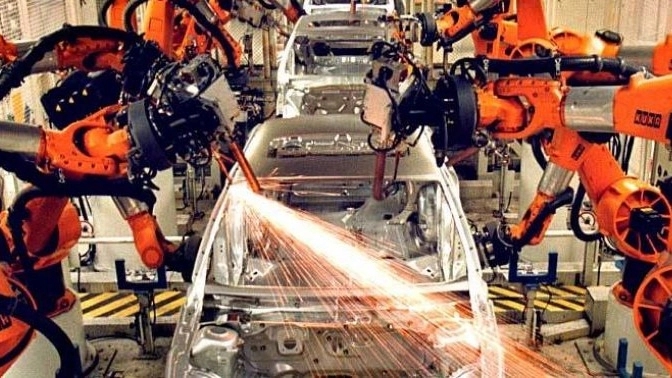
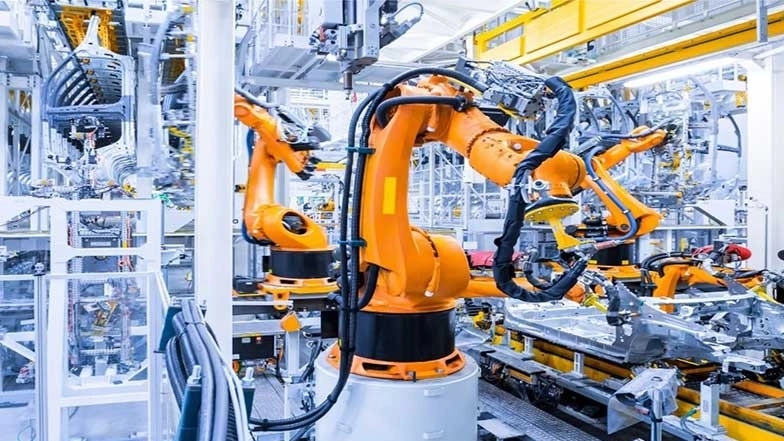
According to the type of product, the production process is divided into three parts: production, packaging and distribution, which is the most important part of the production process. Moving and cutting robots, from measuring the quality of raw materials, performing initial manufacturing operations on them to final product processing and final product control tests, are the constant foot of this sector in most production lines. But since all products and products need to be packaged at the end of the production process and factors such as ease of transportation, duration of use, health issues, etc. affect the quality of the product and its sales distribution, it requires the supervision of human resources. Is. The distribution department takes place from the time the products are placed in the trucks until the product is released in the stores. At this stage, the use of special loading robots and intelligent transportation lines is one of the most important achievements of automation in the distribution sector.
The industrial automation system plays an important role even in the management levels of production. This work is done by human machine interfaces (HMI) because in addition to controlling the system, it is easier to collect, coordinate information and display it at different management levels. It is possible to control the system remotely with the help of HMI.
⚫️ Control components in an industrial automation system
⚫️ Application of automation
Today, the application of industrial automation and precision tools is abundantly seen in various industries and industrial processes. Process control and complex measurement systems used in industries such as oil, gas, petrochemical, chemical industries, food industries, automotive industries, etc. require very accurate and sensitive instruments. Recent technical advances in process control and measurement of various industrial parameters such as pressure, temperature, flow, etc. have increased product quality and reduced production costs.
In general, some of the advantages of industrial automation are as follows:
- Repeatability of activities and processes
- Increasing the quality of manufactured products
- Increasing production speed (production quantity)
- More precise and faster quality control
- Reducing production waste (waste)
- Better interaction with trading systems
- Increasing productivity of industrial units
- Increasing the safety factor for the human force and reducing mental and physical pressure