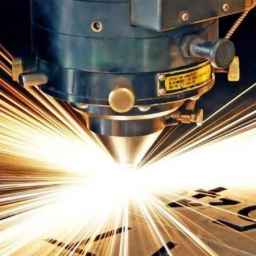

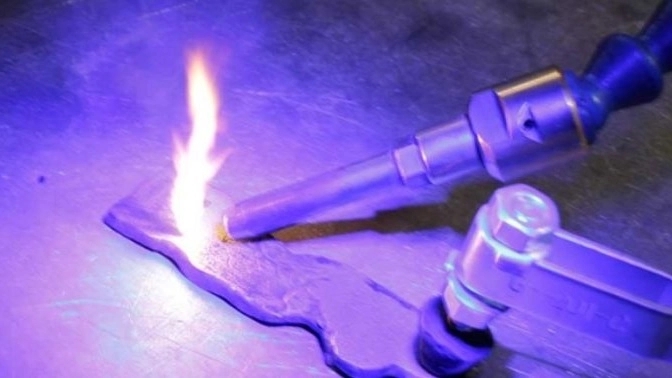
What is a Laser Welding and Cutting?
What is laser welding and cutting and why should we use laser beam welding? Laser stands for Light Amplification by Stimulated Emission of Radiation. A laser beam is a coherent (single phase) light of a single wavelength (monochromatic). The laser beam has low divergence and high energy, and therefore, when it hits a surface, it causes heat.
Laser beam welding is a non-contact technique in manufacturing by which two or more pieces of material (usually metal) are joined together through the use of a laser beam, and access to the weld area is sufficient for welding, and the parts are only welded from one side. Laser welding as an intense laser light quickly heats the material in milliseconds.
Why welding and laser cutting?
Laser beam welding energy transfer is different from electric arc welding processes. In laser welding, the absorption of energy by a material is influenced by many factors such as the type of laser, energy density, and surface conditions of the base metal.
Laser output is not electrical in nature and does not require an electrical current. This removes any effect of magnetism and does not limit the process to electrically conductive materials. Lasers can communicate with any material and do not require a vacuum and do not produce X-rays.
Laser welding operates in three different modes:
Conduction welding
Conduction/Penetration welding
Penetration welding (Keyhole or Penetration).
Guided welding
Conducted welds are performed with low energy and as a result, a shallow weld is created in the part. Conduction welding usually occurs when the compression power is typically less than 105W/cm2. The laser beam is only absorbed on the surface of the material and does not penetrate it. Usually, the width of guided welding is higher than its depth.
انواع اصلی لیزرهای مورد استفاده در جوشکاری و برش
In laser welding and cutting, different types of lasers are used, which are:
Gas Lasers:
In these lasers, a mixture of gases such as helium and nitrogen is used. Another type of laser is CO2 or carbon dioxide lasers, in which a mixture of high purity carbon dioxide and helium and nitrogen gas is used as an intermediate gas. In these lasers, a power source with high voltage and low current is used to stimulate the gas mixture in pulsed or continuous mode using a lasing medium.
Solid mode lasers:
(Nd: YAG and ruby lasers) operate both pulsed and continuous at a wavelength of 1 micrometer. The pulse action of joints is similar to spot welding but with full penetration. The pulse energy is 1 to 100 joules and the pulse time is 1 to 10 milliseconds.
Diode Lasers:
This laser is used for cases where welding areas are very small and difficult to access. For protection, intermittent gas is required.
History of laser welding
Einstein first proposed the quantum mechanical principles of lasers at the beginning of the 20th century.
1960: The first laser called ruby laser started working for the first time in 1960.
1970s: The first high-performance lasers were produced in the 1970s with the development of CO2 lasers. Applications for laser beams have evolved since then.
1980s: In this decade, laser soldering has become a popular method of joining electronic components through holes in printed circuit boards.
1987: Laser powder fusion process developed.
2002: Linde Gas Company in Germany produced a diode laser using process gases and "active gas components" to enhance the effects of "Key Holling" for laser welding, in which argon-CO2 gas increases the welding speed and adds The active gas changes the direction of the metal flow in the welding pool and creates a narrower and better quality weld.