
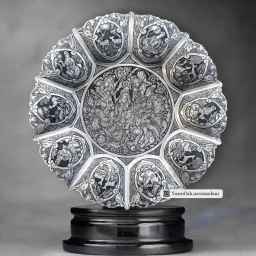

A brief history of Iran's calligraphy, the preparation and manufacture of silver objects and calligraphy on them have been prevalent in Iran since long ago. The history of calligraphy is attributed to the time of the Scythians or Sitites, who were of Aryan race.
The antiquity of the golden cup Hasanlu, which was discovered in 1336 and has prominent motifs such as gods riding chariots, dates back to the first millennium. Marlik gold cups are also among the writing works of the same period.
From the period of the Medes, which were used in Iran in the 7th century BC, there are few writing works left.
With the formation of the government The Achaemenid era also changed the art of calligraphy and influenced the period after it.
This period is actually in the middle of the art of metalwork, but due to the attack of Alexander and the burning of Persepolis, many works were destroyed
and by the order of Alexander, it was melted down and They were converted into coins.
During the time of the Sasanians, that is, in the years 224 to 650 AD, due to the expansion of trade between Iran,
Greece and Rome, the art of Iran was influenced by the art of Greece and Rome. The most common dishes of this period were trays
on which the Sassanians wrote pictures of hunting and kings' ceremonies such as giving gifts.
The art of brushing in the post -Islam period
In the early Islamic centuries, the Arabs imitated the art of calligraphy of the Sassanid period, and in the following centuries, due to the interest of Iranian artists in religion and their tendency towards Islam, influenced by the beliefs of Islam, the motifs of native and mythological Iranian designs gradually replaced them. He gave himself to Kufi lines, verses and hadiths.
The background of the brush
Silver engraving on metals reached its peak of prosperity and perfection in the Safavid period. In this period, all kinds of tangs and engraved bowls became common. Also, in this period, Nastaliq and Thulut lines were used in writing.
Types of brushing styles
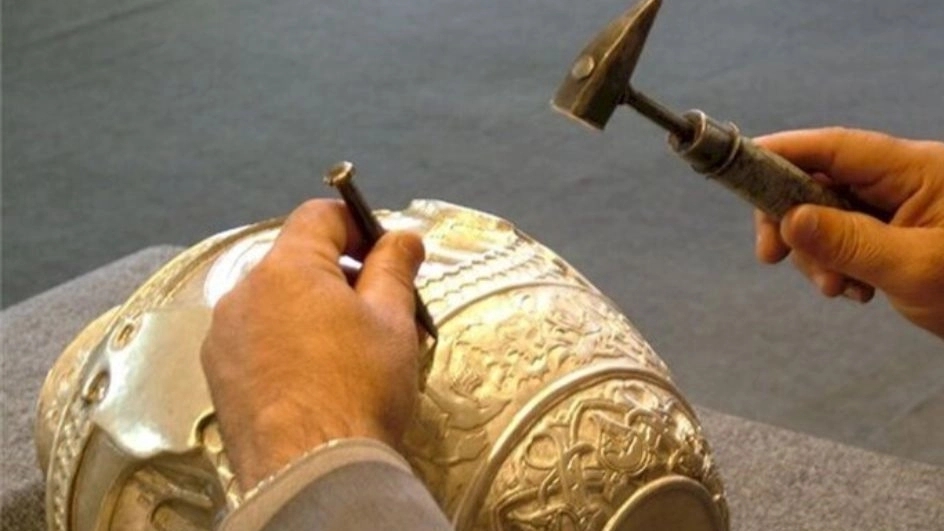
In this type of inking, the back of the work is first tarred, then the design is carbonized on the work, and the design is stabilized by using a pen. After the design is fixed, the bitumen is removed from the back of the work and this time the processed surface is coated with bitumen and the container is highlighted by the pens that include corner, floor, flat floor, etc.
Half-cut lines On the back of the work, there is a guide for the painting process. After the embossing process is done, the bitumen is returned to the first side and at this stage, paving and foundation work is done.
2 . Semi-embossing
In this writing, instead of using embossing pens, normal pens are used, and instead of highlighting the work from the back, they lower the base so much that the processing level to appear.
3. Fine drawing
In this method, the work is designed after being bitumen, and then it is half-cut and paved and the base is not raised, and more designs of flowers and slime chickens are used.
p>
4. Engraving
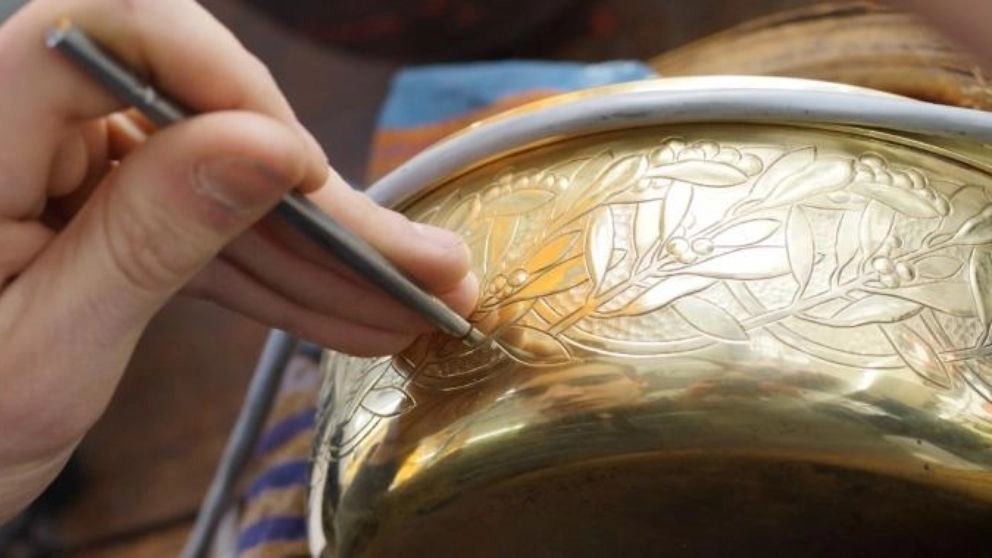
In this method of work, instead of using several pens, only one pen is used and this pen performs the act of engraving. In fact, in this type of pen cutting, the flesh of the metal is removed using a sharp pen.
5. Reticulation
In this method, instead of applying a base like a brush or embossing, the base is separated from the metal surface. This method was usually used in the old days to make lantern lights and places where water is supposed to pass through them.