



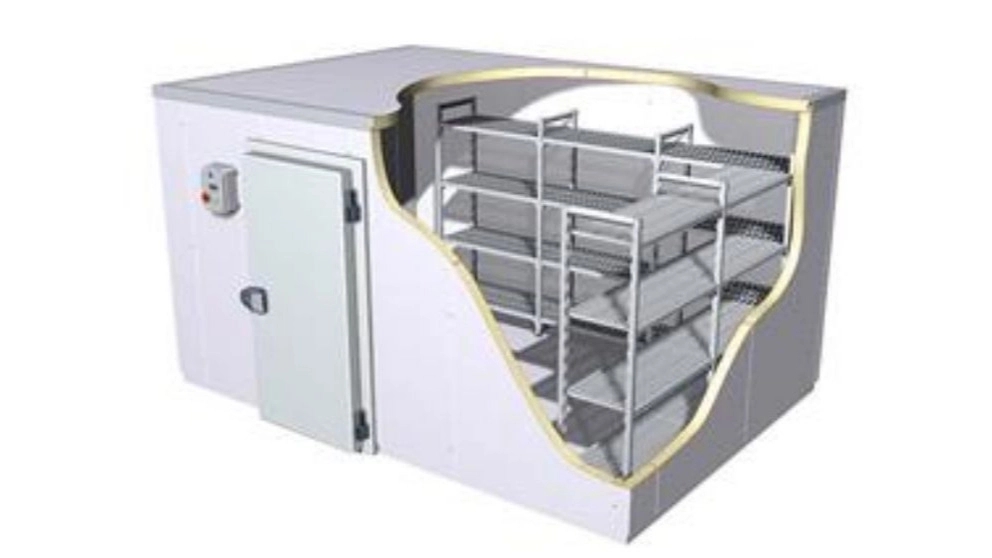
The chiller is used as a refrigeration system for food, fruit, vegetables, pharmaceutical, industrial, laboratory, corpses, etc. The cold room chiller device consists of a number of external units (installed outside the building, which is also called condensing) and a number of internal units (evaporators or fan coils installed inside the cold room) which are connected by piping. is In the following, we will discuss the types and features of chillers and condensing units.
Types of refrigerator chillers and their features:
1. Condensing Unit
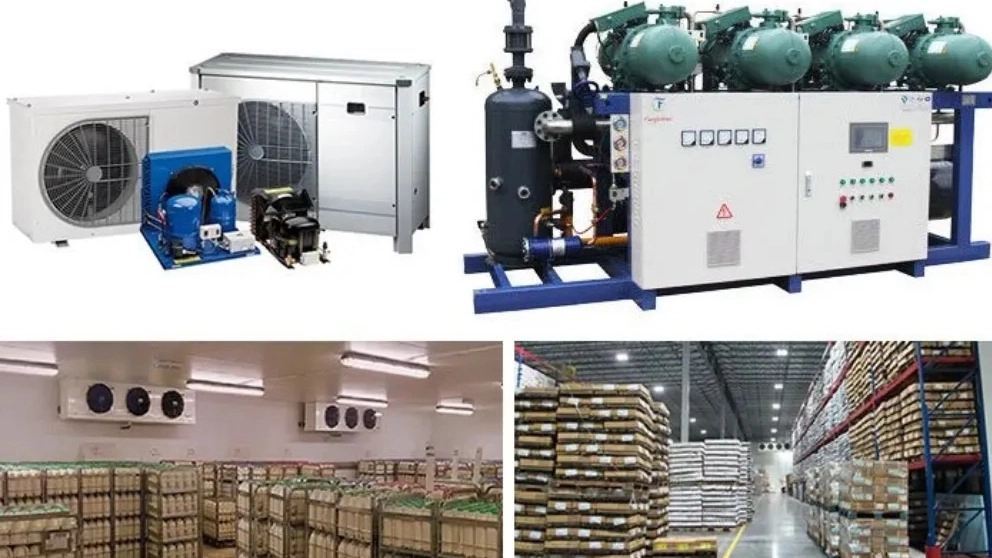
As you can see in the figure below, this system consists of the following main components, which are called condensing units, which are embedded in a condenser and compressor on a chassis that is installed outside the cold room. Refrigerant (freon gas) circulates between the condenser, expansion valve, evaporator and compressor and leads to the cooling of the air inside the cold room, and in fact, by taking heat from the air inside, it transfers it to the outside environment. According to the figure below, there is a copper pipe path (which is also insulated) between the components that we mentioned, and the refrigerant travels through this pipe, which is stretched back and forth, and the important thing is that there is no water in the circuit. Not used. With the help of other components of the system, including indoor and outdoor temperature sensors and pressure gauges, etc., which send temperature information to the controller every moment, the air temperature is carefully controlled. Most chillers of food, pharmaceutical, industrial, etc. cold storages are made in this way.
When the dimensions of the food or fruit and vegetable or pharmaceutical and industrial cold room, etc., are large, instead of one unit, a large number of these condensing units (a set of compressors and condensers and other accessories installed on a chassis and outside installed from the cold room) on the outside of the cold room and each one is connected to the evaporator inside the cold room, thus increasing the cooling capacity of the system. In the figure below, you can see the steps of preparing a number of condensing units for installation outside the cold storage.
2. Water Cooler Chiller:
As we said, a fluid called refrigerant flows between the condensing unit and the evaporator, which is implemented in most food, pharmaceutical, fruit, industrial, etc. cold storages. In some special cases, instead of the refrigerant being sent into the cold room evaporators, in a cold room chiller (which is usually of the compression type) and centrally and in large dimensions (according to the figure below) and by the same components that we mentioned, the water solution And the glycol (antifreeze) is cooled and then this cold water is pumped to the evaporators inside the cold storage and cooling takes place. The problem in this design is that it reduces the efficiency of the system for two reasons. First, one step of cooling the water by refrigerant and then transferring it to the evaporators and cooling the air blown by the evaporator fan actually increases the energy conversion step of the system and considering that energy conversion is always associated with energy loss, so in We will have a waste of energy in the cooling stage of water, and secondly, in order to antifreeze water, glycol must be added to it. Glycol itself has a lower heat transfer coefficient than water and reduces the heat transfer efficiency.
Problems caused by less or more cooling capacity:
Choosing a cold storage chiller with a low capacity will not meet the needs of product storage, and choosing a chiller with a larger capacity will also cause it to turn off and on many times, resulting in increased energy consumption and lack of accurate control of the cold storage temperature. The better the insulation of the walls of the cold storage room, the less energy will be wasted and a smaller capacity chiller will be needed to keep the interior cool.
Division of refrigerators in terms of operating temperature:
Usually, in terms of temperature, cold stores are divided into two groups. In the first group, the inside temperature is between minus 5 and plus 15 degrees Celsius (cold room above zero) and in the second group, which are known as freezers or frozen cold rooms, the inside temperature is between minus 6 and minus 40 degrees Celsius (cold room below zero). is kept In some cold stores, to prevent the formation of ice crystals on the products, a fast cooling method is used, which requires high-capacity cooling equipment.
Usually, in terms of temperature, cold stores are divided into two groups. In the first group, the inside temperature is between minus 5 and plus 15 degrees Celsius (cold room above zero) and in the second group, which are known as freezers or frozen cold rooms, the inside temperature is between minus 6 and minus 40 degrees Celsius (cold room below zero). is kept In some cold stores, to prevent the formation of ice crystals on the products, a fast cooling method is used, which requires high-capacity cooling equipment.
Some of its uses are:
1. Storage of food, meat, chicken, fish, fruit, vegetables, dairy products, etc.
2. Storage of medicine and health and medical products
3. Ice making
4. Industrial water cooler or ice bank for cooling the factories process
5. and any other industrial and non-industrial applications