

Crankshafts
Crank: The presence of non-concentric cylinders that cause linear movement in the work piece is called crank.
Crank value: The degree of eccentricity with respect to the main axis of rotation is called crank value.
Course length: The linear displacement resulting from crank rotation is called stroke length. Its amount is twice the amount of the crank. In the industry, different methods are used for making the crank according to the required dimensions and accuracy. For example, to make a car crankshaft, it is first forged as a raw piece. Then, using special machines, they transform it into the final shape according to the plan. One of the other methods of crank turning, which is usually used for low production, is to make it with a lathe, which is done in different ways. p>
Crank turning with the help of adjustable workers: In this method, three systems are used, the axis of which is adjustable relative to the axis of the working rod of the machine (three adjustable systems). The amount of crank can be adjusted with the help of the divisions that exist on the three systems. If these three systems are used, it is not necessary to draw a line and mark the mandrel, and the bird drill is also done on the same machine.
Amount Small cranks can be measured with a dial gauge. For this purpose, mount it between two birds or on two prisms and by turning it, determine the lowest level of the work piece and set the clock to zero. Then by turning the work piece again, determine the highest level of the work piece and They read the difference of the number shown by the clock. This value shows the crank stroke of the workpiece.
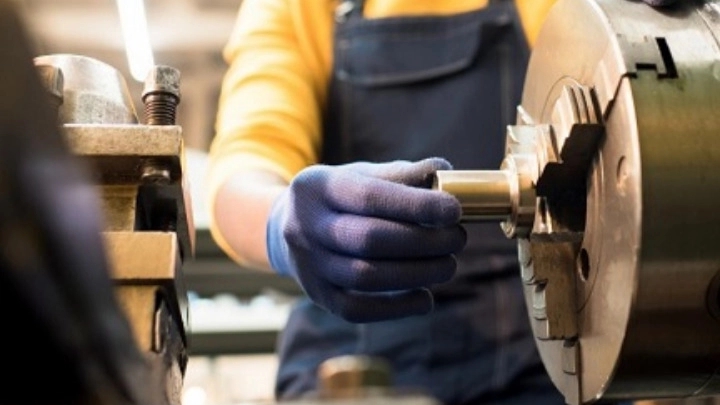
Cranking with the help of three systems or four single systems: In this method, the jaws of three systems or four systems move independently. After calculating the amount of crank and drawing the work piece, the center of the crank is precisely adjusted by moving the jaws. Then, each of the jaws is fully tightened and drilling and chipping operations are performed. mass, and for the purpose of uniformity and high precision in production, special fixtures or restraints are used. It is the most common method of making lame. It can also be used for long pieces. In order to determine the crank centers in this method, first the two ends of the workpiece are faceted. Then, according to the map, they perform line drawing and mandrel marking operations and finally drill the bird.