
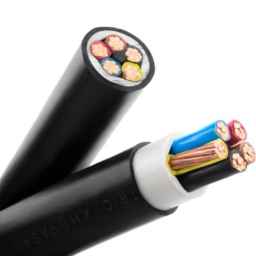

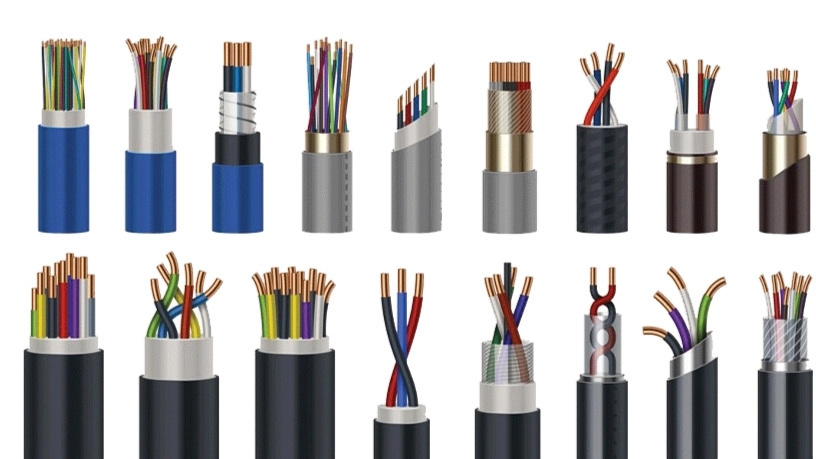
Another type of electrical cable division and its use can be extended to the type and type of insulation used in it. Characteristics such as hardness, softness, density, resistance to flame propagation, ambient working temperature, low smoke, low or high dielectric coefficient, resistance to abrasion, oil and other chemicals and lack of halogen can be Determining the type of electrical cable insulation is effective. Each of the electrical cable insulators can have several characteristics of the mentioned characteristics at the same time. The types of electric cables and their applications are divided into more than 10 types in terms of insulation type, the most important of which are as follows:
Power Cable with Polyethylene Insulation
As it was said, this type of cable is called PEX or XLPE, which is made by netting the linear structure of polyethylene. This network structure is created by connecting the carbons of the main polyethylene chain and these connections limit the movement of the chains in relation to each other and thus they will be resistant to heat, cold and other energies and will not change. This insulation has the best performance at room temperature and above, so it has many uses for building construction and can be useful for fireproof cables, marine and aerial cables.
PVC insulating cable
This type of cable, which has many uses due to its reasonable price and high resistance in chemical environments, is called PVC for short. These cables are generally used for household appliances, house wiring, lighting and devices. Due to the fact that softening materials are used in the insulation of this cable, they have high tensile strength, good flexibility and easy connection. According to the production method, PVC cable can have wide applications.
Elastomeric Power Cable
Elastomer cables are suitable for use in high temperature environments or situations where the temperature is increased by another force. This type of cables can withstand temperatures of 90 degrees above zero in long-term conditions, but in short-term conditions they can withstand temperatures of up to 250 degrees. If the elastomer coating is applied to the cable by extrusion, it is necessary that this coating is 2 or more layers in order to withstand the voltage level of 1100 volts.
Elastomer cables are suitable for use in high temperature environments or situations where the temperature is increased by another force. This type of cables can withstand temperatures of 90 degrees above zero in long-term conditions, but in short-term conditions they can withstand temperatures of up to 250 degrees. If the elastomer coating is applied to the cable by extrusion, it is necessary that this coating be 2 or more layers in order to withstand the voltage level of 1100 volts.
Rubber cables are used in equipment such as generators and electrical transformers. These cables are of great importance for long-term use in normal conditions as well as ensuring high security in power generation stations.
Types of Power Cable and Its Application
Another type of division of electric cable types and its use can be done based on their functional point of view. Based on this, power cables can be divided into two main categories.
Reinforced cable: Reinforced cable is a type of electrical cable that is designed to withstand shocks, pressure, moisture penetration and resistance to external factors and for this purpose Strips of steel and lead sheaths are used in them.
Unarmored cable: This new type of electric cable does not have a resistance structure against external factors and is only made of They are insulated from electric current.
Of course, based on the type of work that power cables do, another division can be made for the types of power cables and their uses, which will be as follows:
Power cables with the purpose of power transmission: which are used on the ground or in the air and include three types of low pressure, medium pressure and high pressure cables.
Power cable with the purpose of signal transmission: which are classified according to the type of signal, control cables, instrumentation and data transmission.
Power cable with the purpose of providing Lighting: and starting electrical appliances in buildings that are installed below or on the surface and are of the type of light cables. These types of cables are used in distribution boards, internal wiring of equipment and small electrical appliances with low mechanical stress.
Types of Power Cable and Its Application Based on Number of Struments
The number of cable strands is another factor of its classification. Types of electric cables and their use based on the number of strands can be categorized as follows.
⚫️ 1 to 5 core cables which are usually low voltage (LV) cables.
⚫️ 1 to 3 core cables which are medium voltage (MV) cables.
⚫️ Cables from 1 to 3 strands, which are high voltage (HV) cables.
⚫️ control cables and precision instruments where the number of strands in the control cable is usually from 3 strands to 61 strands, and in some cases, the number of strands is higher. is used.
tips to consider when choosing a cable
Each electric cable, according to its type and certain cross-section, is capable of transmitting a specific current, which if it exceeds that limit, it will shorten the life or burn the electric cable and cause unpleasant accidents; Therefore, in choosing the types of power cable and its use, the following should be considered:
⚫️must pay attention to the maximum current passing through the power cable.
⚫️must pay attention to the amount of voltage drop and it should not exceed the permissible limit.
⚫️about the selected cross section in terms of power loss , economic calculations should be made. ⚫️ Pay attention to the type of conductor and insulation of the cable and choose it according to the environment it is used in.