
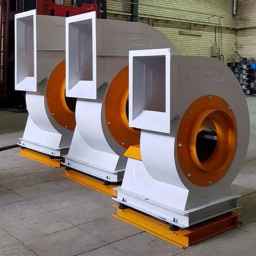

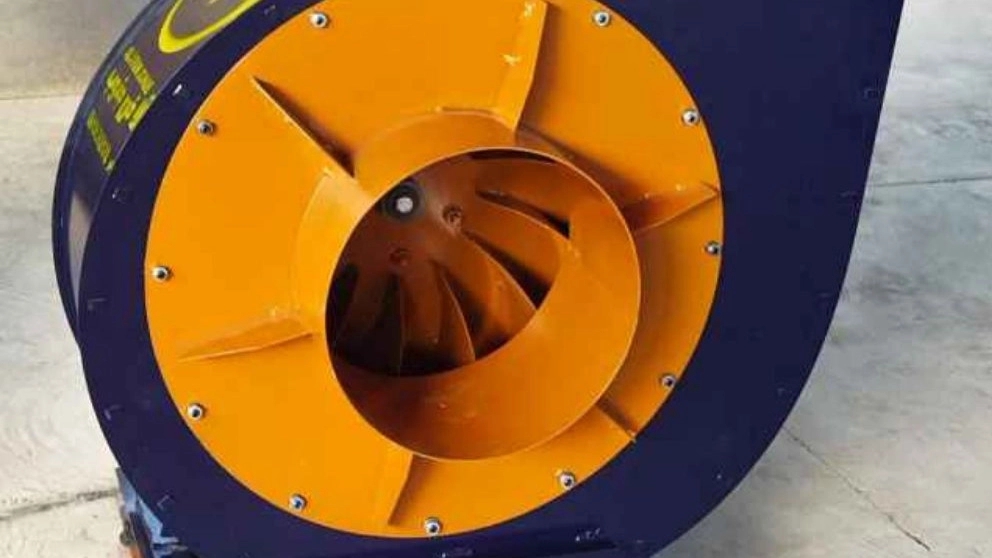
The shape of the vane distinguishes the industrial ventilation fan from blowing and suction fans and it is the pressure ratio that it can achieve. In general, the blower can produce a higher pressure ratio. As defined by the American Society of Mechanical Engineers (ASME) standard, the specific ratio of blower fan pressure to suction fan pressure is defined. Suction ventilator manufacturers define the standard as clean, dry air with a density of 0.075 pounds per cubic foot (1.2 kg/m2), with a pressure gauge at sea level of 29.92 inches Hg (101.325 kW ) and a temperature of 70 degrees Fahrenheit (21 degrees Celsius).
The selection of a blower or suction fan
Selecting a centrifugal fan for operation in conditions other than standard air requires adjustment of both static pressure and power.
At higher than standard altitude (sea level) and higher than standard temperature, The air density is lower than the standard density. The air density correction should be for a centrifugal blower designed for continuous operation at higher temperatures. Centrifugal ventilators, whether suction or blower types, move a constant amount of air in a given system regardless of air density.
The difference between the blower and the suction technically
When a centrifugal fan is specified for a given CFM and static pressure at non-standard conditions, its air density correction factor should be used to select the appropriate fan to meet the new conditions. Because air at 200°F (93°C) moves only 80% of air at 70°F (21°C), a centrifugal fan creates less pressure and requires less electricity.
To arrive at the actual pressure required at 200°F (93°C), the designer must multiply the pressure at standard conditions by a density correction factor of 1.25 (ie 1.0 / 0.8) to bring the system to act correctly To get the actual power at 200°F (93°C), the designer must divide the power at standard conditions by the air density correction factor.
Centrifugal fan performance tables for centrifugal fans or suction fans and blower fans provide fan RPM and energy requirements for given CFM and static pressure at standard air density. When the performance of the centrifugal fan is not in the standard condition, the performance should be converted to the standard condition before entering the performance tables.
Broker and suction fan standards
Centrifugal fans are tested by the American Motion and Air Control Association (AMCA) in laboratories with test setups that resemble typical installations for this type of fan.
Different Types of Standard Blood and Fan
Usually they are tested as one of the four types of standard installation in accordance with the American Standard AMCA 210. It determines the airflow rate, pressure, power and efficiency at a rotational speed. The purpose of AMCA Standard 210 is to define the exact methods and conditions of fan testing so that the ratings of different manufacturers are on the same basis. For this reason, in cooling and heating air conditioners or for air conditioning in halls in Blowing fan is used to blow it to the desired place.
Superstitious
Centrifugal blower with more blades in the fan axis and its significant arc puts more pressure into the channels or the ventilated hall and also requires less power from the electric motor compared to the volume of air produced.