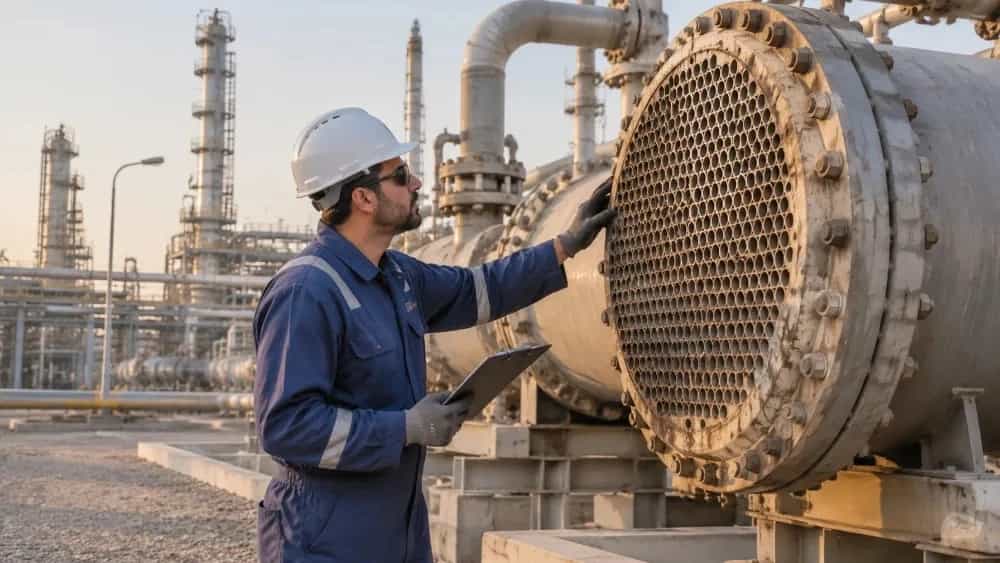

The loss of efficiency of a heat exchanger may first be seen only in the shift report; A few days later, the same issue leads to an unscheduled shutdown of the unit. For operation and maintenance officials in Mahshahr, the main question is not "who will open the machine first?"; The question is what is the cause of the failure and after repair, how can you be sure of fixing it?
The root of many costly decisions is starting a repair before troubleshooting is complete. Replacing the part, cleaning or fixing the leak can remove the failure symptom, but if the process conditions, inspection history and acceptance criteria are not clear, the technical decision is not yet complete.
Where should the repairs of petrochemical equipment in Mahshahr start?
Repairs of petrochemical equipment should begin with a precise definition of the fault, extent of damage and safe working conditions, not with immediate selection of the repair method. After that, the operation, technical inspection and repair team should agree on the appropriate action and equipment delivery criteria.
In a leak, the observed location is not always the actual source of damage; Sediment is not the only possibility for converter performance loss. Temperature, pressure, flow data, shutdown records, inspection reports, and recent process changes should be reviewed together. Inspection standards for pressure equipment and process piping consider it important to analyze the findings and appropriate action with the type of equipment. The selection of the reference standard should be based on the type of equipment and the actual scope of the work, not just the general title of "petrochemical repairs".
This distinction is of practical importance when requesting services: repairing the shell of a pressure equipment, handling a process line leak, and checking the performance of a converter do not have the same documents and acceptance criteria. A detailed work description makes both time and cost estimates clearer and reduces the possibility of delivery discrepancies.
What variables determine the repair method?
The appropriate method of repair depends on the type of equipment, the mechanism of damage, the consequences of the failure, and the possibility of safely removing it from service. Even two similar equipment may require different decisions due to differences in fluid, operating conditions, or repair history.
Type of injury and evidence to be collected
Before making a repair decision, it must be determined whether we are dealing with leakage, corrosion, clogging, loss of heat transfer, or a combination of these. Each diagnosis requires specific evidence; The appearance of damage alone is not enough to determine the cause.
In the heat exchanger, comparing the performance data with the previous situation can determine the direction of investigation. In pressurized equipment and process lines, the location of damage, history of thickness measurement and inspection findings play a role in determining the scope of work.
Unit stoppage, work safety and acceptance criteria
Repair speed is valuable when isolation, work permits and quality control are not sacrificed. Before starting, it should be clear who will deliver the equipment, what post-repair tests are required, and who will approve its return to service.
In Mahshahr, coordinating the repair time with the unit shutdown schedule can be decisive. However, the promise of delivery time without knowing the scope of the damage, access to the part and required tests is not a reliable basis for decision making. The repair plan should clearly record the starting point, the person responsible for each step and the completion criteria.
Observed situation | Required initial investigation | Decision not to be rushed | Recordable criteria for Delivery |
|---|---|---|---|
Decrease in performance of the heat exchanger | Temperature trend, pressure, flow rate and cleaning history | Assuming that any efficiency drop is removed by washing | Comparison of performance after work with the unit's approved standard |
Leakage in pressurized equipment | Leak location, body condition and inspection report | Selecting the repair method based on appearance only Leaks | Confirm inspection and tests specified in repair plan |
Process line damage | Extent of damage, service conditions and inspection records | Local replacement without checking the scope of the problem | Recording the inspection result and confirming the return to service |
Recurring failure | History of failure, previous repairs and changes Process | Repetition of the same previous action without checking the cause | Probable cause registration and follow-up preventive action |
From my point of view, the most expensive mistake in the repair of petrochemical equipment is not having a common answer to the question: "After the work, what exactly do we deliver intact?" When the acceptance criteria are unclear, even the quick implementation of the repair may end in a technical dispute or rework.
I, Mr. Soltani, when reviewing a repair request, I first put together three things: the indication of failure, the history of the equipment and the expected use of the final delivery. This arrangement helps the job description move from a general phrase such as "Fix the converter problem" to more actionable questions: When did the performance drop start? Which data shows it? After repair, which data should be changed?
Another tip I recommend to colleagues is to separate "fixing the symptom" from "fixing the cause". Suppose the leak is fixed, but the cause of the damage and its extent have not been checked; In this case, sealing the leak alone is not the answer to all inspection questions. The analysis of the inspection findings should be part of the decision-making about the status of the equipment and the next action.
This view is also useful in choosing a contractor. Criteria such as clarity of job description, method of recording findings and accountability in delivery are more important than generic labels; Whether it is the topic of maintenance in petrochemical industries, or comparison with the approach of power plant repair companies and activists of Iranian power plant repair. Of course, the experience of a field, without checking its compatibility with equipment and service conditions, is not a substitute for technical qualification for other work.
A practical roadmap for requesting and implementing repairs
A good repair request should have a trackable path from reporting a defect to confirmation of return to service. Each step should produce a specific output so that the next decision does not rely on guesswork or verbal conversation.
- Make the defect report accurate. Record the name and ID of the equipment, failure symptom, start time, performance data and its effect on production.
- Keep the records next to the new report. Review drawings, previous repairs, inspection results and recent changes in operating conditions.
- Determine scope of investigation and responsibilities. Operation, technical inspection and repair team must know the decision about the method With whom is the work and final acceptance.
- Plan the work after the safe preparation of the equipment. Isolation, necessary permits, access to parts and order of activities should be clear in the approved plan of the unit.
- Write the final repair and control procedure before implementation. Determine the type of post-work inspection or test according to the equipment, damage and project requirements; No test should be assumed to be the same for all equipment.
- Document the delivery.Deliver the work performed report, inspection findings, final control results and follow-up recommendations with the equipment into operation.
In Resa Mebadat Sazan Zaubun Company, the basis we propose for a technical discussion about the repairs of Mahshahr petrochemical equipment is this: first clarify the issue with data and scope, then decide on the method and execution time. To complete the study path on the site, the three suggested anchor texts are petrochemical heat exchanger repair, technical inspection of fixed equipment and petrochemical maintenance and repair program.
جهت دریافت اطلاعات بیشتر تماس بگیرید.
Conclusion and final opinion
To choose the path of petrochemical equipment repairs in Mahshahr, start from fault diagnosis and delivery criteria, not from the shortest time or the most general price offer. A good decision is a decision that clarifies the reason for choosing the repair method, the responsibility for its implementation, and the evidence of final acceptance.
I, Mr. Soltani, believe that a professional conversation about repair should begin with actual equipment information. If you have a problem with a converter, pressurized equipment or process line, prepare a fault report and existing records so that we can discuss the scope of the investigation and the appropriate course of work, accurately and without prejudice.