

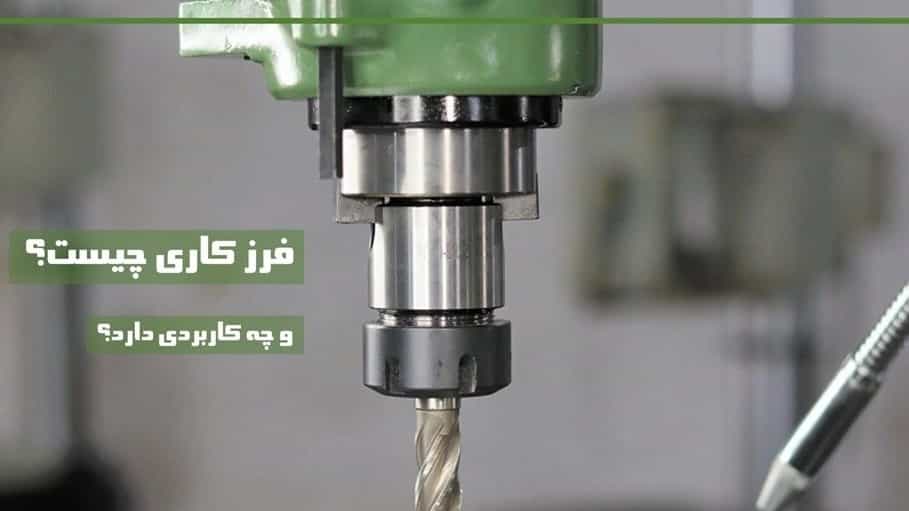
What is milling and what is the use of?
Milling is a process in which the cutting tool rotates with the help of the milling machine to machine additional material from the existing workpiece in the direction of the angle with the axis of the tool. Milling operation is one of the most common production processes used in workshops and machinery industries to produce products and parts with high precision in different shapes and sizes.
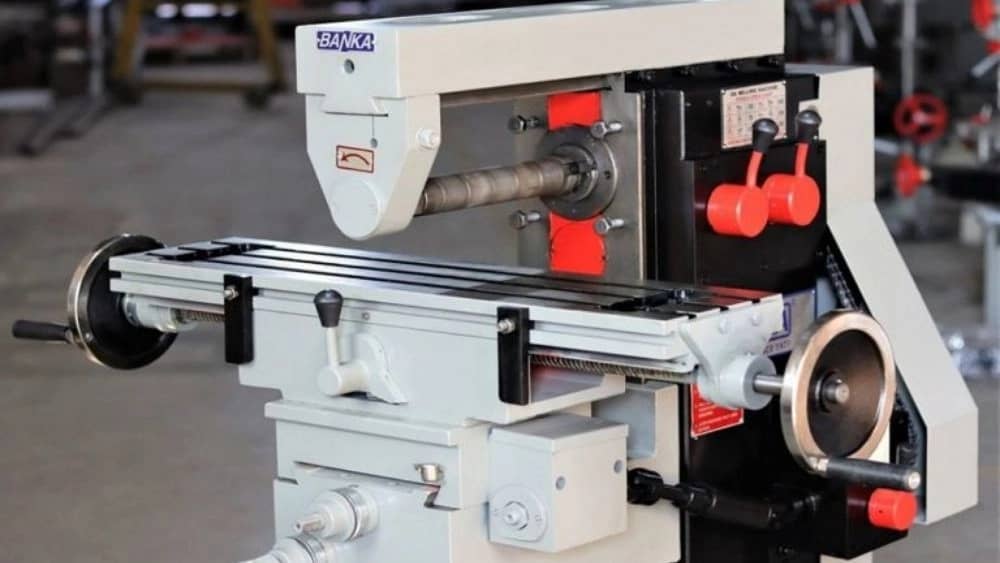
Milling is one of the important machining operations in which the workpiece is fed against a rotating cylindrical tool. A tool (such as a finger mill) consists of several cutting edges. Milling operations are distinguished from other machining operations based on the orientation between the tool axis and the feed direction. In other operations such as drilling, turning, etc., the tool is fed in the direction parallel to the axis of rotation (unlike milling).
The cutting tool used in this operation is called a milling blade, which consists of several edges called the cutting edge. A machine tool that performs milling operations by creating the required relative movement between the workpiece and the tool is called a milling machine. This device provides the required relative motion in controlled conditions. These conditions are known as spindle speed, feed rate and depth of cut.
Typically, milling operations are used to create smooth surfaces. Other complex geometries can also be created with a milling machine. The milling operation is considered as an interrupted cutting operation, where the cutting edges enter and exit the work in each revolution. This cutting action exposes the milling blade to a cycle of impact force and thermal shock in each rotation. The material of the tool and its geometry must be designed to withstand the conditions mentioned above. Depending on the position of the tool and the workpiece, milling operations can be classified into different types.
Cutting parameter
Milling is a metal removal operation using a rotating cutting tool that has one or more cutting edges. Cutting is done by feeding the workpiece against the cutting tool. There are three main cutting parameters that must be controlled in any milling operation. These three cutting parameters are cutting speed, feed rate and cutting depth. Good results are obtained only with balanced settings of these parameters.
Cutting speed
Cutting speed is the peripheral linear speed resulting from the milling operation, which is expressed in meters per minute. The cutting speed parameter can be obtained from the following formula:
V = πdn /****
in which:
d = burr diameter in millimeters,
V = cutting speed (linear) in meters per minute and
n = cutting speed (rotary - spindle speed) in revolutions per minute.
Progress speed
It is the speed that is given to the work piece by the work table and moves it in the perpendicular direction The rotation axis of the cutting blade adjusts. In general, progress is expressed in three ways.
Advance per cutting edge
The distance traveled by the work piece (its progress) between engagement by two consecutive edges is expressed as mm/tooth(ft).
Advanced per round
The movement of the workpiece during one revolution of the milling cutter is expressed as mm/rev and is represented by f(rev).
Advance in the unit of time
Advance can also be expressed as minutes/advance or seconds/advance. The advance distance of the workpiece is in unit time (fm). The above three forward rates are mutually convertible: (fm) = n x f (rev) where n = rpm of the cutting tool. It can be expanded as follows: (fm) = n x f (rev) = z x n x f(r) where z is the number of cutting edges.
Depth of cutting
Cutting depth in milling operations is the amount of penetration of the cutting blade into the workpiece. The cutting depth parameter is the distance perpendicular to the main and final surface of the workpiece and is measured in millimeters.
Different milling operations
Due to the variety of shapes and their high production rate, milling is one of the versatile and widely used machining operations. The geometric form created by the milling operation is divided into three main groups:
Flat surfaces: The surface is linear in all three dimensions. The simplest and most convenient type of surface;
Two-dimensional surfaces: the shape of the surface changes in the direction of two of the axes and is linear along the third axis.
3D Surfaces: The shape of the surface changes in all three directions, for example gas turbine blades, propellers, casting patterns, etc.