

One of the most important and common tools needed to prepare agricultural land for planting is the agricultural disc. After the initial preparation of the land is done by the plow, which is one of the most important primary tillage machines, there is still a need for secondary operations. That is, planting machines cause problems. Also, although the initial tillage (plowing) softens the soil to some extent, this amount of softness is very different from what is needed to create a suitable substrate for planting different types of seeds. br>
For this reason and in most cases, especially when the right time and conditions for plowing are not observed, it is necessary to do secondary tillage. This action has a great impact on the uniform growth of plants and their performance.
In order for the seed to germinate, it must be able to absorb water and nutrients dissolved in water, and to absorb the maximum amount of water and nutrients, the seed must be able to contact the soil particles. Soil particles are possible under certain conditions. First of all, if the particles are small and secondly, if the pressure is applied so that this connection is established. To achieve this goal, farmers have been trying to soften the substrate and the surrounding of the seed. Squeeze a little. This additional operation, which is done after plowing and for the final preparation of the seed bed, is called secondary tillage, and disking operation is one of the most important of them. The way the tillers affect the soil and the relationship between the soil and the seed is shown in the figure below: Basically, the disc operation is done perpendicular to the plowing direction so that the gaps between the plow tines are smoothed and at the same time Now the clods should also be crushed. In addition to this, disking will destroy the weeds and the remaining stems of some plants such as cotton, cereals, etc. and to mix chemical fertilizers or green manure before planting, cover the seeds that are They are poured manually on the soil and in some cases it is used for threshing and surface plowing. Discs are almost the same as disc plows, but unlike disc plows, the discs are connected in groups.
The segmentation of agricultural discs
Disks are divided into two groups, normal disk and scissor disk (off-set disk).
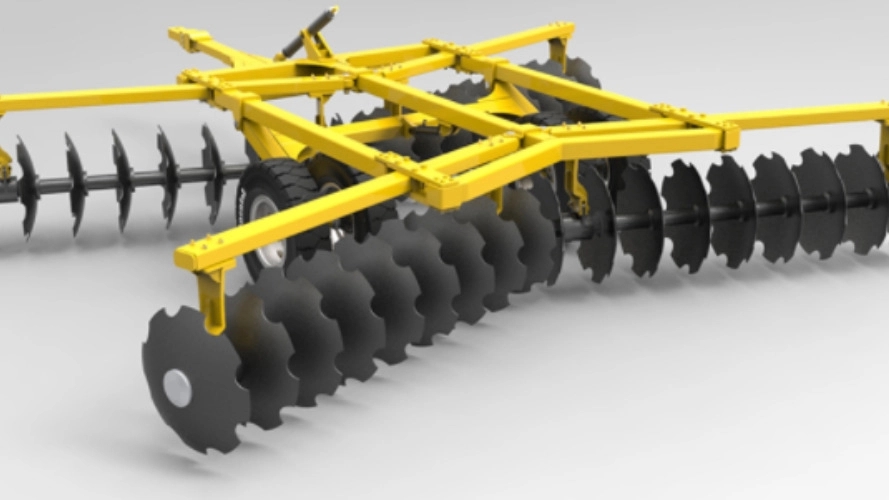
Normal disk may be one or two rows. The structure of the disk consists of a number of circular and round plates that move at certain intervals on an axis (two or four axes).
These plates are thick in the center and thin at the edge and have a diameter of about 45 They are up to 60 cm, sometimes in heavier types this diameter reaches 70 cm. In some types of discs, the edges of the plates have a congress. It varies according to their types. The depth of operation of the discs is from 10 to 15 cm, even up to 20 cm depending on the heavy weight of the disc. When discing the land, the operation is carried out twice in a round-trip fashion so that the soil that was moved in the first round is returned to its place in the second round.
Disks have one aisle and two aisles (scissors) in terms of axis. and half of the two tracks are called offset, and the plates are spherical (smooth, convoluted edge) and incomplete cone plates (smooth, convoluted edge), the central axis of the plates is in the form of 4 corners so that the plates do not rotate around the axis and for A pulley is placed between the plates and between the plates.
If the disc is used to soften and level the soil, the clods that are at a lower depth will also be eaten, but more unevenly than the clods of the thresher. and another disadvantage of the disk is that the disk must be used 2-3 times on the ground to crush the clods. Of course, when using a disk or clod crusher, the frequency of use changes depending on the type of ground. The heavier the soil, the more times it is used. will be The working depth of the disk is low and the disk only creates a groove, in other words, it removes the clods in front of it and does not bury them.
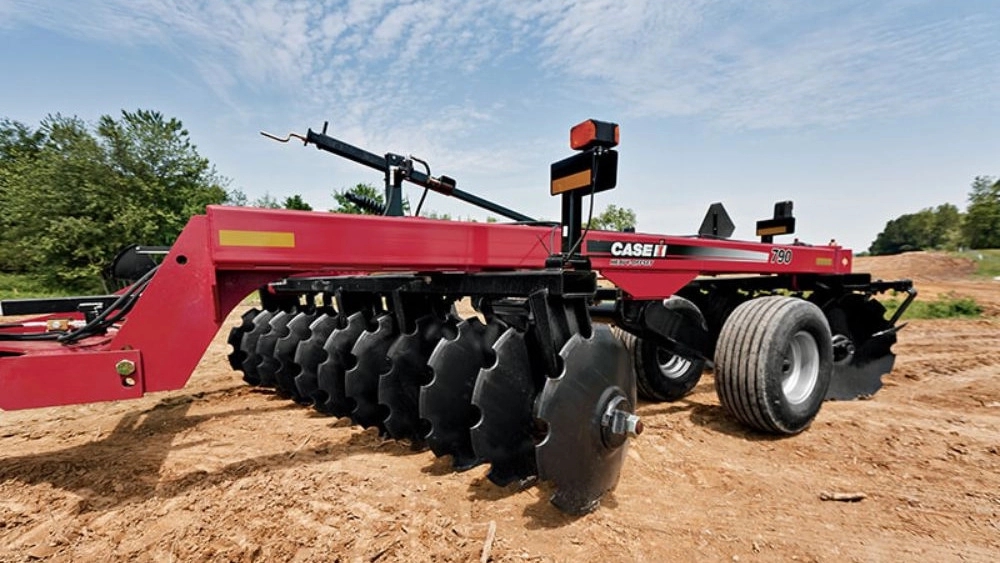
Heavy discs
Usages of heavy discs
To crush the clods caused by plowing and create a uniform surface and prepare the seed bed It is also used as a tool for primary soil cultivation, i.e. disc without plow, according to the soil conditions and its humidity, used in large fields, especially in agriculture and industries. Special specifications of heavy discs - weight of the disc On each group from 72 to 140 kg in different models, it enables the selection of the correct one for different ground conditions.
- The horizontal adjustment system (leveling) makes the working depth uniform and reduces the pressure on the tractor.
- Equipped with Heavy and strong chassis for working in heavy conditions
- height adjustment with hydraulic jack
- full overlap of the blades - the ground does not leave an unscratched disc.
- fenders can be adjusted in wet conditions.
- The front row has radial lip discs that allow better penetration into the soil and crushing of plant remains and clumps. In discs, the plates are connected in groups and the plates of each group rotate around their axis. Constituent components
Light discs
Special features of light discs
- Adjustable fenders provide better performance in wet conditions.
- Dust-proof bearings in the axis of the blades ensure the durability and longevity of the machine.
- The wheeled traction discs are equipped with a depth adjustment jack.
Using light discs
- Mixing manure with topsoil
- as secondary tillage tools to break up clods caused by plowing and remove weeds and prepare the seed bed in light soils