What is a ceiling? Specifications, Applications and Types of Its
In general, a crane is a mechanical tool for lifting and moving heavy loads, which replaced human and animal power after the industrial revolution. Current cranes use electricity to perform their tasks. Although the oldest examples of something similar to a crane can be found **** years ago in the ancient Egyptian civilization, they were made of wood and used to move huge stones, but today a crane is a device that uses electric power, guided With or without humans, carry out the activity of lifting and moving the load suspended in the air by means of hooks or other similar equipment, which are divided into two general categories: mobile cranes and fixed cranes.
Ceiling
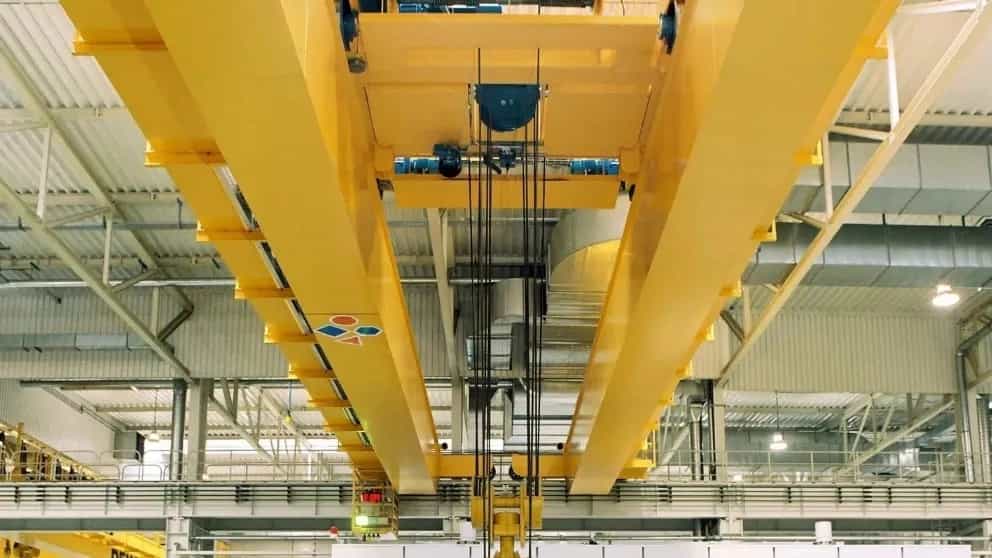
In the construction of overhead cranes, it is generally like a bridge that is installed on two parallel horizontal rails at a suitable height along the length of the walls of the hall or industrial shed or warehouse. have been, they move to make it possible to move the load in the longitudinal axis. A movable hydraulic carriage is placed in the upper or lower part of this bridge so that it moves along the bridge in the transverse axis of the hall and makes it possible for the crane to reach in the transverse axis. But the most important function of a crane is the ability to lift heavy objects from the ground. For this purpose, a pulley is installed in the central part of the carriage that folds and unfolds a metal cable for suitable heights. The end of this metal cable will be connected to the crane hook set to allow the overhead crane to lift, move, move and implement heavy loads. If there are no suitable columns for the implementation and installation of overhead cranes, special support structures or gantry cranes can be used.
🍀 Application of ceiling crane
This type of crane, which is considered a fixed type of crane, is used to move heavy loads that are difficult for humans to carry in warehouses. It is used in industrial halls, sheds and other closed environments and generally the roof of the workshop. This model of cranes works best in indoor places with a large opening and will be able to meet the needs of the employer and workers to move wide, heavy loads that require frequent movements by combining the movement of the main structure along the longitudinal axis with the movement of the overhead crane carriage. along the transverse axis and the metal cable in height. Various industries use these overhead cranes in their work process. Automotive industries, heavy equipment, shipbuilding, power plants, aviation, metal and concrete manufacturing, transportation equipment manufacturing, etc. are among the uses that can be mentioned for this useful tool. The weight of the load and the number of times the device is supposed to be used during the day are very important in choosing the type of crane. The width of the workshop opening and height should also be considered.
🍀 Using the use of ceiling crane
1. Reducing the costs of doing the work: a roof crane can be more useful than a few forklifts, so it will be more economical both in terms of fuel consumption and the number of manpower. In addition, because it can work at a high height and without the need to have a commuting route, it prevents wasting time. 2. Adjustability: The possibility of installing a ceiling crane at any height allows So that employers and workers can use it at any level. Sometimes forklifts may not be able to raise the load to the desired height or lift the load from a height beyond their capacity, but there is no such limitation in the overhead crane. 3. Reduction of human error: because Lifting heavy objects will be very difficult for human power, the possibility of injury to it and also the workers engaged in this work will always exist. By using a suitable overhead crane, such incidents can be avoided altogether.
4. Low maintenance and repair costs: because this type of cranes are specifically designed to carry heavy objects in workshops, sheds, factories and similar items are made, compared to other types of cranes, they have a higher resistance to possible damages and their maintenance and repair costs are lower than other examples.
5. Full access in three dimensions: to Due to the movement of this crane along the longitudinal, transverse and height axes, this crane alone can cover the entire work environment and completely eliminate the need for other types of lifting or heavy lifting. A ceiling crane can remove heavy objects from all sheds and transfer them to any other place in the shed. 6. No need for technicians or special forces: a ceiling crane can be controlled with a very simple manual remote control. is that moving it does not require any special skills or watching a special course. Just hook the load to it to lift it and then unhook it when it's in place. With a few times of practice without load, you can easily learn to control a ceiling crane.
7. Positioning ability: Ceiling cranes can be equipped with an advanced positioning system and can also be prepared by giving programs in advance. , also used their automatic function.
Ceiling crane
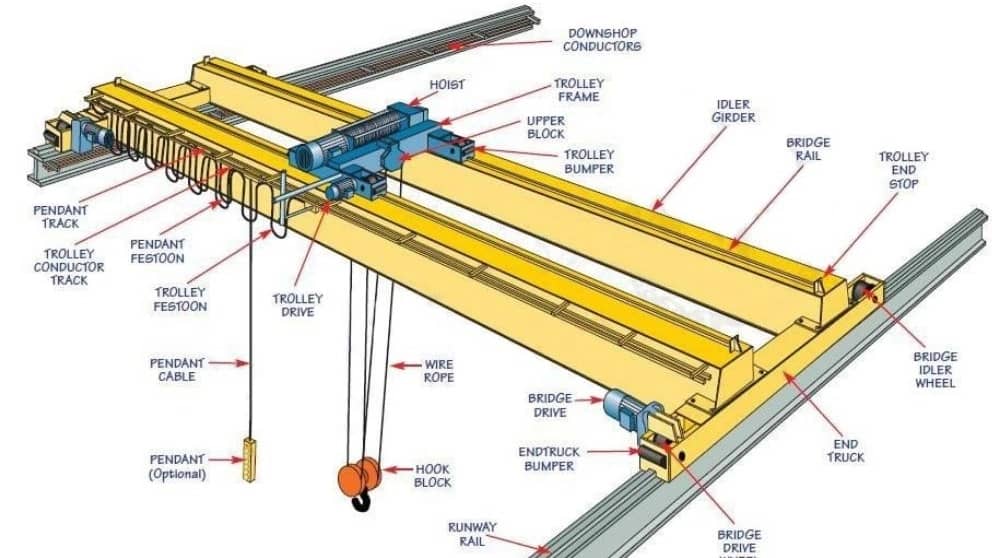
Longitudinal pole: two long metal pieces that are installed parallel to each other on the walls or columns on both sides in the length of the hall, shed or workshop, at exactly the same height, to allow the crane to move along the longitudinal axis. Longitudinal rail: Longitudinal rails are generally a part of a longitudinal beam that continues as a square protrusion along the beam, these rails act as a brace to prevent the bridge from deviating on the beam. The main busbar: There are a set of extra rods that are installed on the body of one of the long poles to enable the electric wires to be supplied to the overhead crane without hanging or being under the feet at the same height as the pole. Clegi: It is a metal part of the bridge that moves on the rail and the depression of its lower part is locked so that the bridge never deviates from its path. Wheels: Every trolley will have two or more wheels to make it easier and simpler to move on the rail. The wheels are installed in such a way that they are completely inside the wheel and are away from damage. Bridge motor: A part that is connected under or to the side of the bridge and is responsible for moving the wheels so that the bridge can be moved in both forward and backward directions in the longitudinal direction and can be moved by it. Bumper: A plastic piece attached to both ends of the bridge that prevents the bridge and its components from suddenly hitting the wall in the part where the rails and poles end. Bridge: The main part of the overhead crane is connected to two legs on both sides and is moved through them that move on the longitudinal rail. Transverse rail (bridge rail): two rows of metal that are placed on or next to the bridge, which, as a rule of thumb, deny the possibility of any deviation from the carriage so that it always remains on the bridge in the transverse axis. Stopper: It is a part of the transverse rail that is placed on a peg at the end to prevent the carriage from moving further and keep it still on the bridge. Carriage power bus: a row of extra bars or a special compartment on one side of the bridge that allows hanging and folding the electric cables of the car and the power cable of the steering wheel. Carriage: a set including electric motor, wheel, shock absorber, festool, gearbox, pulley, etc., which move on the transverse rail (bridge rail) along the transverse axis. Reel (drum): It is an electric and rotating device that, by wrapping a metal cable around itself and opening it, provides a possibility for the crane to move the load at a height. Cable: one or more strands of metal cable that is connected from the top to the pulley connected to the carriage and from the bottom to the pulley of the hook assembly and transfers all the force of the weight of the load to the carriage and the bridge. Hook set: It varies from a simple hook connected to a simple pulley to several hooks with different shapes and connected to several special pulleys, but the task of all of them is to send the force resulting from the weight of the load to the carriage through a cable or metal cables. Command key: It is an electronic part through which the command to move the crane in three dimensions can be sent to it. This key is first connected to the carriage bus and then to the bridge motor and the carriage motor through a cable. Remote control: It is a small, mobile and separate part of the crane, which is connected to the steering wheel via Bluetooth and will work to enable remote control of the crane.
🍀 Types of ceiling crane
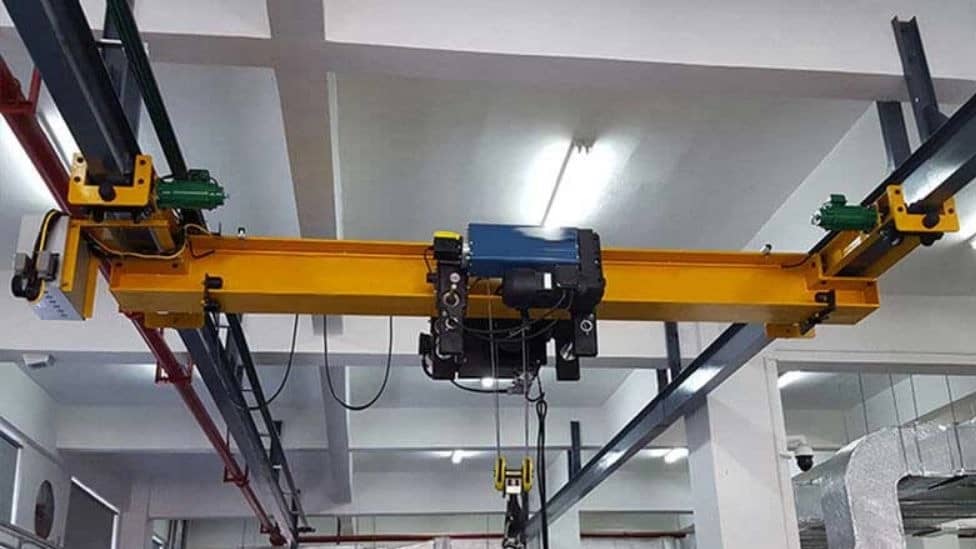
Several different types of overhead cranes are produced, but the two main types are more practical, and these two types are generally used. Single bridge overhead crane (monorail) As the name suggests, there is only one bridge in the construction of a single bridge crane. This means that only a transverse horizontal beam-like structure moves on rails and longitudinal beams. In this type of overhead cranes, transverse rails are installed on both sides of the bridge and support the carriage path. Single bridge overhead cranes are suitable for spans less than 20 meters and are suitable for lifting and moving loads with a maximum weight of 20 tons. This model allows to use the interior space in a useful way in halls that have a complex structure. In this type of overhead cranes, unnecessary costs can be reduced as much as possible by complying with standards and reducing dead weight. This is also very important on the pressure exerted on the rails of the single bridge crane, because in fact all the weight of the used cargo will be concentrated and imposed on one bridge. However, the cost of maintenance and repairs of this type of overhead cranes is much lower. The structure of this model has less weight, so it does not need special columns for stability. The price of this model will be lower than the bridge model, but it will bear less weight. The single bridge model gives the repairer access to the lifting winch during repairs. It does not have any restrictions on the set of hooks and it can also use magnets, rakes, chambers, etc. and move loads with them. b> Needless to say, in this type of overhead cranes, instead of one bridge, two bridges are used, which look like two beams connected together with an empty space between them. In the double bridge overhead crane, transverse rails are placed on the bridge and the carriage rides on them from above and connects the cables to the hook set from the empty space between the two bridges. Therefore, it has a high weight carrying capacity compared to a single bridge overhead crane. A double bridge overhead crane can lift and move up to 320 tons of weight. This type of overhead cranes is suitable for moving large loads in large facilities. Definitely, if the employer wants to move cargo at a high height, it is recommended to use this model of overhead cranes. Also, if the opening of the workshop is more than 25 meters, it will not be possible to use the single-bridge model, so you must definitely use the double-bridge overhead crane. This model of overhead crane can be adapted according to work needs. During repairs, it can be moved laterally. Its installation is more if there are columns that can bear its heavy weight. It also has the ability to be installed at a high height.