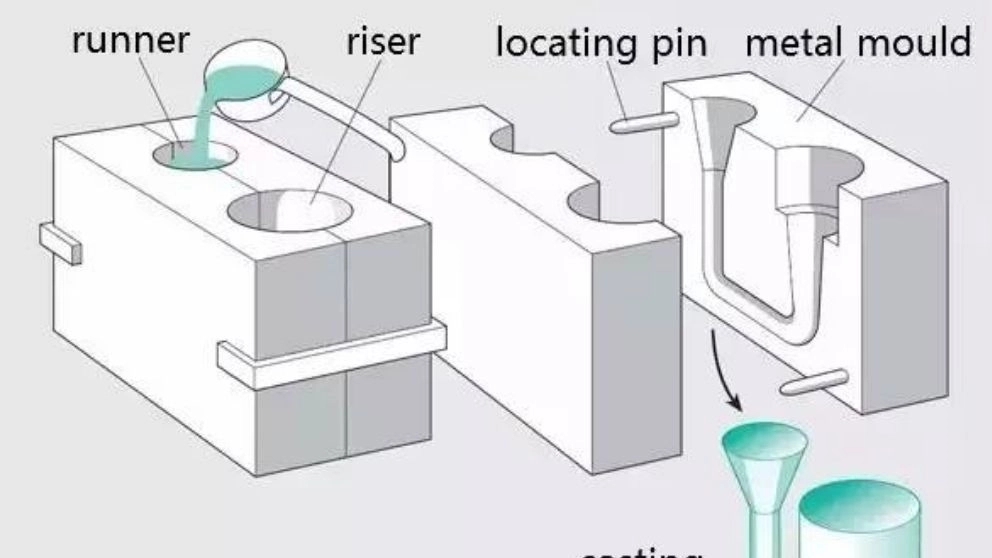
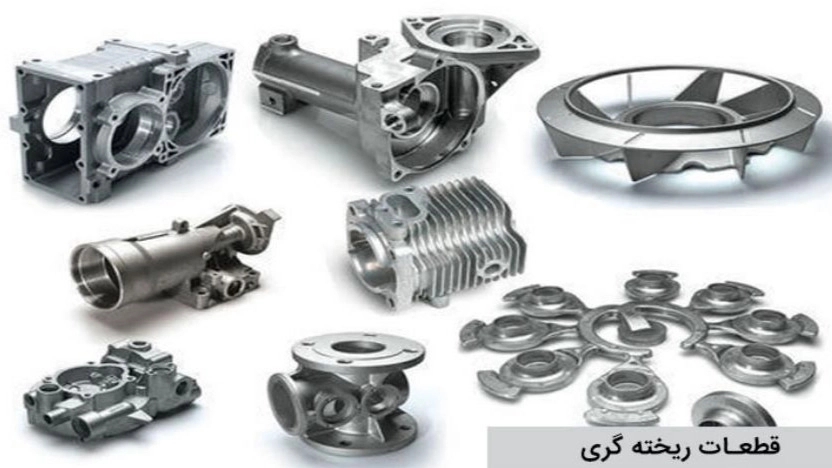


The production method of pouring liquid metal into a mold cavity that fits the shape and size of the piece and waits for it to cool and solidify to obtain the piece or pieces is usually called forming or liquid metal casting.
Process flow: liquid metal → filling → freezing shrinkage → casting
☑️ Process Features:
☑️ Classification of casting:
(1) sand casting
Sand casting: Casting method to produce castings in sand molds. Steel, iron and most non-ferrous alloys can be obtained by sand casting.
☑️ The flow of sand casting process
(2) Investment Casting
Investment casting: usually refers to a casting design in which a mold is made of fusible material and several layers of refractory material are coated on the surface of the mold to form a shell. The mold is then melted and removed from the shell to obtain a mold without a separating surface. After calcination at high temperature, it can be filled with sand and poured. Often referred to as "loss-of-wax casting".
☑️ Investment Casting Process Flow
Advantages:
1. High dimensional and geometric accuracy.
2. High surface roughness.
3. Capable of casting with complex shapes and unlimited casting alloys.
Application: suitable for the production of small parts with complex shapes, requiring high precision, or difficulty in other processing, such as turbine engine blades.
(3) casting
Casting: the use of high pressure to quickly push the molten metal into the cavity of a precise metal mold, and the molten metal is under cold pressure and It solidifies to form a casting mold.
☑️ Process Features
Advantages:
1. During casting, the metal liquid withstands high pressure and has a high flow rate
2. Good product quality, stable size and good exchangeability.
3. High production efficiency and frequent use of casting molds.
4. Suitable for large-scale production with good economic benefits.
Application: Diecast was first used in automotive and precision instrument industries, and later gradually expanded to various industries such as agricultural machinery, machine tool industry, electronic industry, national defense industry, computer, medical equipment, watch, camera and daily hardware. Found. .
(4) low -pressure casting
Low pressure casting: refers to the method of filling the mold with liquid metal under low pressure (0.02-0.06 MPa) and crystallization under pressure to form a casting mold.
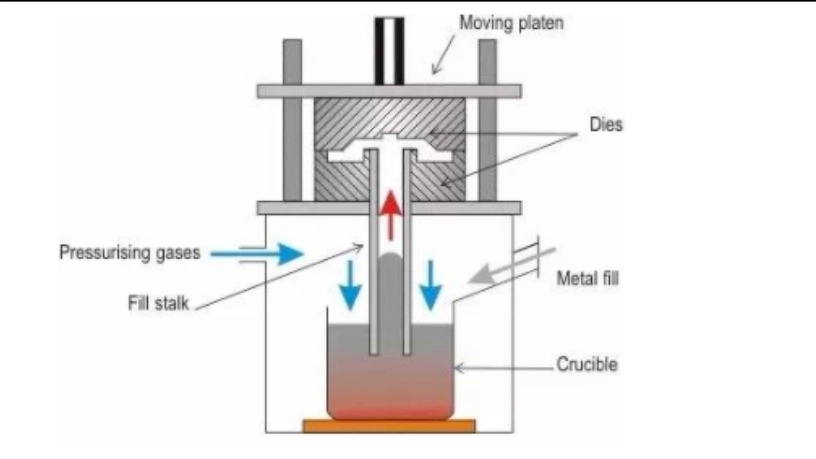
☑️ Technical Features:
(5) Centrionic casting
Centrifugal casting: It is a casting method in which a molten metal is poured into a rotating mold and filled with centrifugal force to It solidifies and forms the mold.
☑️ Process Features
Advantages:
1. There is almost no metal consumption in the pouring system and the lifting system, improving the process performance.
2. The core is not required when producing hollow castings, so the metal filling capacity can be greatly improved when producing long tubular castings.
3. High density castings have less defects such as pores and slag inclusions, and high mechanical properties.
4. Easy to make composite metal castings for cylinder and sleeve.
Application:
Centrifugal casting was first used in the production of cast pipes and is widely used in industries such as metallurgy, mining, transportation, drainage and irrigation machinery, aviation, national defense, and automobile manufacturing in And abroad, it is used to produce steel, iron, etc. Non-ferrous carbon alloy casting is very common in the production of castings such as centrifugal cast iron tubes, internal combustion engine cylinder liners and shaft sleeves.
(6) gravitational casting
Metal mold casting: It refers to a method in which liquid metal is filled in a metal mold under the influence of gravity and in a cold mold and solidifies to obtain a casting.
☑️ Process Features
Advantages:
1. The thermal conductivity and heat capacity of metal molds are high, the cooling speed is fast, the casting structure is dense, and the mechanical properties are about 15% higher than sand mold casting.
2. Castings that can achieve high dimensional accuracy and low surface roughness values and have good quality stability.
3. By not using or rarely using sand cores, the environment is improved, dust and harmful gases are reduced, and work intensity is reduced.
Application: Metal mold casting is suitable for the mass production of non-ferrous alloy castings such as aluminum alloys and magnesium alloys with complex shapes, as well as for the production of castings, ingots and other steel metals.
< /p>
(7) Casting under vacuum
Vacuum Casting: An advanced casting process that eliminates or reduces porosity and dissolved gases in the die cavity during the die casting process. and as a result, it improves the mechanical properties and surface quality of casting parts.
☑️ Process Features
Advantages:
1. Removing or reducing internal porosity in casting molds, improving mechanical properties and surface quality of molds and improving coating performance.
2. Reducing the back pressure of the mold cavity can use alloys with lower specific pressure and poorer casting performance, and small machines can be used for larger castings.
3. Improved filling conditions, able to cast thinner molds.
(8) compressed casting
Die Casting: It is a method of solidifying and forming a flow of liquid or semi-solid metals under high pressure, directly into the workpiece or blank material. obtains It has the advantages of using liquid metal, simple process and stable quality, which makes it an energy-saving technology with metal forming potential.
☑️ Process Flow:
Direct pressure casting: spray coating, casting alloy, mold closing, pressure, pressure holding, pressure relief, mold separation, blank molding and reset.
Indirect injection molding: coating spraying, mold closing, feeding, mold filling, pressure, pressure holding, pressure relief, mold separation, blank molding and reset.
☑️ Technical Features:
(9) Lost foam casting
Lost foam casting (also known as full mold casting): This is a new casting method where paraffin or foam models of the same size and The figure combines the castings into model clusters, dry brushes and refractory coatings, burying them in dry quartz sand. Vibrating molding pours them under negative pressure, evaporates the models, fills the mold position with liquid metal, and after freezing and cooling, forms the casting molds.< /p>
☑️ Technical Features:
(10) continuous casting
Continuous Casting: It is an advanced casting method that continuously pours molten metal into a special metal mold called a crystallizer. The solid casting (shell) is continuously drawn from the other end of the crystallizer and can obtain castings of any length or specific length.
☑️ Technical Features:
< /p>