
✔️ Centrifugal compressor
Air enters the center of the impeller using radial vanes and is thrown out towards the periphery of the impeller by centrifugal forces. Before the air is driven to the center of the next rotating impeller, it passes through a diffuser and a volute chamber, where the kinetic energy is converted to static pressure. It determines the overall pressure ratio of the compressor. Also, after each rotating propeller, the air speed increases significantly. The air temperature at the inlet of each stage plays an important role in the power requirements of the compressor, and that is why cooling between stages is required. Various seals are used in these compressors, the most advanced ones are used in high-speed compressors that supply high pressures. The most common four types of seals include labyrinth seals, ring seals (graphite seals that work dry, but liquid seals are also used), mechanical seals, hydrostatic seals. Centrifugal compressors are used in internal combustion engines as supercharging and turbocharging. Centrifugal compressors are used in small gas turbine engines or as the final compression stage of medium gas turbines.
✔️ Axial Current Compressor (AXIAL)
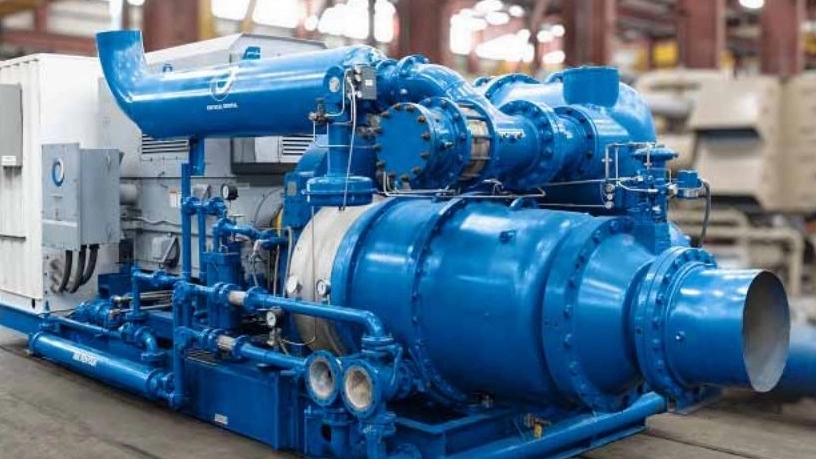
An axial compressor has an axial flow, air or gas passes through rows of fixed and moving vanes along the rotating axis of the compressor, thus the air velocity gradually increases as the fixed vanes convert kinetic energy into pressure. If they do, he will find favor. The lowest volume in such a compressor is about S/15. Usually, a balancing cylinder is installed in the compressor to balance the axial pressure force. Centrifugal compressors are smaller and usually their speed is 25% higher, and these compressors are used for high volume flow rate at relatively moderate pressure.