
Types and Classification of Compressors
Generally, compressors are divided into two types, positive displacement and rotary. Positive displacement compressors compress it by trapping and reducing gas space, but rotary compressors use rotary motion and increase speed and then convert speed into pressure to achieve their goal.
Positive displacement compressors are used in small and medium applications and can produce low flow and high pressure. Screw, blade and piston compressors are the most important positive displacement compressors.
On the other hand, rotary compressors such as axial compressors and centrifugal compressors are usually used for large and medium applications and produce high flow rates.
Compressor components of the screw compressor and its applications
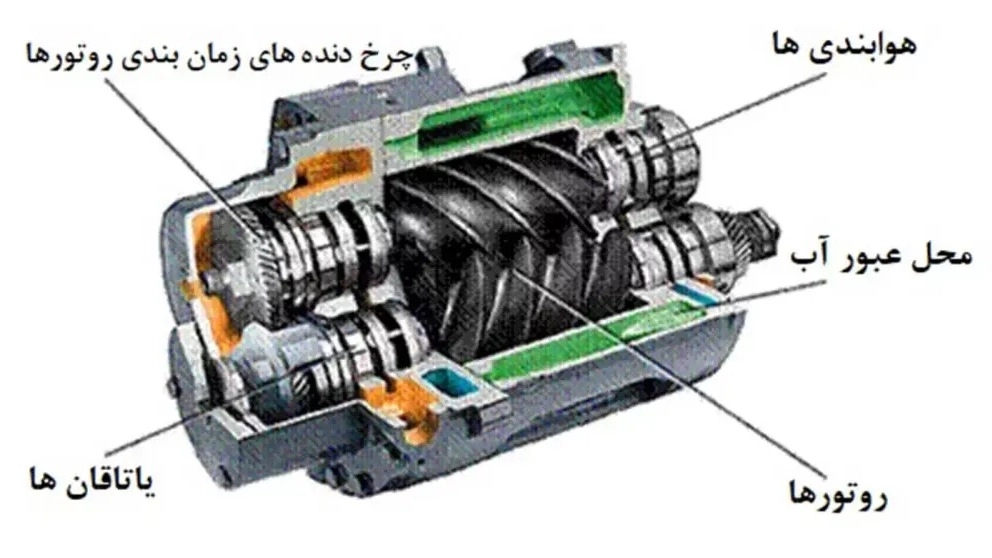
Screw compressors have two locked helical rotors that compress air or any other gas by rotating in opposite directions.
The empty space between the spirals is designed in such a way that it decreases from the inlet to the outlet, and for this reason, as we move towards the outlet, the volume of air decreases and becomes more compressed.
Screw compressors are usually used in applications that require compressed air for industrial devices. These compressors are more suitable for applications that require continuous compressed air.
The most important components of this compressor are:
Rotors
The rotors are two spiral parts that perform the main function of the screw compressor with their rotational movement. When the compressor is turned on, the rotors start to rotate and this movement causes air suction from the inlet side.
The movement of the rotors can be done by the motor and by using parts such as belts, bearings and gears.
Bearings
Bearings help to reduce friction, balance the movement of parts and regulate the temperature of the compressor. Also, axial and radial bearings are used to bear axial and radial loads, respectively.
suction valve
The suction valve opens and closes using a predetermined program, and its use is necessary for the correct operation and higher efficiency of the compressor.
drain valve
The discharge valve is located at the end of the compressor and ensures the safety of the device and the uniform release of compressed air.
Compressor motor
The compressor motor, which is usually in low and medium capacity applications of the type of electric motors, provides the necessary force for gas compression. (Learn more about the wind compressor electric motor and its function.)
Gaskets and air seals
It is necessary to use gaskets and air seals to prevent air leakage. These parts are placed between bearings and compressed air and prevent air leakage.
body
The body of the screw compressor, like the rotors, must have a very low tolerance so that the air can be compressed by being trapped between it and the rotors. Also, all parts are placed in the body. Having a durable and high-quality body is necessary to ensure the health and longevity of the device.
Central compressor components and its applications
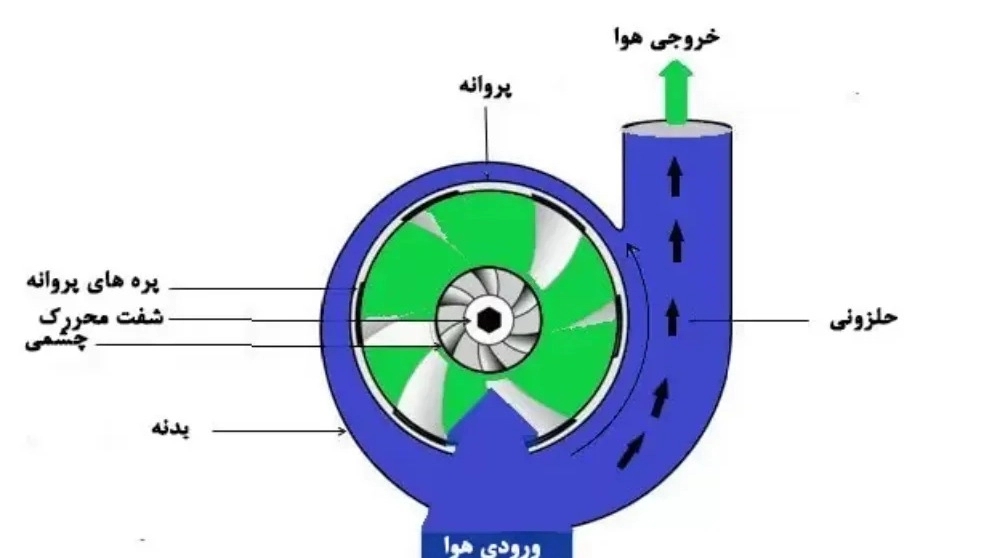
Centrifugal compressors (centrifugal compressors) unlike positive displacement compressors that condense gas by trapping and compressing it, use continuous rotational motion to reach high pressure. In these compressors, after entering, the air moves towards the propeller and in this section, its speed increases. After that, the high-velocity air in the diffuser section is converted into lower-velocity, higher-pressure air. Centrifugal compressors can produce high flow rates but do not have the ability to reach high pressures compared to positive displacement compressors. Turbochargers and industrial compressors are among the most important applications of these compressors. the butterfly Impeller is the main part of the centrifugal compressor, which consists of several blades connected to one part. The speed of the blades increases with the increase of the radius, and the air that is separated from the propeller at the end of the blades has a high speed. Diffuser The diffuser is placed after the propeller and this part of the compressor is a narrow path for air. The task of this section is to convert part of the kinetic energy into static pressure. Snail A snail is placed after the diffuser and its task is to collect and direct the compressed air to the outlet. shaft The shaft connected to the propeller is responsible for transferring power from the engine to the compressor.
Components of blade compressor and its applications
Rotor The blade compressor rotor is a circular piece that rotates inside the casing. The rotor is not located exactly in the center of the compressor and is some distance from its center so that during rotation, it completes the process of air compression together with the blades. The blades The blades are designed so that they are always attached to the body but can move radially. The air is trapped between the blades and they make it possible to compress the trapped air. The rotor and blades are arranged in such a way that the air space at the entrance is large and at the exit is small. Therefore, with the help of blades, the rotor condenses the air in the exit part and directs it out
Return or Piston Compressor Components and its applications
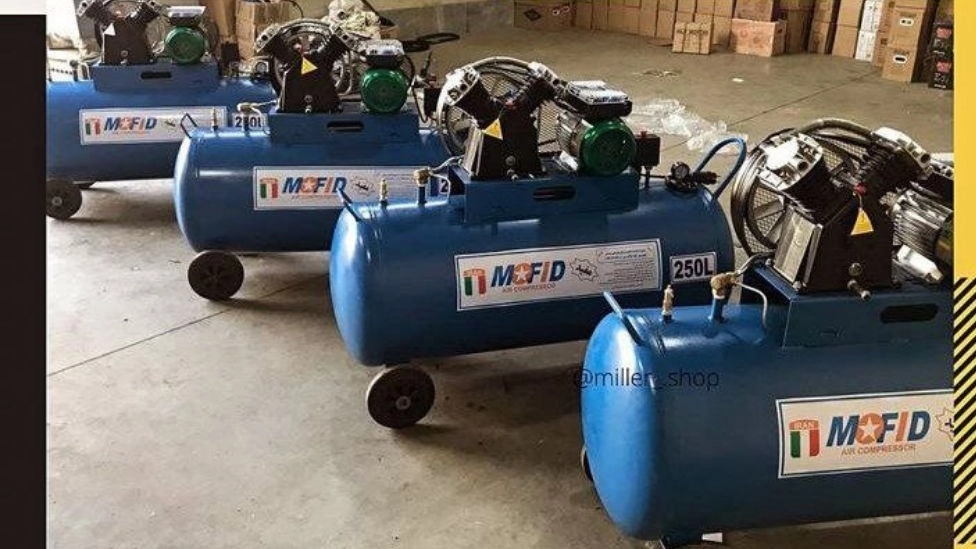
Reciprocating compressor or piston compressor is one of the most popular and common compressors available, which has a long history of use in various industries. This compressor is used in a variety of refrigeration systems, refineries, natural gas processes, and chemical industries.
The components of the piston compressor according to the figure below are:
Crankshaft: This part of the reciprocating compressor is the part that balances the dynamic forces and also transfers the power from the engine to the connecting rod.
Cylinder: It is a container in which the air is trapped. May be available in high capacity piston compressors, up to 6 cylinders.
Connecting rod: This rod, together with the crankshaft, converts the rotational movement of the engine into a reciprocating movement for the piston.
Piston: The piston is a moving part that performs the main function in a reciprocating compressor. This piece compresses the air inside the cylinder and also sucks the air. Around the piston, there are rings that are responsible for air sealing so that high pressure air cannot escape from the chamber.

Mrs. Javadzadeh
Post Author
10184
common:article
SEO-oriented content production specialist with experience in digital marketing and search engine optimization. Focusing on keyword research and content strategy formulation, I produce user-oriented educational and analytical articles to be valuable to the audience and to help grow the site's position in search results.
Similar Posts
Contents of this post
Types and Classification of Compressors
Compressor components of the screw compressor and its applications
The most important components of this compressor are:
Central compressor components and its applications
Components of blade compressor and its applications
Return or Piston Compressor Components and its applications