
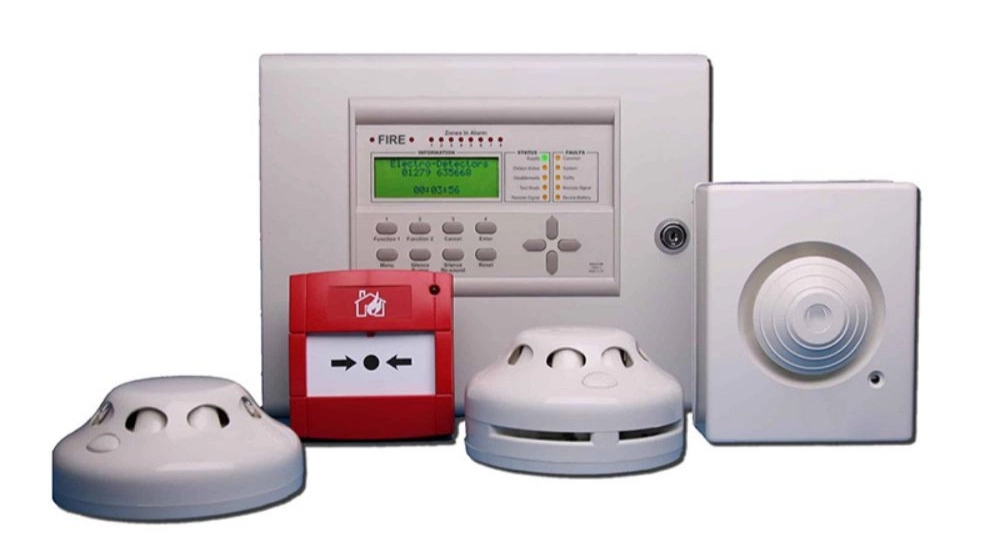


The non-automatic fire alarm system includes a number of buttons, bells and sirens that are connected to the source at different points and by a common or independent zone. Normally, the contacts are open and the current does not pass through the circuit. If one of the switches is closed, the circuit current will be established and the fire alarm system will sound. In the automatic fire alarm system, in addition to this equipment, there are also a number of detectors that are controlled by the central panel. In these systems, there is also the possibility of manual notification. A typical automatic fire alarm system usually consists of these components:
1. Declaration (Call Point):
Fire alarm buttons that are pressed by breaking zinc in case of emergency, and fire alarm system sirens are activated within 2 seconds. Shasti are placed in the way of exits or stairs that generally reach safe places. Shasti are usually installed at a height of 1 meter and 25 cm from the ground. The color and location of the thumbs are in such a way that they can be seen easily.
2. Alert tools:
Warning devices are presented in two ways: audio (sirens and bells) and visual (flashers). The frequency of sirens and bells in the fire alarm system is different and controllable. Electronic sirens have a greater variety in sound level and tone, and the choice of the type of alarm depends on the environment they intend to use. Audible warning devices are also used for places where making noise is uncomfortable or to inform people who are deaf.
1. Discovery or detectors:
At the core of the fire alarm system, there are detectors. Detectors can be divided into different groups including:
• The thermal detector
The thermal detector can work well in environments with constant temperature. If the ambient temperature is higher than the preset value, it sounds the alarm. Or the thermal detector that can work with the rate of temperature change. Usually, heat detection sensors work in a similar way to an electrical fuse. The heat detector has a heat-sensitive alloy that activates the fire alarm system when it gets too hot.
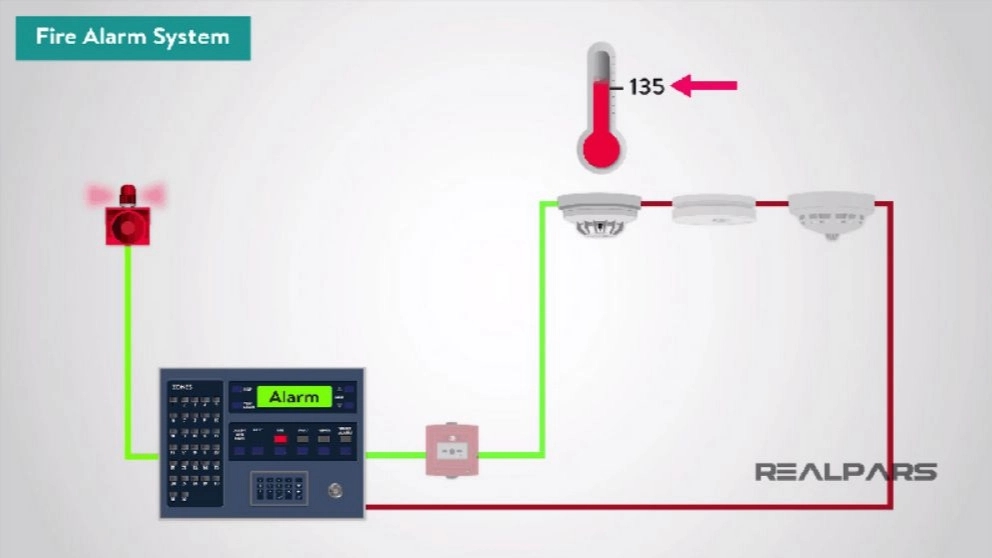
• Smoke detector
Smoke detectors are divided into two general categories: ionization and optical. In ionized smoke detectors, as soon as smoke particles enter, the available electric current decreases and as a result, the system announces the occurrence of fire. The basis of the work of these detectors is sensitivity to small smoke particles. Optical smoke detectors are also activated by the absorption of light by particles in an optical path, and unlike ionized smoke detectors that detect invisible particles, this type of detector is sensitive to larger particles.
• Gas detector
This detector senses the gas leak and informs the fire alarm system. Carbon monoxide detectors, also known as CO detectors, activate the fire alarm system by detecting the level of carbon monoxide in the air. Carbon monoxide is a poisonous gas that causes combustion. Carbon monoxide fire detectors use the same sensors found in the home, but are more sensitive and respond faster. Carbon monoxide detectors have an electrochemical cell that detects carbon monoxide.
• Combined detectors
Detectors that work with multiple sensors are hybrid detectors. The inputs of these detectors are a combination of optical sensors and thermal sensors that are processed using a complex algorithm built into the detector circuit. This model of detectors are designed in such a way that they react against a wide range of fires. Line detectors that detect fire along a line. Examples of these detectors are linear smoke detectors and thermal sensing cables. Point detectors are another type of detectors that work in smoke and heat detectors in such a way that the sensor is placed at a specific point.