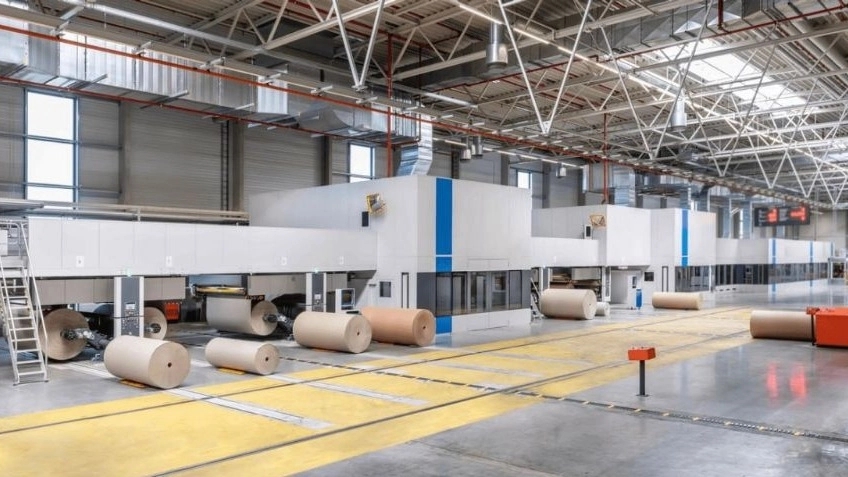
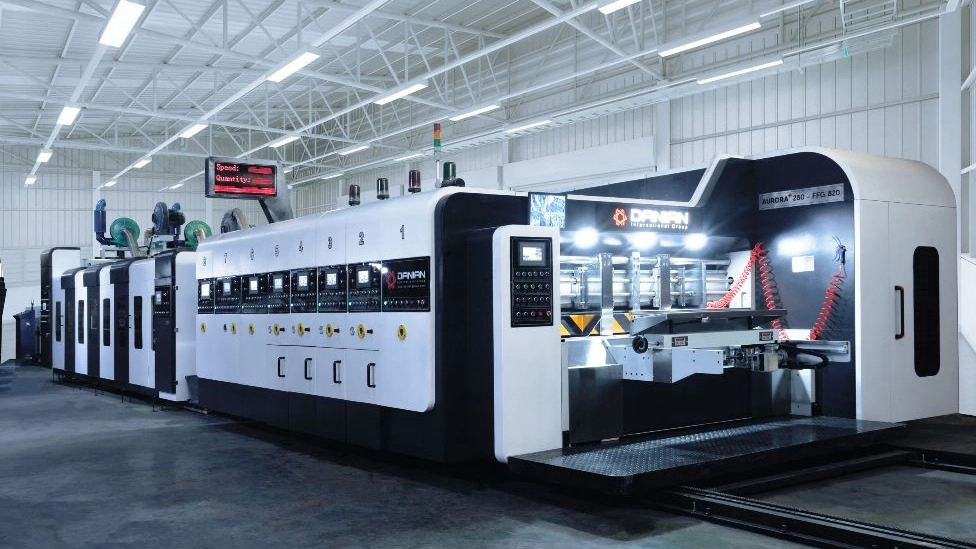
The laminating machine is an engineering masterpiece that efficiently converts paper rolls into strong cardboard sheets. Here, citing details from FEFCO, the Federation of European Cardboard Manufacturers.
We describe the key components and their functions:
Connector & Roll Opener (Splicer & Roll Stand):
Imagine a tireless team feeding the sheeting machine with paper. Connectors and roll openers (splicers and roll stands) play this role and ensure continuous paper flow by connecting paper rolls without interruption and allowing quick replacement without interrupting production.
Single Facer: Single Facer:
This is where the magic begins! The single facer turns the flat paper into a single layer liner with a series of wavy arcs called corrugations. These grooves are created by large cylinders called rolling or carogate rollers and effectively increase the strength of the sheet.
Double Facer: Double Facer:
The single-layer liner is prepared in the glue and double-facer unit for the final connection with the outer liner. This part involves applying the adhesive and preparing the surfaces for a tight bond, similar to Single Facer but with some changes in the preheating and bonding processes.
Bridge (bridge):
Not all components work at the same speed. The bridge allows the double facer to adjust its speed compared to the single facer, especially when changing rolls or changing orders.
Hot Page section (Hot Plate):
This section is the culmination of the process, where the single-layer liner and the outer liner are securely bonded together using heat to form the main structure of the three-layer cardboard sheet.
Female Line / Cutting Woman (Slitter / Scorer):
Imagine a skilled craftsman carefully marking and cutting the sheet to length. The cutting/cutting line does this and converts the monolithic sheet into different lengths based on the desired box style and the customer's order.
Rotary Shear (Rotary Shear):
The newly formed sheet passes under the rotary shears, a clever tool that moves from left to right or vice versa when necessary and cuts the sheet precisely across its entire width.
Cutting blades (cut-off): precision is the first word! The cut-off blades, like a rotating guillotine, ensure that the cardboard sheet is cut to precise widths to make boxes of different sizes.
Picking up (stacker):
The final stop! The stacker takes over and automatically arranges the finished carton sheets into neat stacks ready for further processing or transport to converting plants.
By understanding these components and their function, we gain a deeper appreciation of this valuable sheet metal machine. This machine is a testament to human ingenuity and a vital part of the process that provides the cardboard sheets that are essential to our daily lives.