

What is a ceiling crane?
Often we are familiar with the crane and its efficiency in the construction of buildings. A device that can be seen these days more than ever in the streets and half-built structures and is often used to carry loads and heavy objects. Cranes, like other industrial tools, have different types and depending on their efficiency, they are used in different environments, one of the most important types of which is used in industries and workshops is the overhead crane. In the following, we will talk to you about the overhead crane and its uses, and we will tell you what exactly this device is used for and what is an overhead crane.
Ceiling cranes
Single -bridge crane
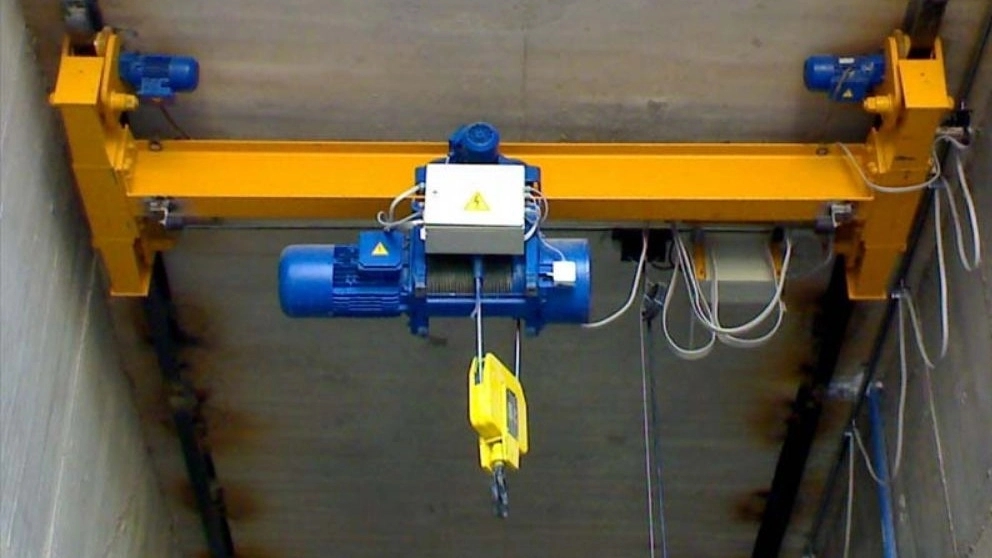
This type of overhead crane consists of only one bridge or a horizontal beam-like structure and can help to carry and move heavy loads in both longitudinal and transverse directions. In this type of overhead cranes, transverse rails are placed on both sides of the bridge and support the carriage track.
These cranes are usually used in halls with a span of less than 25 meters and to move loads with a capacity of less than 20 tons. However, due to the high functionality and standard structure of this device, many people use it to move loads in their sheds.
The single-bridge overhead crane is designed in two modes: overhead and suspended, which is installed on the rail and has the ability to move on the rail. Also, in the hanging type, the crane is placed under the rail in a hanging position and moves.
The benefits of using a single bridge crane
The structure of this model has less weight, puts less pressure on the rails and does not need a column to be installed.
Due to the ability to move at different angles, it has more uses for moving loads.
The cost of maintenance and repairs of this model is lower than the model of a pair of bridges or two bridges.
The single bridge model gives the repairer access to the lifting winch during repairs.
Two -bridge crane
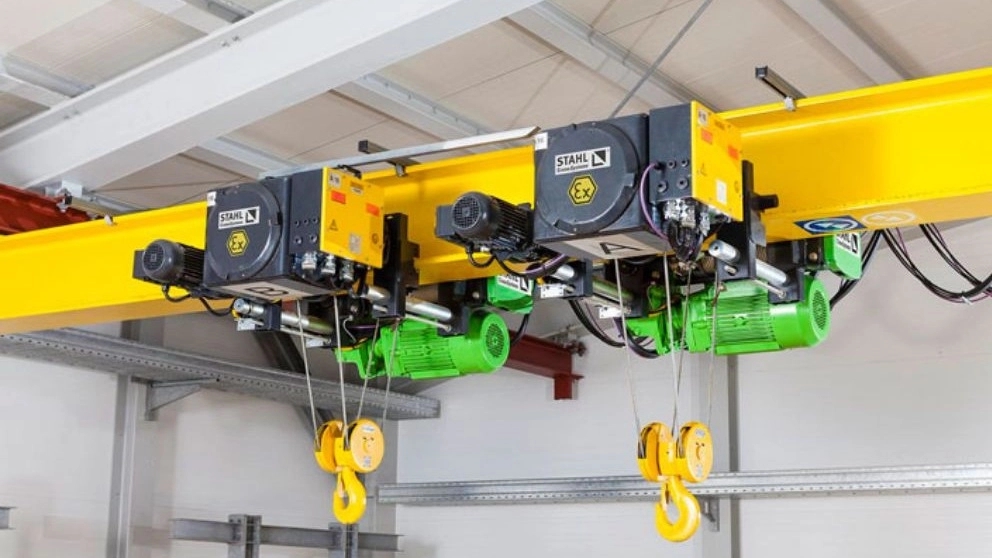
Unlike the single bridge model, this crane is made of two bridges that look like two beams connected together. In the double bridge overhead crane, transverse rails are placed on the bridge and the crane carriage is mounted on them from above and connects the cables to the hook set from the empty space between the two bridges.
Unlike the single-bridge overhead crane, the double-bridge crane is a suitable option for halls and industrial environments that have a capacity and span higher than 25 meters. This crane model has more speed and power than the single bridge model and can be used to move heavy loads that are long and wide and in industrial environments and large facilities.
It is interesting to know that double bridge overhead cranes can lift and move up to 320 tons of weight, which can be increased by combining two or more lifting devices. Another advantage of these cranes is that you can install a maintenance corridor along with a handrail along the bridge of this device. In this way, by installing this corridor, you can easily repair the parts of the crane, or repair and replace the hall lamps, heating facilities and power lines of the industrial environment.
The benefits of using two bridges (bridge pairs)
This model has more safety compared to single bridge overhead crane.
The double bridge overhead crane is compatible with any environment and can be adapted to work needs.
During repairs, it can be moved laterally.
It also has the ability to be installed at a high height.
Gateway crane
Gantry cranes are often installed in open spaces or large industrial environments such as factories without roofs. These cranes consist of a horizontal pole, 2 or 4 legs and other peripheral devices such as pulleys and cables and move in longitudinal, transverse and vertical directions.
Gantry overhead cranes are usually made with spans up to 70 meters long and their capacity is up to 50 tons.
Hemisphere
This crane is similar to the gantry crane in terms of performance, with the difference that this crane has less carrying capacity. However, the rotation angle of the pole of this crane is more flexible and can move 180 degrees and in other examples up to 360 degrees. The reel of this device works both electrically and manually, and the beams are designed up to 10 meters long.
Crane
This type of crane has the capacity to carry up to 5 tons and is mostly used in the environments of halls, warehouses and machinery manufacturing lines. Rotation up to 180 degrees manually and arm length of 6 meters are other advantages of this device.