
Ceiling
Different industries and fields of application require cargo transportation services in the workshop.
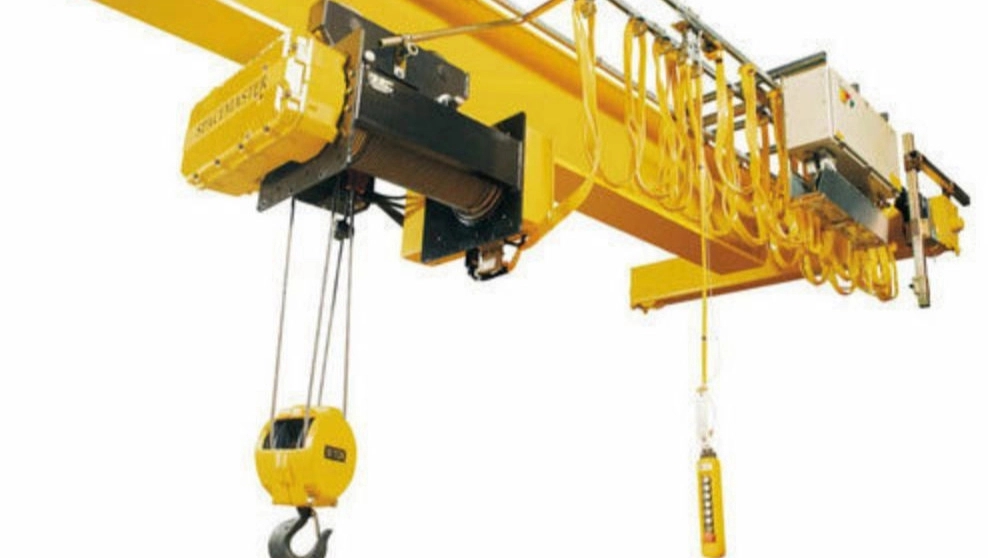
Transfer of materials in the production line and warehouse systems and mooring equipment and handling in ports are among the tasks of overhead and gantry cranes.
Manually operated overhead cranes were in use in the 1880s.
At the same time, more complex designs were introduced by American and British manufacturers for non-manual cranes, which included a drive shaft running the length of the hall. And with the help of multiple clutches, they transferred the power to the hoist, trolley and girder. The first three-motor electric crane was used in 1890. The initial speeds were very low and the lifting weight was also limited to 40 tons.
The design of the crane is evolving every 5 years, as:
1880 was the era of manual cranes.
1900, the era of electric cranes with a separate motor for each movement.
1920, specific standards for cranes were established.
1940 was the period of using gearboxes and roller bearings and designing under the standard. 1960 was the period of making changes in the way of crane control, which caused millimeter movement and higher accuracy in moving. 1970, the Crane Manufacturers Association of America (CMAA) published its "Specification 70", which was the first set of standards for the design of overhead and gantry cranes in general use. Some time later, this association published its "Specifications 74", which included standards in the field of overhead cranes and single bridge cranes.
The current needs regarding the accuracy of carrying objects, especially in connection with the nuclear energy industry, caused the need for a simple and flexible control to increase the accuracy of hook movement in all directions. In recent years, it became possible to use remote control as a substitute for hanging control. The complexity of nuclear power plants caused many changes in crane technology. Paying attention to factors such as earthquake stress, radiation resistance, working underwater, damage tests and product quality control, all increase the complexity of work and production cost. It limits the qualified producers.
Dual ceiling crane
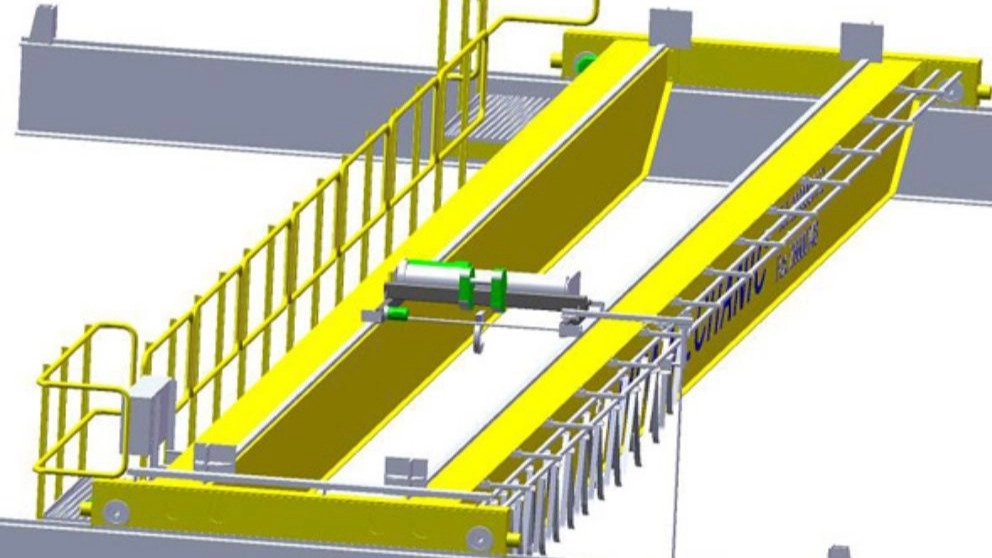
Double Girder Overhead Crane
Using Double Girder E.O.T Crane is the best way to move materials in halls where more opening and capacity are required. It is needed and with this type of cranes you can use a higher height. Usually in halls that have an opening of more than 25 meters and for loads that have a large length and width and during transverse and longitudinal movement by creating a reverse force in the accelerations. And the brakes are problematic, the two-bridge crane structure is used.
A variety of ceiling crane
1- Three movements with one carriage: general use
2- Four movements with one carriage and two hooks: low speed and heavy loads for The main hook and high speed and light loads for the auxiliary hook.
3- Five moves with two carriages: Two identical tops for carrying long objects.
4- Seven movements with two carriages and two hooks: Its use is similar to the use of cases 2 and 3.
5- Five movements with two carriages: one carriage with high capacity and Another one with low capacity, for single heavy loads or long light loads.
6- Bucket Crane: To carry coal and similar materials, and the opening is such that materials such as cement and It passes (does not carry) fertilizers and... (fine-grained materials). Steel and...
8- Mesh bridge: In open places or when the length of the span is more than 49 meters, it is preferable to all the cases mentioned up to here.
9- Carriage with two motors and two hooks: To carry special beams, the hooks can be both inside and outside the bridge.
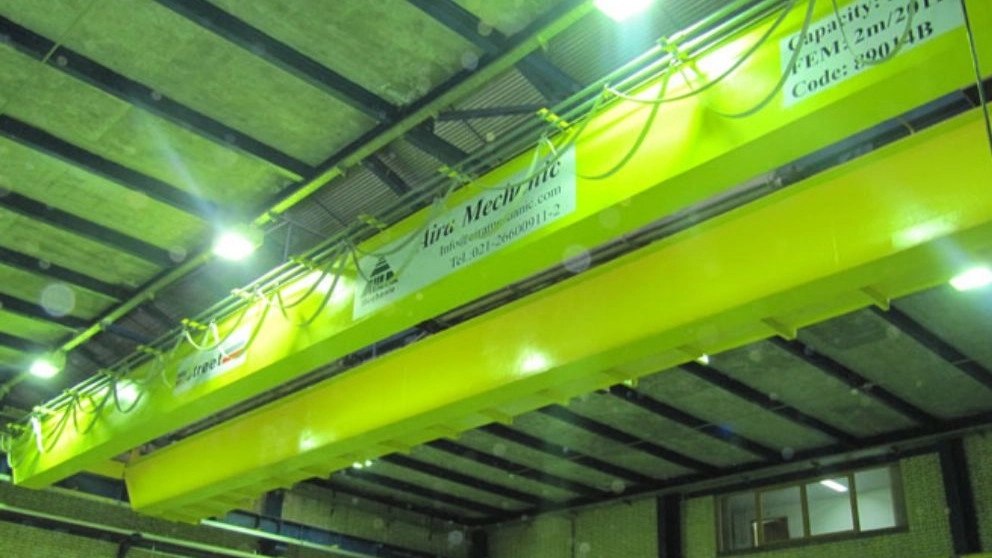
With the engineering design and construction of the structure of this type of crane in accordance with the standards in this field and with low dead weight, the best use can be made economically.
Also, another advantage of this type of overhead crane is It is possible to install a maintenance corridor with a handrail along the crane bridge, which, in addition to the ease of access and the possibility of repairing various components such as lifts, carriages, clutch motors and electrical panels, is a suitable possibility for repairing and replacing hall lamps. It also provides heating facilities for the hall and power lines.
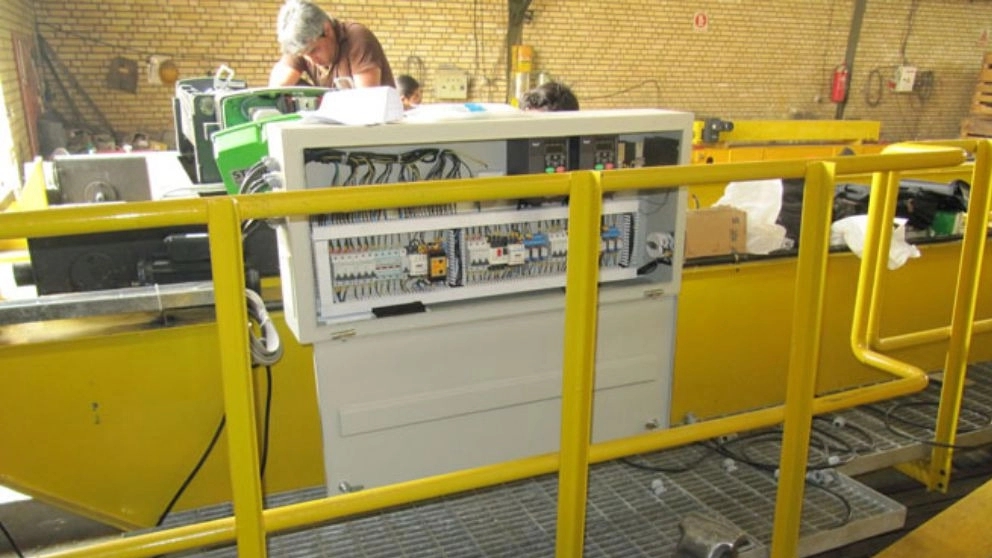
At the same time, with a special design in the way the lifter is placed on the carriage, you can reach the maximum lifting height in the overhead crane.
To cover all the points of the work complex (production hall, shed part of the outer space where the work is done) we need three separate movements in x, y, z directions. For this purpose, a crane must be able to perform at least three movements in a normal state.
In the direction of x (the length of the hall), the movement is done by the bridge. In the direction of y (width of the hall), the movement is done by the carriage, and in the direction of z (height), the movement is done by the elevator