
How is an inverter work?
By receiving electrical energy from a battery pack or DC link capacitors, the inverter converts DC electricity into alternating current with a certain frequency and voltage level. This action is done by continuously turning off and on the power switches. In fact, the primary side of the transformer used in the inverter device is charged by electrical pulses, which are generated by turning on and off MOSFETs or EGBTs or other electronic power switches. These alternating pulses create an alternating sharp junction between the primary and secondary windings of the transformer. It should be noted that if the inverter of the desired motor is intended as a booster, in this part, according to the required voltage, the ratio of the number of turns of the primary and secondary side of the transformer is determined.
Control by PWM method
Actually, we need two control waves for PWM control; One is the control wave that is produced according to the feedback from the output, and the second is the carrier wave. By comparing these two waves, a square wave is produced, which according to the feedback signal, the main harmonic of the generated wave (by switching MOSFETs or IGBTs) is usually sinusoidal.
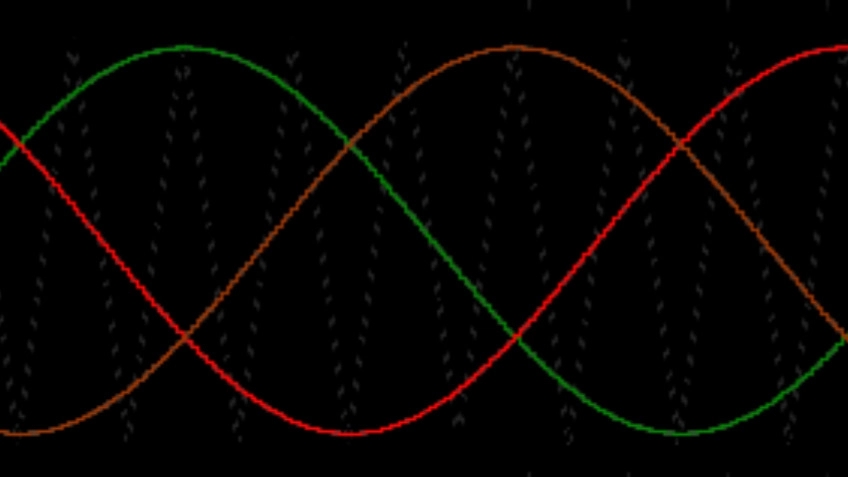
As can be seen from the figure above, the triangular wave is the carrier wave, which shows the frequency of this wave, the frequency of switching on and off of the keys, and the higher it is, the higher the loss of the keys, but on the other hand, the harmonic The output wave becomes less. Also, the three sine waves shown are the control waves that are produced by the control system of the inverter device and their frequency determines the main harmonic frequency of the output wave. If we consider the structure of the inverter as follows, the switching will be in such a way that wherever the control wave corresponding to phase A exceeds the carrier wave, the TA+ switch will turn on and wherever the control wave corresponding to phase B exceeds the wave When the carrier increases, the TB+ switch turns on, and this happens in the same way for the third phase, as a result of which a square wave is produced as follows:
According to the Vdc reference signal that is given to the controller, the inverter tries to stabilize the voltage of its input smoothing capacitor, and on the other hand, with the rotation of the turbine axis, the capacitor C1 is charged, and the inverter tries to keep the voltage constant. Its input transfers the received power to the network; Regarding the frequency of the inverter, explanations have been given above. In fact, with the rotation of the turbine by the wind, mechanical energy is delivered to the generator, which delivers a three-phase sinusoidal voltage to the rectifier. The boost converter that is placed between the inverter and the generator is to follow the maximum power point.
In other words, considering that the wind speed is not constant, the boost converter works according to the reference speed + Ω Following the work point is to get the maximum power. The example mentioned was to explain the role of the inverter in an industrial system, and inverters will have different structures depending on the type of application, and the full bridge inverter operation was explained above, but inverters have different topologies.
For example, inverters are an impedance source of another type of inverters, which using this type of inverters is no longer the boost converter shown in the figure above, and the inverter alone will have the ability to adjust the voltage, but on the other hand, it should be Note that impedance source inverters usually have a frequency limit, which can be considered as a negative feature.