
Introduction to the sealing of concrete tanks
Water tank sealing means managing and controlling the flow and distribution of water in a water tank. Parin Beton Pishgam Company, is a tank sealing executive. and concrete walls in Isfahan, in order to provide and distribute water to different areas, control floods, provide energy through electricity generation, and protect the environment, sealing concrete tanks is an important act. It is in managing water resources and providing various needs of society and industry. This work includes determining the time of water discharge, determining the maximum and minimum amount of water storage, securing the dam and reservoir, and managing water for different uses.
🔰 Steps to sealing the concrete tank
The stages of water tank insulation are very vital, and correct facilities and proper quality of materials used are of particular importance. Also, the sealing of the tank should be done in accordance with the relevant standards. The sealing of the water tank is very important to prevent heat loss and energy loss so that the water in the tank is kept in optimal conditions. Following are the general steps for sealing the tank:
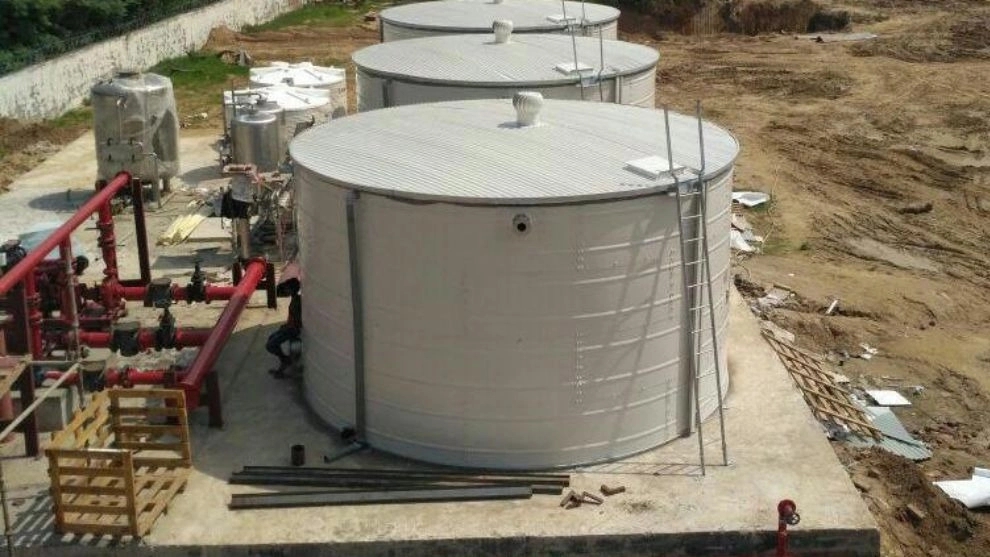
✅ Preparation of the tank: The first step includes cleaning the tank and making sure it is completely clean. Any type of dirt, adhesion, or sediment on the walls of the tank must be removed. Insulation is usually made of materials such as cotton wool, rock wool, cottonwood, or cellular thermal insulation. Also, a protective layer is usually placed on the insulation.
✅ Installation of insulation: Insulation materials are installed on the walls of the tank and pipes. Insulation must be done carefully so that no point of insulation is incomplete.
✅ Installing the protective layer: After installing the main insulation, a protective layer is placed on the insulation. This layer may be made of aluminum foil or moisture resistant sheets. This protective layer helps prevent the new insulation from disintegrating.
✅ Coating and installation of additional items: Finally, insulation must be completed by applying external coatings and installing additional components (such as sheet metal, pipes, and piping).
< Installing a control system: Some tanks have control systems to monitor the temperature and internal conditions. These systems must be installed correctly and have proper settings. Test and evaluation: After installing the insulation and related systems, the water tank sealing must be tested and evaluated to Ensure the quality and efficiency of insulation.
Water reservoirs are used to store water for various purposes, drinking water, agricultural water for irrigation, fire suppression, water for animal husbandry, chemical production, food preparation and many more. The parameters of the water tank include the overall design of the tank and the selection of construction materials and coatings. Various materials are used to make the water tank: plastic (polyethylene, polypropylene), fiberglass, concrete, stone and steel. Water tanks are an efficient way to help developing countries to save water.
Sometimes concrete tanks have water leaks that should be stopped as soon as possible. Sealing the tank is usually done to prevent water leakage. Concrete tanks are not naturally waterproof. If the concrete surface of the tank is not properly prepared before use, the premature failure of the concrete and the deterioration of its substrate is inevitable.