

One of the most important and expensive processing steps is stone crushing. The first stage of cutting is firework; Crushing is done during two main stages of crushing and softening or grinding. The most energy consumption in processing units is related to the grinding operation; Therefore, many studies have been carried out by renowned technology companies in order to reduce the energy consumption of the mentioned process. In order to optimize, these companies have proposed the additional step of stone crushing (Fine Crushing) as one of the implementation solutions.
Traditional Steps of Wisdom
- Primary Crushing - Secondary Crushing Tertiary or Fine Crushing Course Grinding Second stage grinding (Fine Grinding) Third stage grinding (Ultra Fine Grinding)
The benefits of rock breakdown third
(if pre-processing is performed) Reducing Asia's energy consumption per ton of input feed Relatively effective crushing of the interface of minerals and then reducing the grade of pre-processing tailings An increase of more than 20% in the life of the Asia liner A decrease of about 20% in the consumption of Asian bullets Reducing the wear of parts of the slurry pump and piping after the first Asia that are subject to wear (reducing pump maintenance costs) In general, reducing energy consumption and reducing costs in circuits that use Asia in their downstream.
Types of Roll Crashine
Applications
Re-shredding and processing of the intermediate product of the shredding and waste unit Crushing of materials before entering Asia in order to increase their capacity and reduce their operating costs, such as reducing the amount of bullets and increasing the life of liners. Increasing the capacity of cone crushers by removing its circulating load for critical sizes Shrinking loads with relatively high humidity and...
The Benefits of Roller Roller
Increasing the reduction ratio and achieving a higher degree of freedom Shredding of materials with minimum soft production Increasing the input feed capacity and consequently reducing energy consumption Increase the access factor Ease of throttle adjustment Reducing the consumption of pellets and first Asia liner in the downstream process Crushing wet and sticky materials In some ores, crushing is done by creating cracks at the junction of ore and ore, and this has good metallurgical advantages. Reducing the wear of slurry pumps and...
Roll Roll Deviation (Hydraulic System)
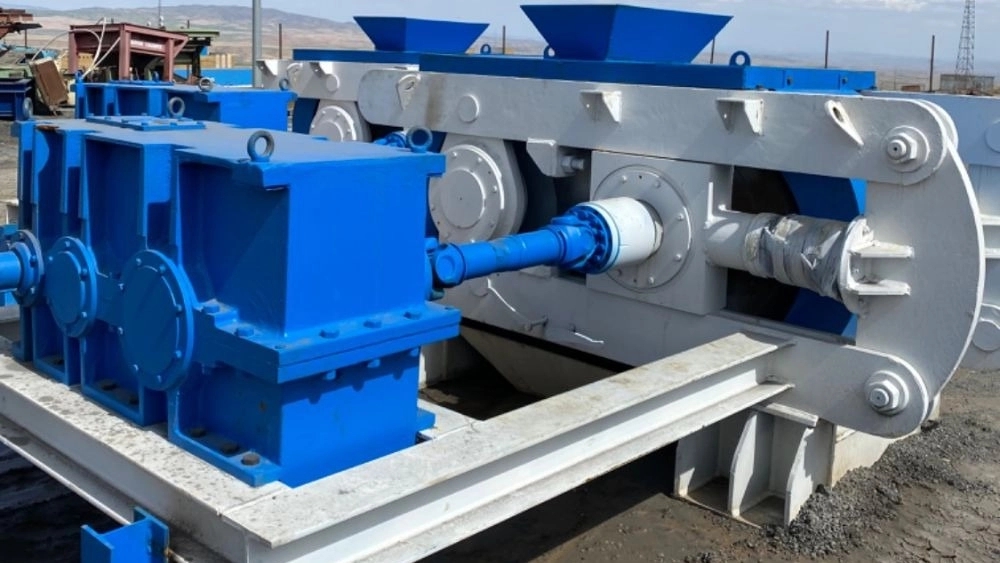
The ability of the roll crusher to react to the change of feeding conditions to the device (different particle size and hardness) occurs through the deflection of the floating roller. Thus, when the floating roller starts to deviate, the device control system adjusts the hydraulic pressure applied to each side so that the roller surfaces are as parallel as possible. This optimizes the stone crushing efficiency and maximizes the wear life of the rollers.
Product Figure
It is possible to produce a higher percentage of the product in the form of a cake (similar to HPGR) and compared to the product of other micro crushers, it produces a larger fraction of fine grains.
The purpose of optimizing roller rocks
All optimizations were done in order to achieve the following goals: Increasing the life of the surface of the rollers Increasing the production capacity compared to old machines like Waltz The working pressure is 10 times that of the waltz Reducing energy consumption Reduce operating costs Ease of throttle adjustment Providing the possibility of crushing hard minerals Increase the access factor Increasing the reduction ratio and achieving a higher degree of freedom (in some cases to less than 2 mm) Simple maintenance and reducing the number of opening and closing of rollers
Roll Krashir Profile
The diameter and width of the roller is 90 to 110 and 80 to 100 cm. The capacity of the machine is up to 60 tons per hour Feed granulation: 0-20 mm The gap between the rollers can be adjusted up to 20 mm. Product granularity: 0-5 mm Working speed: 40 rpm Electric motor power: from 55 to 110 kW Number of electric motor and gearbox: 2 sets (for both rollers) Equipped with accumulator and hydraulic system connected to PLC system Material and thickness of rollers: Hadfield manganese molybdenum chromium steel with a thickness of about 15 cm and a completely solid central core made of anti-vibration cast iron. The possibility of scraping and peeling the surface of the roller shell on site Long life of rollers (optimized for hard stones) Very low cost of maintenance