



Many people think that the benefits of learning music for children are only because it engages different parts of their brain, but music is related to human nature, and perhaps it is the common mother tongue of all people in the world.
Neuroscience researchers have concluded that our brain processes speech like musical notes, and that music may be rooted in human nature. It is interesting that even prehistoric people played music before discovering or inventing the basic facilities of life.
Archaeologists have discovered the remains of an early flute and estimate that it dates back to the Neanderthals; Neanderthals lived before intelligent humans and had not yet evolved. Psychologists also believe that music is related to the process of human evolution. In short, according to the reactions of the human mind and body to music, there is a high possibility that we are connected to this unique art.
What is the effect of music on infants and young children?
Music also affects babies. Even old mothers who did not know anything about the benefits of learning music for children raised their children with songs and lit the first sparks of music in their children's minds by singing lullabies.
Research shows that babies are also familiar with rhythm; A lullaby regulates their heart rate and puts them to a deeper sleep. Also, brain scans show that three-day-old babies recognize drum patterns and their brains react when the melodious sound of the drum stops.
Nicola Benedetti, the famous violinist, is another example in this field. He organizes music education campaigns in underprivileged areas and says that after a few years his students find smarter perspectives in different aspects of life. He says: "When I play a piece of music and the children listen to it, I learn things from the criticism of a four-year-old child that I didn't learn in years of professional training!"
۲۰ of the benefits of music learning for children
Brain development and improvement of learning level
One of the most important benefits of learning music for children is its effect on their brain health and development. Research shows that students who understand music and are trained in this field often score better on standardized tests and even score higher in later years such as middle and high school.
Music activates the left hemisphere of the brain. which is responsible for processing language and reasoning and causes it to grow. This effect has been seen more in children, because they are still in the development stage and mental exercises have many benefits for them.
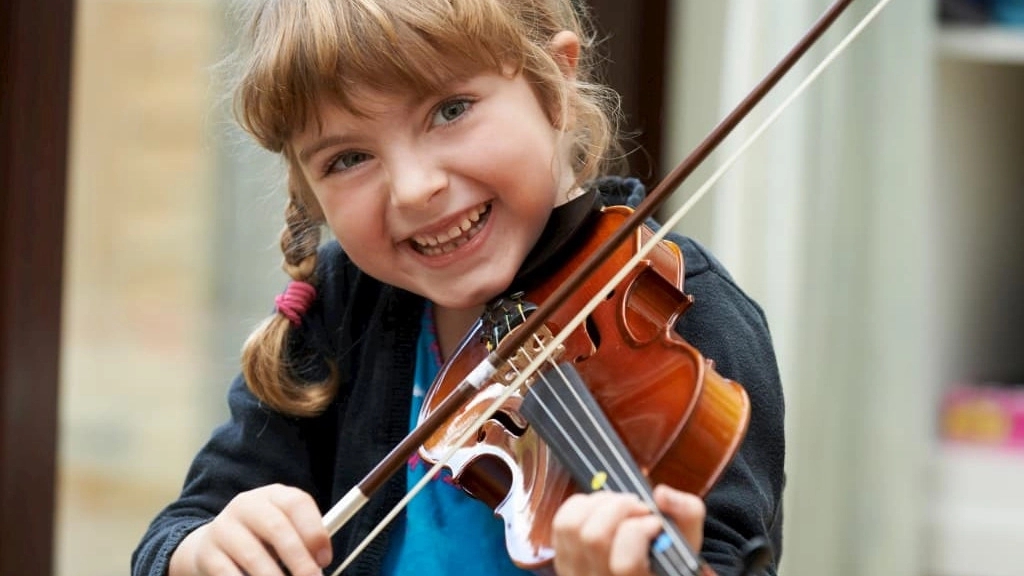
Teaching discipline and hard work
In order to be able to play the instrument professionally, you have to practice continuously and there are no shortcuts to reach this goal; It can only be achieved by spending time and hard work. Daily music practice teaches kids discipline. Parents and teachers should teach them that even when their lessons are difficult, they should continue to practice in order to finally achieve results.
Increasing the ability to learn math
Music and math seem different at first glance, but the two sciences are completely similar! The same proportion and proportions and operations that we do in mathematics are also there in the rhythm of music. Therefore, strengthening math can be one of the benefits of learning music for children. Professor Gordon Shaw at the University of California conducted a study on seven-year-old children in Los Angeles. The results of the research showed that children who learn the rhythm of music understand proportion and proportion and fractions much more easily.
Strengthening social and cognitive skills
Music helps children learn to express and control their emotions. In this way, children show their feelings in the language of music and learn the skill of self-expression.
Strengthening social skills is another benefit of learning music for children. They learn to perform in a professional group, they must be in harmony with their peers and work as a member of the group for a common goal, thus achieving social cohesion and gaining the ability to understand others.
Enhance concentration
Playing an instrument or singing requires full concentration and this is one of the benefits of learning music for children. Concentration is also needed in other educational classes, but it is possible that the child will think about other subjects during the class. This does not happen in music classes, because to play an instrument, the body parts must be coordinated and the mind is only busy managing them, so they don't have extra time to be distracted.
Concentration in music class reduces stress and makes the child's mind It calms down.
The benefits of learning music for children have encouraged parents to send their children to kindergartens, schools and schools that offer music education programs. Today's children are incredibly smart and talented, and parents should invest in their talent. Parents' attention to children's education has a significant impact on their present and future, and establishing a connection between children's minds and music will create future creative adults.