Difference of ordinary polymer and mosaic mosaic
There are various types of floor coverings, among which the most common and widely used ones include polymer mosaic and pressed mosaic. Each of these cases has its own advantages and disadvantages, and this factor has caused the choice of a better and more suitable option to depend on the conditions and type of project. In other words, the difference between ordinary and polymer mosaic includes various things. Percy mosaic is older than polymer mosaic. Until the last few years, concrete was considered the most important material for the production of various types of flooring such as mosaic. But now, in addition to cement and sand, chemical and polymer materials such as resins and lubricants are also used in this industry, and this factor has caused the quality and variety of construction materials, especially precast concrete, to be much higher compared to the past. In fact, the most important difference between ordinary and polymer mosaic is the presence or absence of polymer. With the introduction of polymer into the precast concrete production industry, favorable conditions were provided for the supply of better quality flooring. Because the materials produced using concrete and cement have many disadvantages. For example, they have low resistance against moisture penetration and stain absorption, and this factor has caused their use to be associated with various limitations. The floors are made based on polymer materials, they are superior to the old and normal floors in many aspects and are mostly approved by the contractors. According to the explanations provided, we can conclude that the most important difference between ordinary and polymer mosaics is the type of material used for their production. Of course, the difference between polymer and ordinary mosaics is not only limited here, and these two types of flooring have other differences, the most important of which include the following.
Moisture absorption
The percentage of moisture absorption by each of these two floors. As mentioned, ordinary mosaic has a very low resistance to the penetration of moisture, and this factor has caused it to have low durability and longevity in humid environments. But the amount of moisture absorption by polymer mosaics reaches less than 0.03. Therefore, it can and is much more resistant to moisture compared to Persian mosaic. In such a way that this type of mosaic can even be referred to as a type of waterproof flooring.
Structure
The other difference between polymer and normal mosaic is in their structure. In general, the courtyard mosaic consists of two categories, single-layer and double-layer, where two-layer mosaics consist of a top surface layer and a bottom layer. The top layer is made of a combination of stone powder, mineral pigments and colored aggregates in equal proportions. But the bottom layer consists of cement, water and sand, which is thicker than the top layer and can withstand a lot of weight and pressure. The terminal is not very strong against moisture. Polymer mosaic has a one-handed structure and its main ingredients include pigment, cement, sand and resin or super-lubricating materials. The presence of resin in the polymer mosaic structure creates a very strong molecular bond between the particles. As a result, it should be said that this type of flooring has a completely uniform and dense structure. In this way, polymer mosaic has a very good performance in addition to high resistance against water and moisture penetration, as well as the harmful rays of the sun.
Color diversity
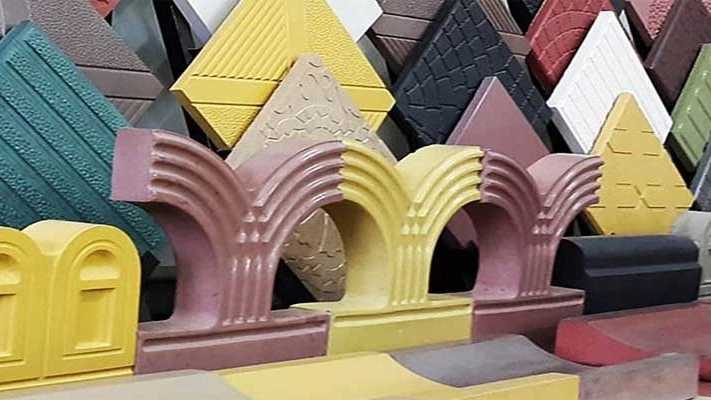
Resin or super-lubricating materials are available in different colors such as white, red, brown, black, green, yellow, etc., which has caused the variety of design and color of polymer mosaic to be much higher compared to Percy. Also, unlike Persian mosaics, the possibility of using chemical pigments in polymer mosaics is not accompanied by any restrictions, and this factor has made the conditions for producing products with a high variety of designs and colors very favorable.
Abrasive resistance
The amount of abrasion resistance is another difference between polymer and ordinary mosaic. Mineral pigments are used in the top layer of Persian mosaics, and the top layer must be sanded after production. The above factors have caused its wear resistance to decrease to a great extent. But polymer mosaics have very high abrasion resistance and can even be considered as a type of anti-wear flooring.
Density
Another difference between ordinary and polymer mosaics is their density. In general, polymer mosaics have a very high density compared to other flooring. Therefore, they are considered a very good and suitable option for use in cold regions and are always protected from freezing. But the density of Persian mosaics is much lower compared to polymer. Of course, it goes without saying that the density of courtyard mosaics depends on the production quality, and the more pressure they are subjected to in the production process, the higher their density will be.
The benefits of polymer mosaic over permeat
The most important advantages of polymer floor coverings compared to Persi were mentioned, in this way, it can be concluded that the advantages of polymer mosaic are more than Persi mosaic and this type of flooring is considered a better option for use in difficult conditions. Of course, in addition to the mentioned cases, polymer mosaic has other advantages over Percy.
Useful in different environments and conditions
Polymer floors are not associated with such a limitation. Because the high density of this category of products has made them last even in the harshest weather conditions.
Less thickness
In general, the higher the percentage of lubricants in the mosaic structure, the higher its density and resistance. This factor has provided the conditions for manufacturers to produce and market all types of polymer flooring with low thickness but high resistance. But it is not possible to produce Persian flooring with low thickness. Because reducing the thickness of the face directly affects their resistance.
Diversity of the design
Another notable advantage for polymer mosaics is the variety of design. Production conditions in press flooring are such that it is not possible to make various products. But polymer floors are not associated with such a limitation and are produced with a variety of designs, the most popular of which are stone design polymer mosaic and wood design polymer mosaic.