Introduction
What is line and network fittings and why is it important?
Parah Bray, which is liked to be a line of line and his network with a group of Zandakhani adopting as a deam?
Selection of a valid supplier for line and network fittings is as important as the quality of the products itself. Line and Network Networks with a specialized focus on this area offers unique benefits to its customers, from large contractors to local electricians:
Danish art and consultations
We're not just the seller; We are your consultant. Our team will help you choose exactly the appropriate piece for low, medium or strong lines according to your project conditions, with full mastery of the types of line and network standards and standards of the Ministry of Energy (Tavanir).
include Kvitt and Standard:
All products offered in the line and biographical network fittings are made from reputable manufacturers in accordance with the latest industrial standards. Corrosion resistance (hot galvanized), tensile strength and precise dimensions are the main features of our products.
Comprehensiveness and variety of products:
We have compiled a complete basket of line and network fittings. From a simple bolt to the most sophisticated clamps and fittings, you can get everything you need to run a line project and save time and money.
Competitive Price:
Due to the high volume purchase and direct contact with manufacturers, linear and biographical networks are able to deliver the best prices to your customers and help you manage your project's budget.
Introduction to the types of line and network fittings and their applications
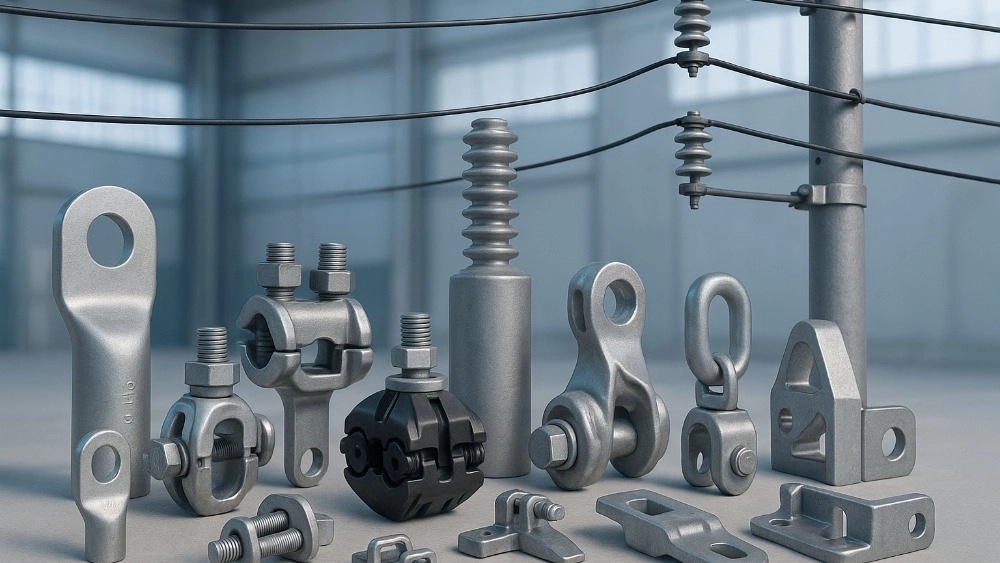
The set of line and network fittings is very broad. The following is an introduction to the main and most widely used categories in the line and the life network.
1. یراق آلات اتصال هادی به مقره (یراق آلات آویزی و کششی)
These types of fittings are used to connect the power cords to the insulators in the tension and tension rigs. U-Bolt & Clevis: U-shaped or horseshoe parts to create a detailed connection between the insulator and other fittings. Eye Nut: to connect to the end of the insulator and create a loop to connect the next fittings. Ball & Socket: A standard articular connection system that allows the insulator to move and flexibility. Dead-end clamp: is used to inhibit the ends of the lines and tolerate all wire tensile force in tensile towers. These clamps are available in a variety of types such as screws, percussions and wedge. Suspension Clamp: is used for conductor maintenance in the middle rigs (pendant) and allows the wire to have longitudinal movement.
2. یراق آلات مربوط به پایههای توزیع (تیرهای برق)
This group contains components used to install equipment on concrete or wooden stands on low and medium -sized networks. Cross ARM: Horizontal metal arm mounted at the top of the beam and the insulators and conductors are mounted on it. Line and Network Framework offers a variety of light and heavy logos. Bolt and Washer: Includes a variety of hexagonal head screws (machine), Master Bolt (twin thread screws) and flat and spring gaskets with hot galvanized coatings for rust resistance. ARM Brace: is used to reinforce and inhibit the cross logo. Rack: A multi -storey base for installing stall (pulley) insulators in low -pressure service lines. Pigtail bolt: for direct installation of needle insulators or pendants on wooden stands. clamps: Includes branch clamp (to branch out of the main line), low -pressure end clamp and hot line clamp (to work with warm line).
1. یراق آلات اتصالی و حفاظتی
These components are responsible for connecting the conductors to each other or protecting the lines. Pression Splice: for permanent and secure connectivity two conductors using the press. Connectors: contains a variety of split-bolt connectors and a wedge for connecting two wires. Vibration Damper: Weights mounted on the conductors to prevent wind -induced vibrations and prevent wire fatigue and fracture at the clamp connection. Introduction to the types of line and network fittings is not complete without knowing this piece of protection. Armor ROD: The strands of spiral wires that are wrapped around the conductor at the junction of the hanging clamp to prevent wear and focus on the main wire. Ground Rod & Clamps: is used to create a connection to the ground and drain the error and lightning currents.
1. یراق آلات کابل خودنگهدار
Belightful cables are widely used in urban distribution networks because of their higher safety and require their own line and network fittings. Tension clamp (end): is used to inhibit the self -absorbing cable at the beginning and end of the line and in the screws. Hanging clamp: to hold the cable at the middle base of the route. Brackets (Brackets): Parts mounted on the wall or beam and clamps attached to them. Clamps of the Subscriber Division (IPC): To get branching from the main self -esteem cable for subscribers, without the need for cable bare.
Important points in selecting and buying lines of line and network
We are heading: the election of Hashmannana Bray, Kaydar,
As you can see in this comprehensive guide, familiarity with the types of line and network fittings and understanding the performance of each piece is essential for proper, safe and durable implementation of electrical projects. These small pieces play a major role in the stability of the country's energy infrastructure, and any shortage in their quality puts the entire network at risk.
Line and Line Networks, with a deep understanding of this responsibility, nominates itself as a reliable partner for contractors, engineers and electrical industry experts. By providing a complete basket of standard products, accurate technical advice and fair prices, we help you bring your projects to the highest level of quality and safety. For more information, pricing inquiries and benefiting from our experts' free consultation, contact the Line and Line Networks today. We are next to you to build a brighter Iranian.